

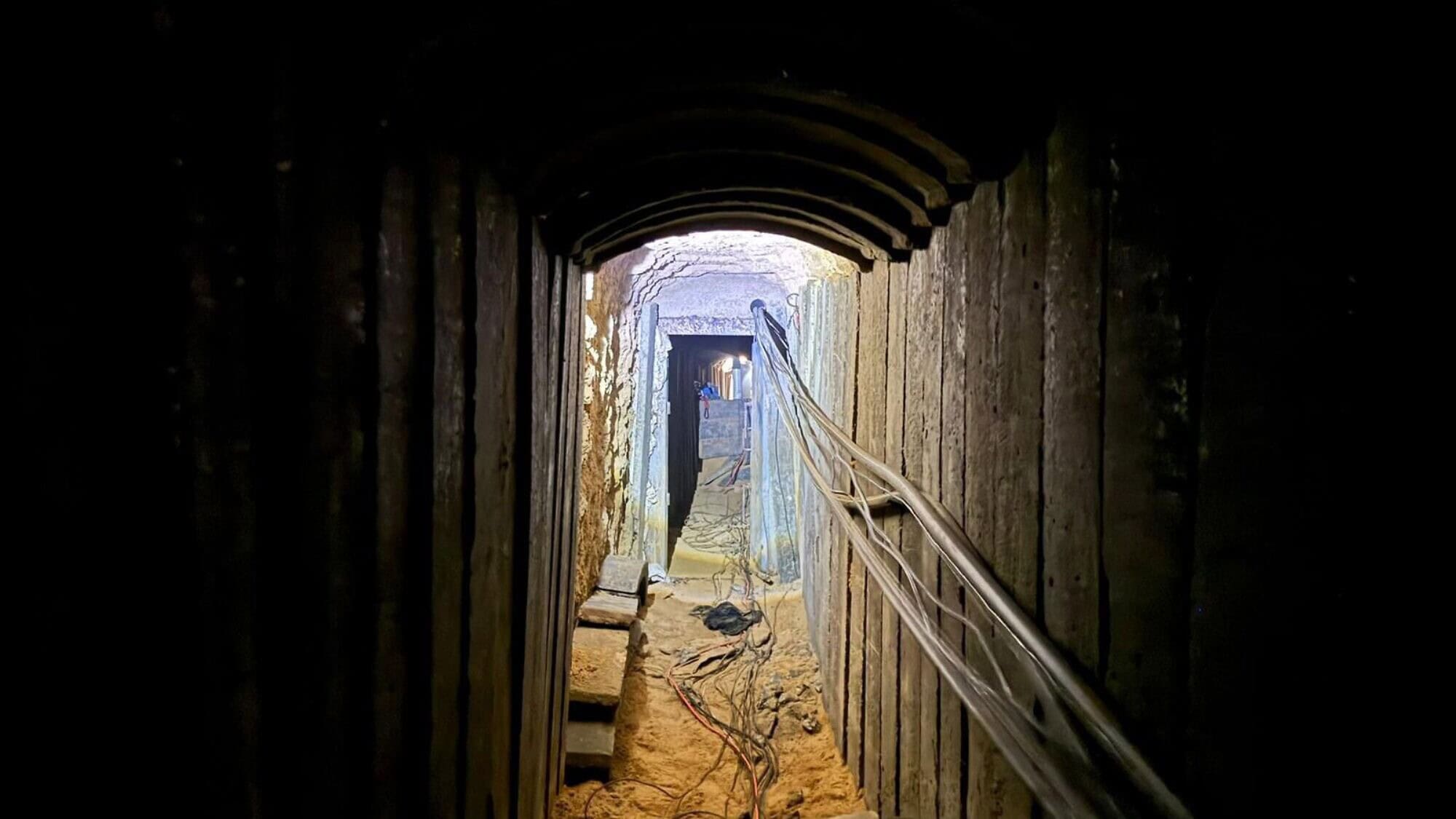

(Israel Hayom) Before Oct. 7, 2023, Israel knew that digging was taking place in Gaza, and on a massive scale. But for a long time, warning signs were ignored, and there was a refusal to believe that one day we would discover a dark, brutal world beneath the ground.
Today, after more than two years of fighting, tunnel experts are warning against falling asleep on watch again.
“Before the war, we said, ‘It’s there, we’re here, we’ll make sure no tunnels are crossing the fence,’” says Lt. Col. R., 37, commander of the IDF’s 603rd Combat Engineering Battalion, who knows Gaza’s shafts and passageways intimately.
“At the end of the day, if they are digging, it’s not to get home faster. It’s to get here and slaughter Jews. We understand their learning curve is constantly improving, and we are doing the same. I am a million percent certain that at this very moment they are digging.”
Before the war, locating a subterranean site was considered an achievement. We’d say, ‘Wow.’ But last Saturday alone, just in my sector, a company commander destroyed a kilometer and a half of tunnel. It’s no longer exciting. We’re in a different place in understanding the enemy.”
In 2024, The New York Timesestimated that Gaza’s underground network was between 560 and 720 kilometers (348 and 447 miles) long. When I try to ascertain how many tunnels have been found in recent years, Lt. Col. Y., 36, head of the Subterranean Branch in the IDF Southern Command, is careful not to cite a number.
“Today, the shaft system is at the level of thousands. I won’t say how many, but it’s closer to tens of thousands than to a few thousand shafts that were probed and marked by the forces.”
The two officers, who have spent years studying hundreds of tunnels, never imagined that when they enlisted, a significant portion of their service would take place underground. Today, it is part of their daily routine.
Lt. Col. Y., who has become an expert on all things subterranean, notes. “There wasn’t a single time I exited a tunnel and wasn’t happy,” he admits.
To this day, it sounds like a cat-and-mouse chase beneath the surface. Both sides are in an arms race, one refining digging methods, the other improving detection and destruction.
“The most challenging thing is the endless learning competition, even during the war,” says Lt. Col. R. “Over these two years, we’ve seen monthly changes in their infrastructure, thinking and operational methods. Hamas understands how we work and adapts defensively, and we must reinvent ourselves.”
Lt. Col. Y. jumps in. “Unlike the IDF, Hamas can change much faster. It places no real value on human life.”
A bottomless pit
The Gaza Strip is in ruins, and in the IDF, there is an assessment that even now, Hamas operatives are using remaining tunnels to hide, especially as targeted killings continue. There, underground, the enemy is preparing for the day after.
Lt. Col. Y relates, “The destruction caused by the fighting is now fertile ground for digging. How do you distinguish, amid entire neighborhoods lying in rubble, between someone clearing sand to salvage belongings from a destroyed home and someone digging a tunnel?
“At this stage, Hamas isn’t fantasizing about strategic tunnels. It’s planning moves that can yield a tactical advantage in the next round of fighting. And that’s something it knows how to do.”
Lt. Col. R. knows where the challenges will arise soon. “The tunnel in Gaza City that housed Hamas’s intelligence data was 13 meters [43 feet] deep, in a UNRWA compound,” he says. “It took time to find it, and while we were searching for the shaft, a deputy battalion commander and a company commander from the IDF’s Shaldag unit were killed by a sniper ambush.
“Identifying a terrorist tunnel within what appears to be a regular structure in a UNRWA compound is difficult. No one notices if, instead of 10 trucks, 200 trucks of sand leave the site. They build a tunnel in a place that is hard to strike because of legitimacy and international law.”
As we spoke, gunfire could occasionally be heard across the border. With it came the understanding that despite the return of the body of Ran Gvili, the final hostage, and talk of the next phase in Gaza, it will take a long time before the threat to the south of Israel is removed.
“The underground threat we will face in the future won’t resemble what we’re dealing with today, so we’ll have to improve,” Lt. Col. Y. is convinced.
“Factually, Hamas is deterred. But the question is whether it has a choice. From its perspective, what it went through was successful. To sustain two-and-a-half years of fighting against the strongest army in the Middle East, regardless of how, all within a relatively small territory, that’s a significant achievement in its eyes.”
When senior officers talk about the tunnel industry, they point to the areas around Rafah in southern Gaza as the capital of digging.
“There’s a joke that wherever you drill there, you’ll hit a tunnel,” says Lt. Col. Y. “At first, we laughed, and in the end, we discovered it was true. Historically, Rafah is the mother of tunnels. It started with a unit that led smuggling between Gazan Rafah and Egyptian Rafah, but I have a subterranean archive with testimonies from 1967 of tunnels that were basically underground pantries. From the 2000s, it became an empire. Every crime family that wanted to set up a business without a headache dug a tunnel.”
Lt. Col. R. explains, “Just along the Philadelphi Corridor on the Egyptian border, over nine kilometers [5.6 miles], we found about 200 tunnels, and I’ve been in all of them. Sometimes you find one tunnel beneath another. That’s what happens when you don’t need city permits.
“In my view, the future hinges on the question of our presence. If there’s a presence, we’ll have the ability to sample and inspect digging daily. The moment we leave, their ability to dig freely becomes much easier. We saw digging in Philadelphi just 30 meters [33 yards] from an Egyptian position. The Egyptian saw them digging.”
Today, extensive work is underway to destroy a large portion of the tunnels, whether through controlled explosions, sealing with concrete, and other projects requiring massive effort.
“These are major engineering operations,” explains Lt. Col. Y. “The largest concrete pour ever done in Israel was around 20,000 cubic meters [roughly 26,000 cubic yards]. We have a tunnel into which 12,000 cubic meters [almost 16,000 cubic yards] were poured over three days. That’s about 1,000 truckloads and shutting down concrete plants across the southern region.
“But this was a tunnel that demanded treatment because it threatened Israeli communities. We are focused on destroying subterranean infrastructure in the Green Area, territory under Israeli control. That’s the mission given to us by the political leadership and the IDF chief of staff. There is no hermetic seal underground, but we want to get as close as possible to locate tunnels reaching the area and destroy them.”
Just last month, in an area of Rafah under IDF control, six terrorists emerged from an underground shaft and exchanged fire with Israeli forces.
“It was pouring rain,” Lt. Col. R. recalls. “They disappeared into the rubble. To avoid endangering soldiers, we used two robotic D9 [armored] bulldozers to push the debris until the terrorists popped out. Armed terrorists were moving in our territory and firing during the incident.”
Lt. Col. Y.: “Before the war, the average digging rate was six to 11 meters per day. The pace has slowed significantly. Digging has become manual, less massive, but that doesn’t matter. In my view, their intention now is not to reach communities.
“Think about it. If Hamas manages to abduct a soldier, we’re back to square one. That’s the goal from their perspective. If you think they’re digging for defensive purposes, I say they’re doing it for offensive ones,” he concludes.
Originally published by Israel Hayom.










For all the trouble Israel is going through in Gaza concerning tunnels, it would be cheaper to use the same kind of bombs used to kill Iran’s nuke system to eliminate the tunnels and the diggers. It wouldn’t take long to destroy the tunnels and the fear level of going underground for anything as long as there was the chance a bunker buster would end their day would be a real deterrent to going underground for anything.