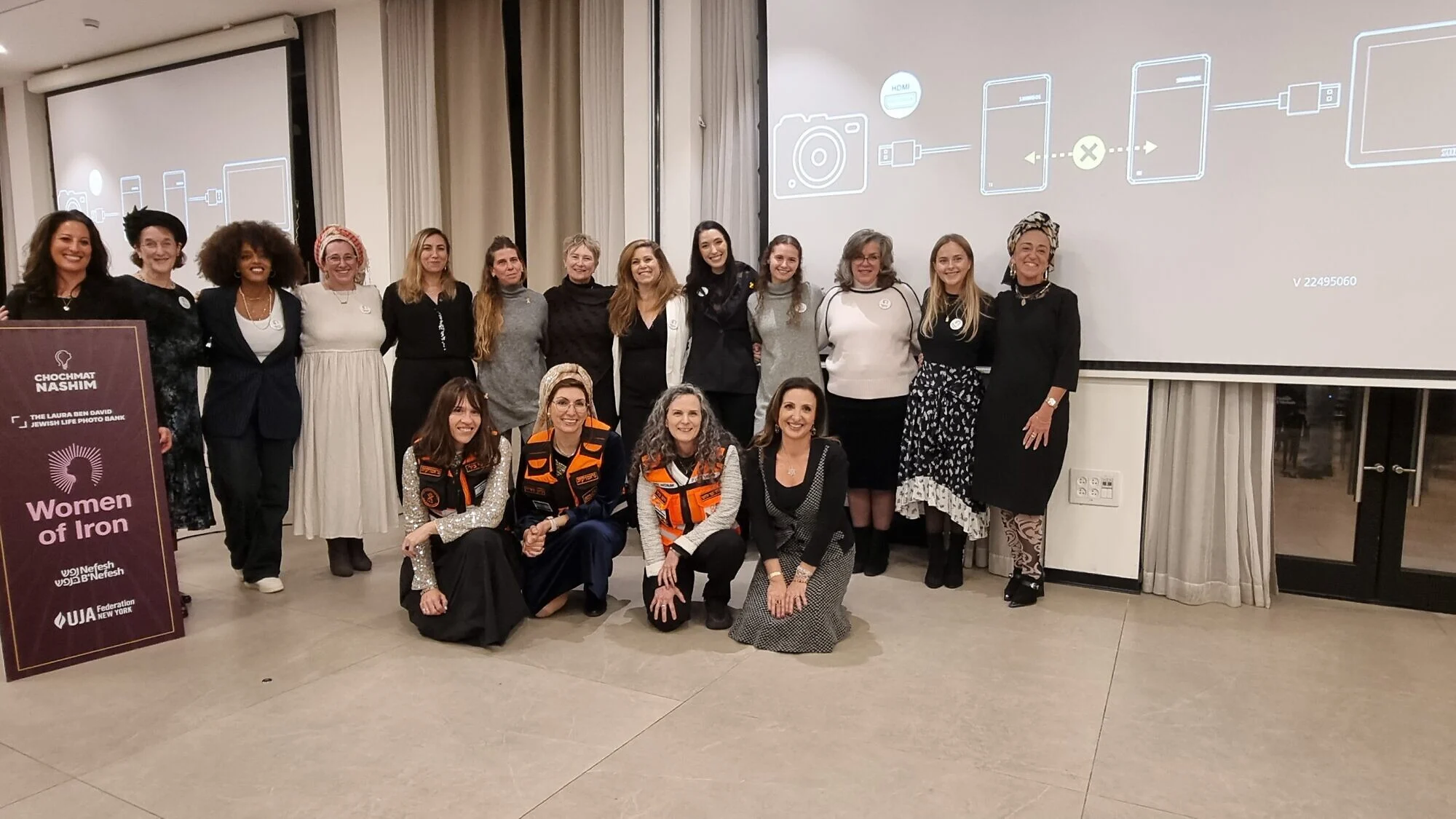
(JNS) In the wake of the Oct. 7, 2023, attacks, when shock and grief threatened to overwhelm Israeli society, a group of women stepped forward—often without title or preparation—and chose action over paralysis. On Tuesday, their leadership was honored in Jerusalem at a standing-room-only gathering that reflected both loss and resilience.
On a cold, rainy night, warmth and light filled the Nefesh B’Nefesh Jerusalem Aliyah Campus as hundreds gathered for Women of Iron, an event hosted by Chochmat Nashim honoring 18 women whose leadership emerged from one of the darkest chapters in Israel’s history.
Chochmat Nashim, an Israeli advocacy organization focused on strengthening women’s voices within Jewish religious, communal and public life, was founded in 2017 by activist/writer Shoshanna Keats Jaskoll.
As rain fell outside, stories of courage, advocacy and moral clarity took center stage inside. The evening recognized women who, after Oct. 7—amid chaos, grief and uncertainty—refused to remain silent. Instead, they stood up, spoke up and led new initiatives.
The honorees represented a wide spectrum of responses to the crisis. Some were directly involved in lifesaving rescue and emergency response. Some took on Israel’s battle for moral legitimacy on the international stage. Several transformed personal tragedy into national advocacy, while others strengthened communities, defended truth or offered solace and hope to those in need.
The 18 women honored by Chochmat Nashim were:
- Ashager Araro: Ethiopian-Israeli community leader and advocate.
- Gitty Beer: veteran emergency and rescue volunteer.
- Michal Barkai Brody: social advocate following personal loss.
- Shifra Buchris: Border Police commander and war hero.
- Zahava Diener: grassroots community organizer.
- Laly Derai: humanitarian and social activist.
- Cochav Elkayam-Levy: chair of the Civil Commission on October 7th Crimes
- Senai Guedalia: young widow who started a fancy dress gemachlending group so women could dance again.
- Iris Haim: outspoken moral voice after the loss of her son, hostage Yotam Haim.
- Shirel Liberman: advocacy and public diplomacy activist.
- Sivan Mashiach: frontline trauma and crisis responder.
- Shari Mendes: supporter of families and communities.
- Emily Schrader: journalist countering anti-Israel disinformation.
- Tamar Shlezinger: physician involved in emergency care.
- Sarit Zussman: advocate for unity after personal tragedy.
- Bazy Rubin: voice of reservist families through humor.
- Sharon Laufer: communal and public-policy advocate.
- Arbel Yehoud: survivor and public witness.
Rather than elevating the women as abstract symbols, the evening focused on action—what each woman did when faced with unimaginable circumstances. Whether saving lives, confronting antisemitism, advocating for victims, or holding families and communities together, each story reinforced the same theme: Leadership is often born in moments when no one volunteers for the role.
Not all the honorees were engaged directly in combat or emergency response. Bazy Rubin, a long-suffering IDF reservist’s wife with young children, turned her experience into viral social-media videos infused with humor. Her content resonated deeply with families facing similar pressures, offering a moment of levity under strain.
Shifra Buchris—a war hero, Border Police commander and mother of 10—was unable to attend, as she was on duty in the Border Police Southern Brigade.
Shari Mendes
Among the women honored was IDF reservist Shari Mendes, who told JNS that the recognition moved her more deeply than she had expected.
“None of those who stepped up in Israel in the aftermath of Oct. 7 did so to be thanked or for personal glory. Every one of us would prefer it never happened, but it did, and I was privileged to be able to show kindness to these young women soldiers who were killed,” said Mendes, who participated in identifying female victims of the Hamas-led Oct. 7 massacre.
“Women did many brave things in this war, and it is meaningful to be recognized among this group of women,” she added.
Mendes explained that in 2010, the IDF Rabbinate determined that as more women were drafted into combat units, a dedicated framework was needed for the identification and burial preparation of fallen female soldiers.
“They couldn’t use 18-year-old religious men to do it, and they wanted the process to be more respectful,” she said.
A friend of Mendes helped establish a volunteer unit at the time. Women who were members of the Chevra Kadisha burial association—qualified to ensure the dignified handling of bodies—were responsible for burial preparation, while Mendes worked on identification.
“I’m an architect. I was supposed to handle computer systems and fingerprinting. We knew we needed to be prepared for mass-casualty events and trained through simulations, but I wasn’t trained for burial preparation—that wasn’t my role,” she said.
In 2023, Mendes said, the unit became an official IDF unit and its members were enlisted as soldiers.
“On Oct. 7, I looked at my phone and saw the Tzav 8 emergency call-up. I reported immediately. Others in my unit and I were stationed at Shura Camp for weeks, dealing with deceased female soldiers,” she said.
“Because of the volume of the dead, the government and the army designated Shura Camp as a national morgue for civilians, police and military personnel. Our unit also handled cases we initially believed were soldiers, only to later discover they were civilians,” she continued.
“Our obligation was to help the families. In the first days after Oct. 7, families were frantic—they didn’t know what had happened to their loved ones. Identification was crucial, and thoroughness was essential. I was proud that we balanced efficiency with accuracy. We also took time with each of these young soldiers and cared for them as the last people to see them. It was a privilege to do this holy work, and I am grateful to the women soldiers who taught me quickly how to prepare young soldiers for burial,” she added.
Mendes also described how she became one of the leading voices drawing international attention to Hamas’s sexual violence on Oct. 7.
“People began questioning what happened and even denying it, which was unbelievable after what we saw. The safest place to bring foreign journalists and officials was Shura Camp, because the kibbutzim were still dangerous. We had containers and refrigerators holding unidentified body parts. My commander would ask me to accompany the chief rabbi or representatives from the police or dental identification units and speak on behalf of our unit, because I speak English fairly well,” she said.
“It was very lonely work, speaking to the world about sexual violence. I am a mother, an architect, and I run an emergency breast cancer relief fund. I had no experience—neither speaking to the press nor preparing deceased soldiers for burial,” she continued.
“It is very gratifying to hear that I represented Israel well and did a good job. I feel I did my part, and I was deeply touched that it was recognized,” she added.
Mendes said it has become increasingly difficult, more than two years later, to speak about what she witnessed. She referenced victims who were shot in the face and other acts of extreme brutality she no longer wishes to detail, noting that the evidence is part of the public record.
Cochav Elkayam-Levy
Also honored at the ceremony was Cochav Elkayam-Levy, chair of the Civil Commission on October 7th Crimes by Hamas against Women and Children.
“I think it represents the journey we began more than two years ago. From the very beginning, we knew we needed to prepare a war crimes archive of testimonies, videos and images documenting Hamas’s sexual and gender-based violence,” Elkayam-Levy told JNS. “It was an opportunity to reflect on everything we have done over the past two years and the journey we have been through. This recognition gives us strength to continue.”
Elkayam-Levy said the commission has been documenting testimony, preparing for legal proceedings and building an evidentiary body on sexual violence to support those efforts.
She noted that new testimonies continue to emerge weekly. This week, she said, former Hamas captive Romi Gonen is expected to speak publicly for the first time about the violence she experienced, while former hostage Rom Braslavski and other male captives have testified about sexual violence they endured in captivity.
Footage continues to surface, Elkayam-Levy said, which the commission archives according to the highest historical and legal preservation standards.
“For us, Oct. 7 did not end. It continues on a daily basis. We keep analyzing, collecting and archiving, and making sure the world knows. We continue to provide testimonies around the world and speak as a civil commission about the sexual violence,” she said.
Elkayam-Levy pointed to two pivotal moments in her journey. The first was a meeting with senior White House officials in Washington on Dec. 6, 2023. Following that meeting, the White House released a statement saying that “as President Biden has again underscored, the world cannot look away from the accounts by survivors and witnesses detailing the brutality of that day.”
After the statement was issued, Elkayam-Levy said she received more than 1,600 requests worldwide for information, marking a turning point in her work.
The second moment came when she addressed the United Nations on Oct. 30, 2023.
“It was a powerful moment. I realized we needed to establish a commission of inquiry. We were experiencing denial—not only from pro-Hamas groups, but from the U.N. and human rights organizations,” she said. “We began working to preserve historical truth, legal truth and to give a voice to those who could no longer speak.”
The Civil Commission was formally established a month after the attacks and currently employs 20 staff members. In the coming year, Elkayam-Levy said, the commission expects to reach a critical mass of testimonies.
She added that the commission will take part this year in two significant lawsuits related to Oct. 7—one in the United States and one in Israel.
“Knowing that our work will be crucial for legal proceedings means the world,” she said.
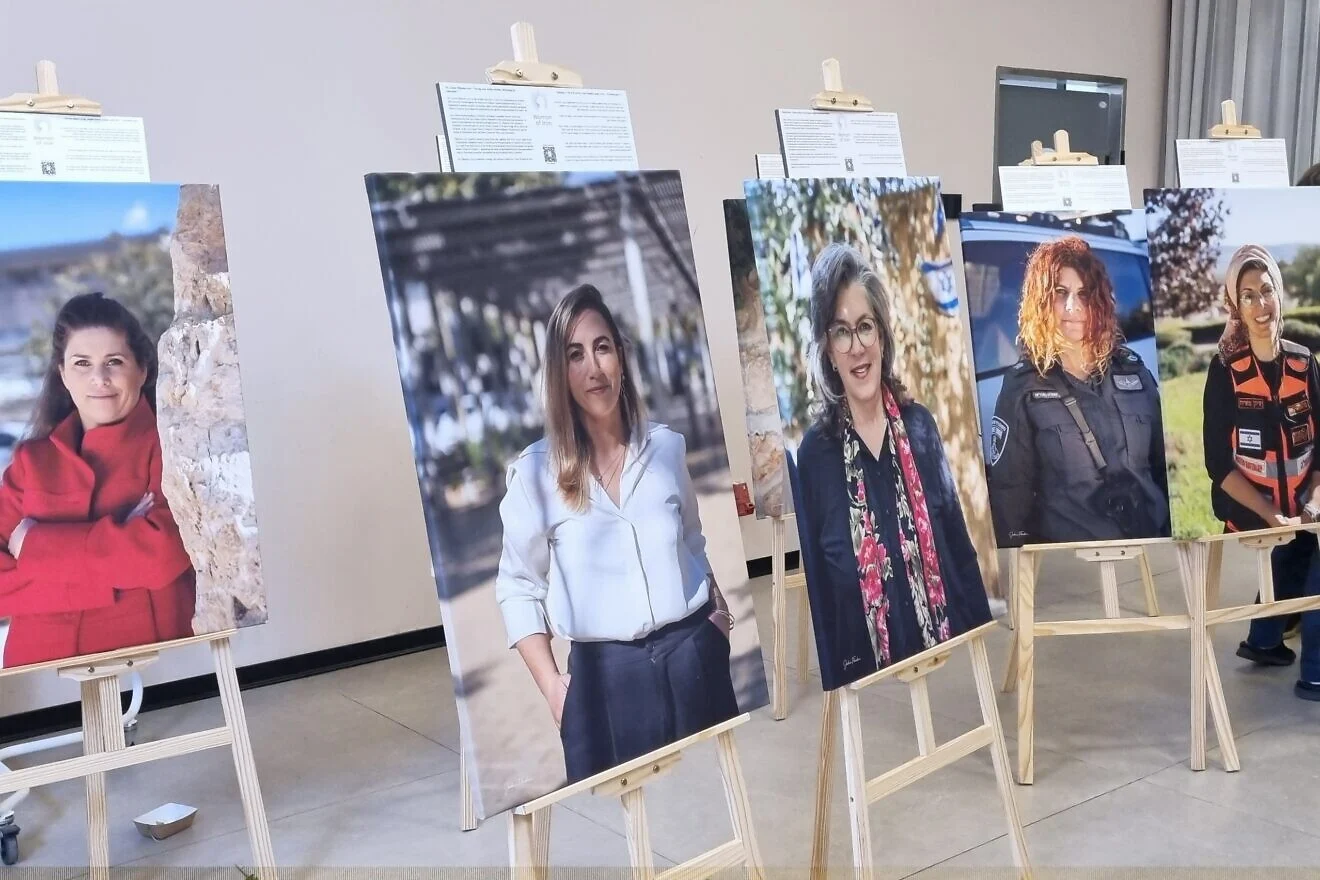
Photographs by Laura Ben David displayed in the lobby of the Nefesh B’Nefesh Aliyah Campus in Jerusalem, Dec. 23, 2025. Photo by Sharon Altshul.
Visual storytelling and legacy
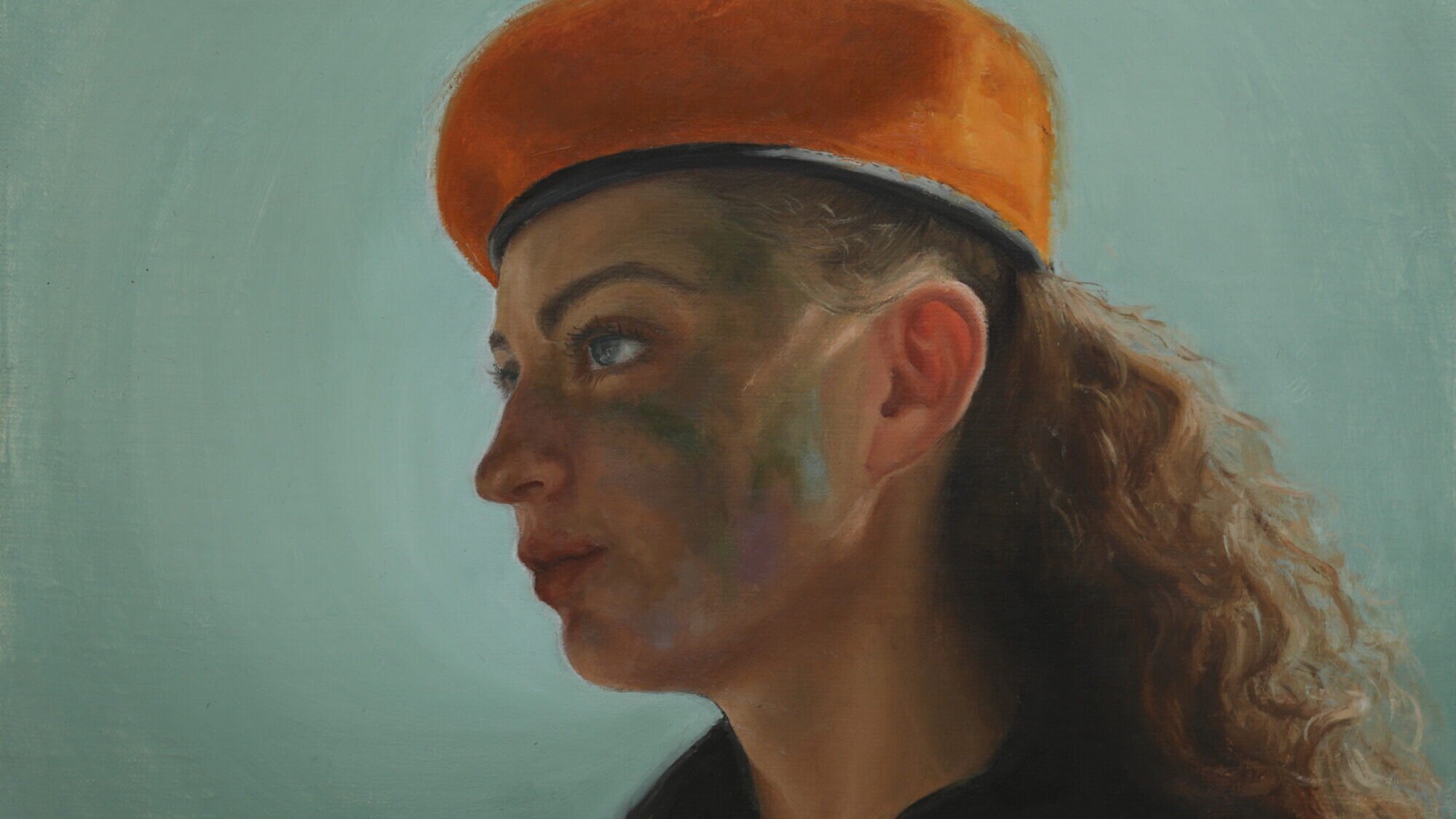
Central to the Women of Iron project is its visual language. Photographs by the late Laura Ben-David, a shining star of the American immigrant community who died of cancer on July 17 at the age of 56, were featured prominently in the lobby. The Chochmat Nashim Jewish Life Photo Bank, founded by Keats Jaskoll, which documents Jewish communal life, has been named in her memory.
The program opened with remarks by Ben-David’s daughter Lexi Rotem, who spoke on behalf of her family. Her words transformed the exhibition into more than a record of leadership, underscoring continuity, memory and creative legacy. Storytelling itself, the organizers suggested, is a form of resilience.
Chochmat Nashim’s Women of Iron project was never intended to remain confined to a single event. The exhibition is designed to travel, bringing the stories of 18 female leaders to Jewish communities worldwide.
Keats Jaskoll urged attendees to see it not only as a tribute but as a call to action. “We have tremendous power when we use it to care for one another,” she said.
“This evening was about naming what so many have felt: that our people have been carried, time and again, by extraordinary women whose strength is both quiet and fierce,” Keats Jaskoll added. “These women represent hundreds more that we have filled us with awe as they rose to heights of courage, strength and leadership through the crisis of the last two years.”
The evening was co-hosted by Keats Jaskoll and Fleur Hassan-Nahoum, the popular host of JNS-TV’s The Quad, former Jerusalem deputy mayor and former Foreign Ministry special envoy for innovation. She spoke about the need for greater recognition of women’s leadership at the highest levels of public life.
“There are so many heroines that stepped up after Oct. 7 in so many different ways, I am proud we got to shine a light on their strength and resilience,” she said. “The country is a better place for their leadership, and we need to keep pushing forward for more female leaders in key positions.”
Journalists, activists, diplomats and communal leaders filled the room—many choosing to listen rather than speak.
Behind the scenes, Keats Jaskoll thanked the organizers and supporters who helped bring the evening together.
Still, the focus remained on the honorees themselves—not as distant heroes, but as ordinary individuals who acted when action was required. When first approached about the recognition, many of the women reportedly responded with the same question: “Why me?”
Leadership that endures
More than a year after Oct. 7, Israeli society continues to grapple with loss, unity, anger and fracture. The Women of Iron project does not claim to resolve those tensions. Instead, it documents something quieter and more enduring: the emergence of women who refused to wait for permission to lead.
As attendees eventually stepped back into the cold Jerusalem night, the rain had stopped. Inside, a sense of warmth lingered—an appreciation that leadership is not always loud, and strength often reveals itself when the cost is high.
The Women of Iron exhibition ensures these stories will not fade into the background of history. Instead, they will travel—across cities, communities and generations—bearing witness to the women who chose to stand, speak and act when it mattered most.
“It was a profound honor to be among such extraordinary Israeli women,” Bellamy, a creator and consultant who hails from South Africa, told JNS. “Heroines of Zion whose courage and clarity of purpose illuminate what true leadership looks like. Their example shows young women across the Diaspora how high we can soar when women lead.”