(JNS) Iran’s response to the initiation of hostilities with Israel and the United States was a rapid mobilization of its international proxy network. Hezbollah, Iraqi militias and even Western propagandists were quickly activated to serve the Iranian regime’s needs. Yet, amid this intense regional conflagration, one of the most historically active militant factions has remained unexpectedly quiet: Yemen’s Houthi movement.
Over the past few years, the Houthis established themselves as a disruptive global force, launching a sustained campaign against commercial shipping in the Red Sea and firing ballistic missiles toward Israeli territory. However, as their primary military and ideological partner in Tehran faces direct existential threats, the group has refrained from opening a major retaliatory front.
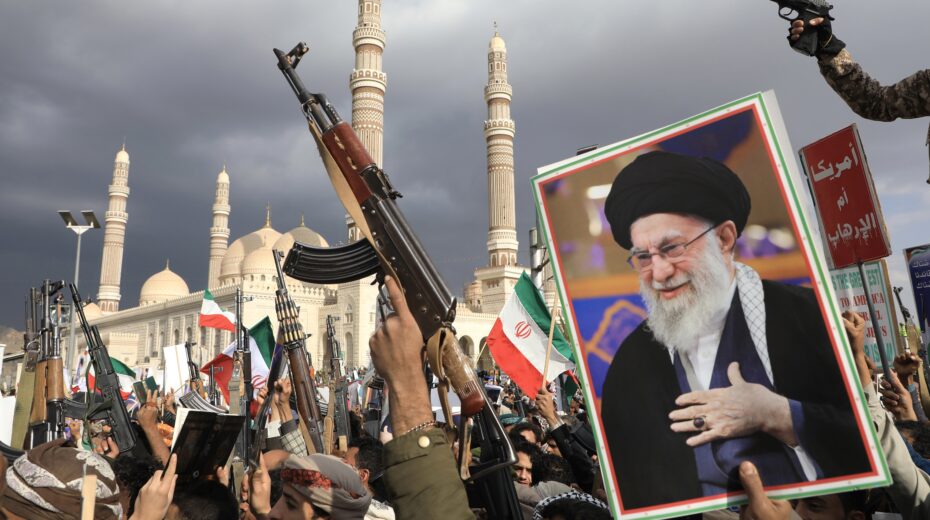
While Houthi supreme leader Abdel-Malik al-Houthi has maintained a posture of readiness, publicly warning adversaries that his forces’ “finger is on the trigger,” this rhetoric has largely remained confined to televised speeches and orchestrated demonstrations in Sanaa, rather than being translated into military action.
Highlighting this approach, senior Houthi official Mohammad Ali al-Houthi recently stated, “We call upon the Arab and Islamic peoples for moral, humanitarian and Islamic solidarity” with Iran, emphasizing political mobilization over military engagement.
Relationship with Iran
This deliberate silence challenges conventional assumptions about the rigid command structures within Iran’s militant networks. Rather than automatically mobilizing as a subordinate proxy on Tehran’s behalf, the leadership in Sanaa appears to be evaluating the conflict through a distinctly local lens.
Ari Heistein, a Yemen-affairs adviser and researcher at the Jerusalem Institute for Strategy and Security, explained, “The Houthis will fight in the Israeli-Palestinian conflict in support of Hamas, because it aligns with their ideology. … Fighting for Iran is a different calculation.”
He added, “The Houthis’ relationship with Iran has not necessarily changed, but this war has shed light on some of its nuances.”
Aviram Bellaishe, vice president of the Jerusalem Center for Security and Foreign Affairs, observed that to understand the Houthis’ strategic restraint, it is necessary to discard the pervasive assumption that the Yemeni militant group operates as a strict subordinate within Iran’s regional network. While Tehran and Sanaa have built a formidable military and logistical alliance over the past decade, their relationship is not defined by a rigid chain of command.
“The Houthis never viewed Iran as a command authority. They viewed it as an ideological and military partner,” Bellaishe told JNS. “There is no command-and-control relationship that obligates them to open a front when Tehran comes under attack. Their decision is entirely their own calculation.”
The Houthis’ military capabilities
The ideological reluctance of the Houthis to enter the current regional conflict is heavily reinforced by the recent degradation of the movement’s military capabilities and the high vulnerability of its supply lines.
The Houthis have recently suffered profound capability attrition. Throughout 2025, Israel and the United States launched a series of strikes against Houthi military assets, culminating in the Aug. 28 Israeli airstrikes in Sanaa, which dealt a devastating blow to the group’s leadership, killing at least 13 senior officials, including Houthi-appointed Prime Minister Ahmed al-Rahawi and military chief of staff Muhammad al-Ghamari. Outlining the impact of these operational losses, Bellaishe noted that “there is real capability attrition. Israel’s strikes in 2025 decapitated the Sanaa government and its military leadership. An arsenal built over the years takes time to replace.”
The group also faces severe technical constraints. While the Houthis have established a domestic military-industrial base capable of producing basic drone airframes and close-range ballistic missiles locally, they remain far from complete independence.
The group is fundamentally reliant on Tehran for advanced medium-range ballistic missiles and critical components, such as electro-optical guidance kits and specialized solid-fuel propellants.
“The Houthis have invested heavily in indigenizing their military industry, but are still assessed to be far from self-sufficiency on the high-end platforms. If Iranian support dries up, the key questions are what the Houthis still depend on Iran for and whether they can develop alternative supply lines for similar or substitute systems,” Heistein noted.
As the 2026 conflict severely degrades Iran’s domestic military-industrial output, the Houthis face the acute risk of their external support drying up. Given the difficulty of rapidly replacing advanced arsenals built piecemeal over several years, the leadership in Sanaa is likely prioritizing the conservation of its remaining high-end stockpiles over launching regional strikes, which are unlikely to sway the outcome of the conflict due to the Houthis limited military capacity.
Internal debate
The Houthi leadership is facing an intersection of severe physical constraints and acute pressure to act militarily. Currently, pragmatic interests appear to be steering the group’s strategy, prioritizing domestic concerns over regional obligations. However, hardline factions view military engagement as a core religious duty and continue to issue public threats.
Bellaishe outlined the logic of non-engagement, noting that “right now, that calculation says waiting is worth more than acting. Renewed strikes would invite direct American retaliation that could end their rule.”
Ibrahim Jalal, a senior researcher and policy adviser at the Stimson Center, added to this perspective, writing in a recent report, “An external military adventure would allow the Houthis to deflect growing internal pressure and distract from the shortcomings of governance, but it would simultaneously open the Houthis to severe international military response.”
Beyond the threat of direct military retaliation, the group faces severe economic realities. The ongoing war has already led to the effective closure of the Strait of Hormuz by Iranian forces, severely disrupting global energy markets and causing economic blowback across the Middle East.
A renewed Houthi blockade of the Bab el-Mandeb Strait would have catastrophic domestic consequences for Yemen, a critically import-dependent nation. As Bellaishe points out, “Disruptions to oil exports through Hormuz are already hitting hard. Adding a closure of Bab el-Mandeb on top of that does not only increase pressure on the coalition; it damages the Yemeni economy itself.”
Jalal added that “public opinion within Houthi-controlled areas is polarized, with populations prioritizing salary payments and basic services over adventurism.”
Despite the current policy, the Houthis maintain a state of high military readiness.
“In the days preceding the current war, the Houthis had redeployed missile launchers, radars, and long-range capabilities along the Red Sea coast in Hodeida and Hajjah and near the Saudi borders in al-Jawf and Sa’adah. They consolidated decentralization of stockpiles, reinforced local command autonomy, and reactivated wartime emergency protocols,” Jalal noted.
Despite this mobilization, Heistein explained that breaking the current silence would require specific conditions that satisfy both domestic political needs and strategic risk management.
“If the Houthis want to get involved while managing risk, they will need at least one of two things: a cause that is both legitimate and popular, or a target where the likely response is limited,” he told JNS.
Jalal, on the other hand, observed in his report that hardline elements may decide to drag the Houthis into war regardless of practical considerations.
“If Iran orders the Houthis to formally enter the war, the hardline faction within the movement will almost certainly comply, regardless of the costs,” he wrote. “The Iranian signaling that mobilized Hezbollah may soon reach Sanaa as well.”
The advantage of inaction
Despite their passive position, the Houthis wield significant asymmetric leverage even without engaging in direct hostilities. By maintaining a latent threat along the Red Sea, the group effectively holds neighboring Gulf states hostage and deters regional participation in the broader war against Iran.
“Even when the Yemeni front is closed in practice, it is wide open in Gulf decision-making consciousness,” Bellaishe explained.
With the Strait of Hormuz effectively closed to international shipping due to the ongoing conflict, global energy markets are relying heavily on overland bypass routes. Saudi Arabia is rerouting massive volumes of crude oil through its 750-mile East-West pipeline to the Red Sea port of Yanbu. Underscoring the severity of the situation, Saudi Aramco CEO Amin Nasser recently described the maritime blockade as “the biggest crisis the region’s oil and gas industry has faced.”
The Houthis hold immense sway over this critical economic artery. “If Bab el-Mandeb closes too, that last lifeline disappears. Riyadh knows this,” Bellaishe observed. “Riyadh cannot afford to join an offensive campaign against Iran as long as the southern border remains potentially open.”
An unrealized Houthi threat is also likely to exacerbate the highly fragmented nature of relations among the Gulf Cooperation Council members. Highlighting this disunity, researcher Dr. Ariel Admoni, a researcher at JISS, told JNS that there is massive divergence between the GCC states policy regarding the Houthis.
“It is problematic to talk about a unified ‘Gulf’ position; for example, just two months ago, the Qatari prime minister stated that they do not consider the Houthis a terrorist organization.”
The United Arab Emirates and Saudi Arabia, meanwhile, perceive the Houthis as a critical national-security threat. So long as the Houthis don’t show their true colors, this policy misalignment is likely to persist and serve as another factor preventing a unified Gulf front in the face of Iranian attacks.
Bellaishe added that even without engaging in direct military confrontation the Houthis are still serving the Iranian cause by sapping US and Israeli resources, which need to be set aside in case the Yemen front opens up.
“So as long as the Houthis hold that option open, even without activating it, they are running a double lever: against Israel and the United States, who keep forces ready in case they move,” he concluded.
Want more news from Israel?
Click Here to sign up for our FREE daily email updates