
The decision by a Saxon city to no longer permit the installation of new Stolpersteine (stumbling stones) commemorating victims of the Nazis has prompted significant reactions in Germany and Israel. The city council of Heidenau, located southeast of Dresden, voted on Thursday evening in favor of a motion stipulating that no new Stolpersteine should be laid in public streets and pavements. Thirteen council members voted in favor, six against, and one member abstained.
The motion had been submitted by council members from the AfD, the CDU, and the citizens’ initiative Oberelbe. The initiators explicitly do not oppose commemorating the victims of the Nazis, but rather object to the existing form of remembrance through Stolpersteine embedded in pavements. Instead, a central memorial space is to be created or expanded, preferably at Heidenau’s Nordfriedhof (North Cemetery).
The motion’s stated justification is that the memorial stones embedded in the ground are stepped on by passers-by. According to the motion’s sponsors, numerous citizens, relatives, and memorial initiatives consider this inappropriate for dignified remembrance. At a central memorial site, by contrast, it should be ensured that directly stepping on the memorial elements is prevented.
The city administration itself had opposed this part of the motion. A central memorial site at the Nordfriedhof could indeed fulfill an “independent and dignified commemorative function,” according to the official resolution proposal. However, it could not serve as an equivalent replacement for the memorial sites at the former residences or places of activity of the victims. The administration therefore recommended continuing to decide on a case-by-case basis regarding the installation of new Stolpersteine.
Heidenau currently has Stolpersteine at two locations. In 2021, a stone was laid for former mayor Paul Gröger, and in 2023, Stolpersteine were added for the Jewish merchant family Reiner. Last year, applications had been submitted for the installation of seven additional Stolpersteine.
Israel’s Ambassador to Germany, Ron Prosor, responded with particular sharpness. “I am ashamed,” he declared after the decision became known. Prosor pointed out that Stolpersteine in Berlin commemorate members of his own family — assimilated German Jews who were forced to leave Germany because of the Nazis.
Ich bin beschämt.
In Berlin erinnern Stolpersteine an Mitglieder meiner eigenen Familie. Stolze, assimilierte und erfolgreiche Deutsche, die wegen der Nazis ihr Land verlassen mussten.
Und im Deutschland des Jahres 2026 beschließt ein Stadtrat, keine neuen Stolpersteine mehr… pic.twitter.com/eQqbhLoEeM
— Ambassador Ron Prosor (@Ron_Prosor) September 25, 2026
“And in Germany in the year 2026, a city council decides to allow no more new Stolpersteine,” the ambassador wrote. Every person has a name, a world, and a story. “Whoever erases the victims from the past erases the past itself.” Germany needs a clear firewall against antisemitism “from the right, from the left, and from Islamist circles.”
Criticism also came from within the CDU itself. Federal Education Minister Karin Prien called the decision a “scandal.” Stolpersteine in public spaces make the annihilated Jewish life visible and serve as a reminder that Jews, before their persecution and murder, were a natural part of life in German cities and communities. Those who relocate such places of remembrance to cemeteries make Jews “invisible once again,” said Prien.
Charlotte Knobloch, Holocaust survivor and President of the Israelite Cultural Community of Munich and Upper Bavaria, also criticized the decision. Removing places of remembrance from the urban landscape was “entirely the wrong path.” At the same time, she expressed her dismay that CDU representatives had supported the motion together with the AfD.
The International Auschwitz Committee had already sharply protested against the motion before the vote. Its Executive Vice President Christoph Heubner stated that Stolpersteine are a “daily message” reminding people of “what must never happen again in Germany.” The Committee particularly criticized the planned relocation of commemoration from everyday urban life to a cemetery.
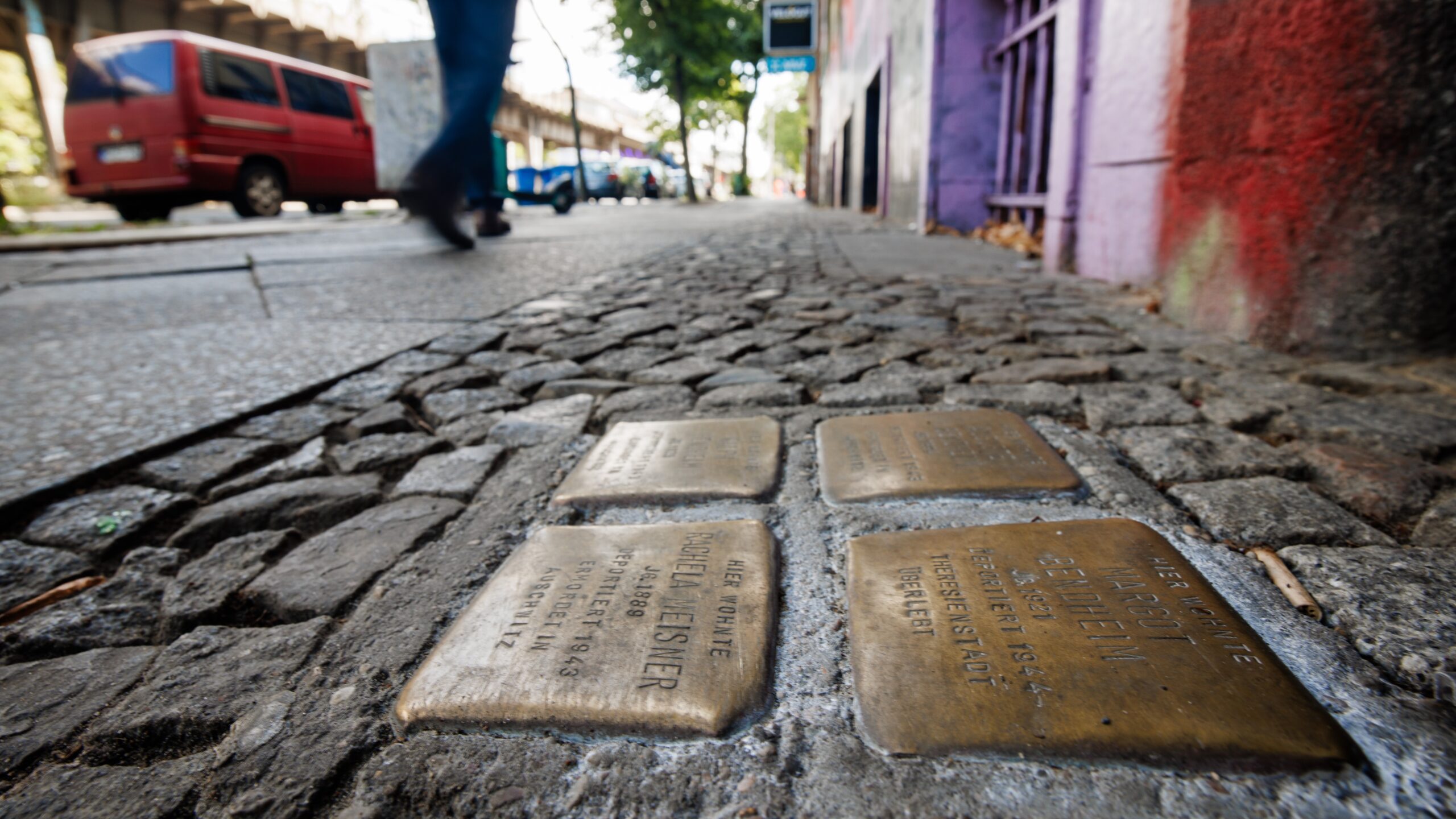
The Stolpersteine project originated with German artist Gunter Demnig. The small concrete stones with brass plaques are typically laid in front of the last voluntarily chosen place of residence or activity of people who were persecuted by the National Socialist regime. The names and biographical details are intended to restore the victims’ individual identities and make remembrance visible at the very places where they were once part of social life. To date, well over 100,000 Stolpersteine have been laid in Germany and numerous other European countries.

However, this form of commemoration is not without controversy everywhere. Critics have argued for years that it is undignified to embed the names of victims in the ground, thereby exposing them to being walked upon. Munich also does not permit Stolpersteine on public ground and instead relies on wall plaques and stelae. The Central Council of Jews in Germany, by contrast, describes Stolpersteine as a “very good and dignified form of commemoration,” because they directly confront people in their daily lives with the fates of those who were persecuted.
In Heidenau, the existing Stolpersteine will remain in place. The resolution concerns future installations. How the planned central memorial space at the Nordfriedhof is to be specifically designed remains an open question.
Want more news from Israel?
Click Here to sign up for our FREE daily email updates