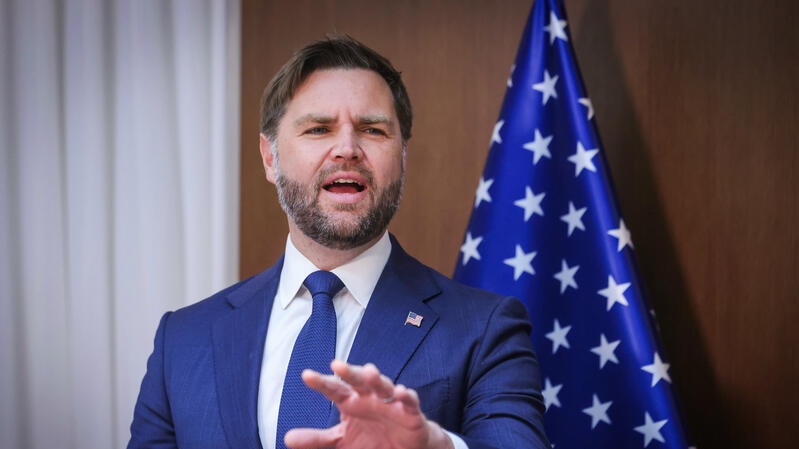

In April, days before Hungary’s parliamentary election, JD Vance flew to Budapest to meet Viktor Orbán and attend a rally with him. He was not subtle about why he came. “I am here to support him in this election cycle,” he said.
On Monday, Vance was asked whether he supports Benjamin Netanyahu’s reelection, just days before Israelis vote. It turns out he doesn’t do foreign elections.
Speaking with journalist Mark Halperin, Vance said: “I endorse American candidates, and that’s where I’m focused on as the midterms.” He added: “I’m not anti-endorsing him. I’m not pro-endorsing him.”
This came one day after President Donald Trump gave Netanyahu his “complete and total endorsement” on Truth Social. Trump warned Israelis against choosing “anyone other than Bibi.”
🚨 BREAKING: President Trump gives Israeli PM Netanyahu his “Complete and Total ENDORSEMENT” for re-election, 9 days before Israel votes
“Bibi Netanyahu has been a Great Warrior Prime Minister, and an even greater Partner for Peace in combatting the Islamic Republic of Iran.”
“If Israel has the wrong Leader, which would be anyone other than Bibi, America will have to do this work ourselves, and I am not inclined to do so.”
“Normal men or women in such situations would have wilted under the pressure — But Bibi did not wilt, he actually got stronger.”
“BIBI NETANYAHU WILL NEVER LET YOU DOWN!”
Israelis vote on October 27
Netanyahu is already the longest-serving prime minister in Israel’s history.
— Eric Daugherty (@EricLDaugh) October 18, 2026
Selective consistency
Vance did not turn on Netanyahu. He simply declined to stand beside Trump.
He did not criticize Trump’s endorsement or express opposition to the prime minister. He even praised the political weight of Trump’s endorsements. Declining to meddle in another democracy’s vote is also a respectable principle.
The trouble is that it doesn’t appear to be Vance’s principle.
If the rule is “American candidates only,” Budapest is hard to explain. If the rule is that Vance campaigns for friends abroad when he chooses to, then Netanyahu was a choice.
Not a blank slate
The refusal also didn’t come out of nowhere.
In June, Vance publicly rebuked Israeli officials who criticized Trump’s memorandum of understanding with Iran. He warned them against “attacking the only powerful ally” they have left. He told Israelis who see Trump as their biggest problem to “wake up and smell the reality.” He also pointed out that two-thirds of Israel’s defensive weapons are built and paid for by Americans.
In July, Axios reported that Vance had accused Netanyahu of stoking opposition to the Iran memorandum and had questioned his loyalty to Trump. The two then held a one-on-one meeting that officials on both sides described as “frank and direct,” diplomatic-speak for “tense.”
None of that makes Vance anti-Israel. In the same June briefing, he insisted Israel keeps its right of self-defense if Hezbollah fires on it.
It does mean his “not pro, not anti” is not a shrug. It is a position.
Vance’s own premise
The most revealing line from that June briefing may be Vance described Trump as “the only head of state in the entire world who is sympathetic” to Israel right now.
If Trump really is Israel’s only sympathetic head of state, then the pressing question for Israelis is not whether Trump stands with them. It is who stands with them after Trump.
And one of the leading candidates for that job just declined to.
Why it matters so much to Israelis
Trump’s endorsement of Netanyahu is not US policy. It is personal.
There is a difference between supporting Israel and making public solidarity with its elected leader part of one’s political identity. Trump does the second. So, in Argentina, does Javier Milei.
Both men have a close personal relationship with Bibi. But for both he is also the face of Israel on the international stage. That matters more today than it did a decade ago. Israelis feel more isolated than they have in years. Their critics are loud and organized, and loud friends are part of how a small country answers them.
Vance is striking a decidedly different note.
The Rubio murmur
Here in Israel, we’ve been hearing a recurring line: many Israelis would rather see Secretary of State Marco Rubio carry the Republican banner in 2028.
Israelis have certainly taken notice that while Vance embodies the non-interventionist “America First” camp, Rubio represents the hawkish, staunchly pro-Israel conservative tradition.
And Vance’s decision not to wade into Israel’s election like he did in Hungary suggests to Israelis they were right to be wary of him.
Want more news from Israel?
Click Here to sign up for our FREE daily email updates