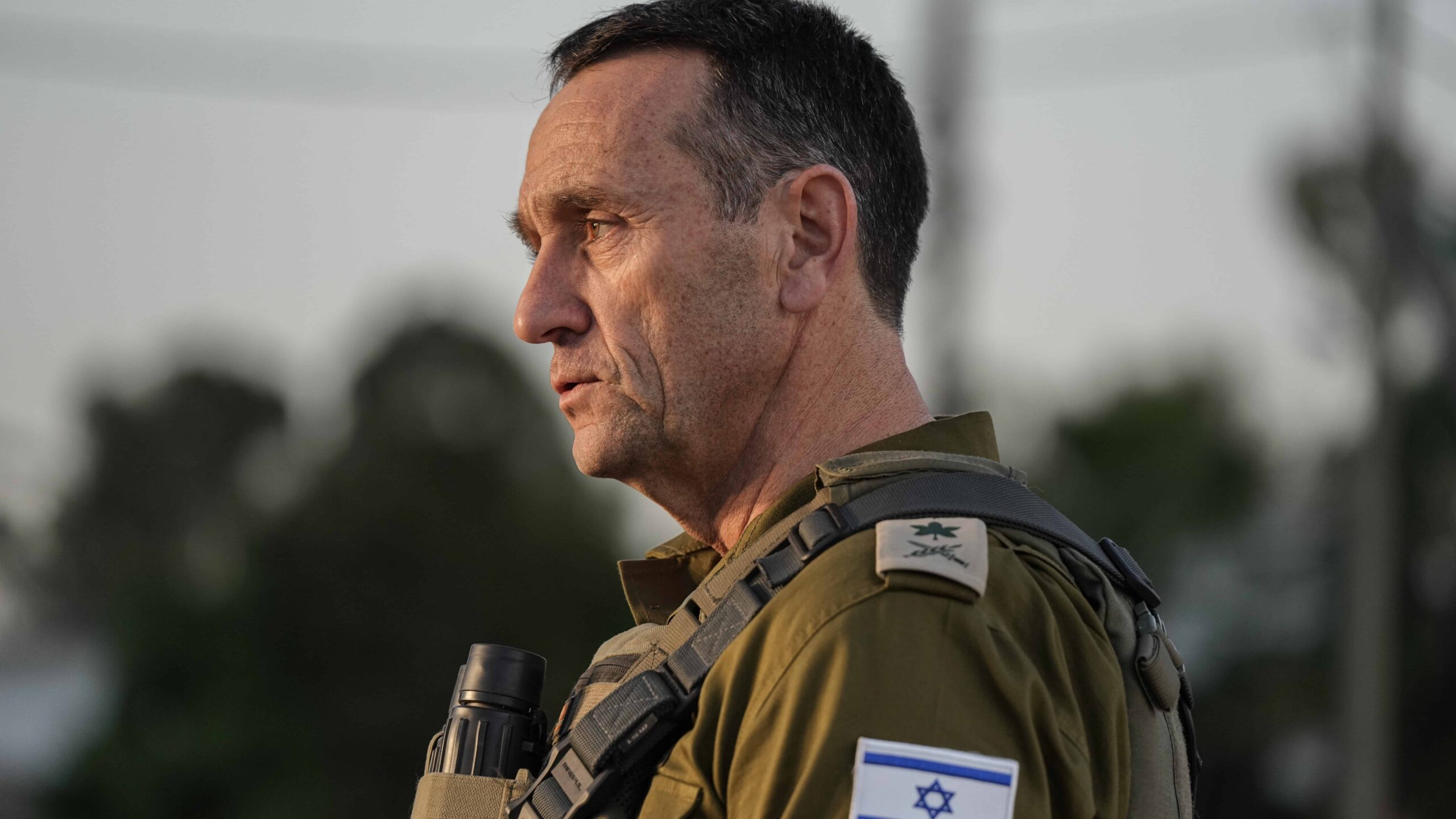

(JNS) Herzi Halevi, former Israel Defense Forces chief of staff, said that the Hamas-led terrorist attacks of Oct. 7, 2023, could have been prevented but rejected allegations that members of Israel’s security establishment deliberately assisted the terrorist group.
“There was absolutely no betrayal,” Halevi said at the third annual Rage Against the Hate conference on Sunday. “The political echelon and the country’s leadership need to state this clearly and unequivocally.”
Halevi, who was IDF chief of staff during the attacks, said he could explain how they unfolded “down to the smallest detail,” but could not believe that colleagues with decades of military service would help Hamas.
“From a practical standpoint, aiding Hamas would require not just a single collaborator, but an extensive network,” he said. “Yet, even after three years, not a single such person has been found.”
The conference, hosted by the Israeli legal advocacy organization Shurat HaDin at the Museum of Jewish Heritage in New York City, focused on defending Israel, protecting IDF soldiers and combating Jew-hatred. According to the organization, dozens of pro-Israel organizations, Jewish opinion leaders and American influencers attended.
Halevi also called for a state commission of inquiry into the failures surrounding the attacks, saying Israel must complete its investigation and confront the mistakes that allowed Hamas to launch its assault.
“As part of the process of learning and healing, Israel must complete its investigation and ask difficult questions—just as we have done within the IDF,” he said. “This is of great importance. Oct. 7 was a failure that could have been prevented.”
Halevi stepped down from his position in March 2025, writing in his letter of resignation that “the IDF under my command failed in its mission to protect the citizens of Israel.”
Israeli Prime Minister Benjamin Netanyahu has resisted calls to establish a state commission of inquiry, arguing that a panel whose members are appointed by the president of the Supreme Court would be biased against his government.
The Netanyahu government has instead sought to establish a commission appointed through a political process, but failed to pass the necessary legislation before the Oct. 27 election.
The issue was a central campaign promise of several opposition leaders, including Gadi Eisenkot, Naftali Bennett, Yair Golan and Avigdor Liberman, who pledged to establish a state commission of inquiry if they formed the next government.
The High Court of Justice has given the government until Jan. 15, 2027, to provide an update on how it intends to investigate the failures surrounding the attacks.
“We must look failure in the eye in order to be able to fix things,” Halevi said. “I look at a photograph of Shiri Bibas and see the fear in her eyes. We were not there in time to help and save her. That is the failure.”
‘Should have gone to war in Gaza’
Halevi also discussed Israel’s prewar assessment of Hamas, saying the country’s security establishment had prioritized the threats posed by Iran and Hezbollah over the terrorist group in Gaza.
“We should have gone to war in Gaza, but our order of priorities was first Iran, then Hezbollah, and only then Hamas—because we did not know that Hamas intended to carry out an operation of this scale,” he said.
The prevailing assessment within the IDF, the Shin Bet security agency and the political leadership was that Hamas did not want a major war, Halevi said. Instead, Israeli officials believed the group was focused on demonstrating its ability to govern Gaza and provide for its roughly 2 million residents, while ultimately seeking to expand its control to Judea and Samaria.
“Hamas invested significant effort into leading us to this assessment,” he said.
Halevi added that Yahya Sinwar, the Hamas leader who was killed by Israeli forces in southern Gaza on Oct. 16, 2024, “did everything in his power” to catch Israel by surprise and trigger a broader regional conflict.
“Every point along the Gaza border was attacked immediately after 6:29 a.m.,” he said. “Sinwar was also confident that we would not conduct ground maneuvers within the Strip, as he was convinced that Israel viewed Gaza as an overly complex combat theater.”
“Regrettably, we contributed to that perception,” he said.
Asked whether Israel could achieve an “absolute victory” in Gaza, Halevi defended the decision to launch a ground offensive, saying it took considerable time to persuade the political leadership to approve one.
“We needed to break the pattern of small, limited rounds of conflict that relied solely on airstrikes,” he said.
“I know some people think otherwise, but without strong military pressure inside Gaza, we would not have been able to bring the hostages back,” he said. “I can prove this.”
He acknowledged, however, that the IDF had “made mistakes,” including carrying out strikes that killed hostages.
“Of course, this was not intentional. We did not know they were there,” Halevi said. “We underwent an accelerated learning process to improve our ability to pinpoint the exact locations of the hostages, with the goal of preventing such errors.”
Want more news from Israel?
Click Here to sign up for our FREE daily email updates