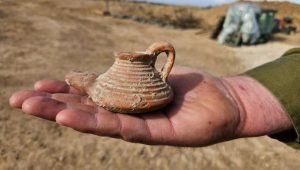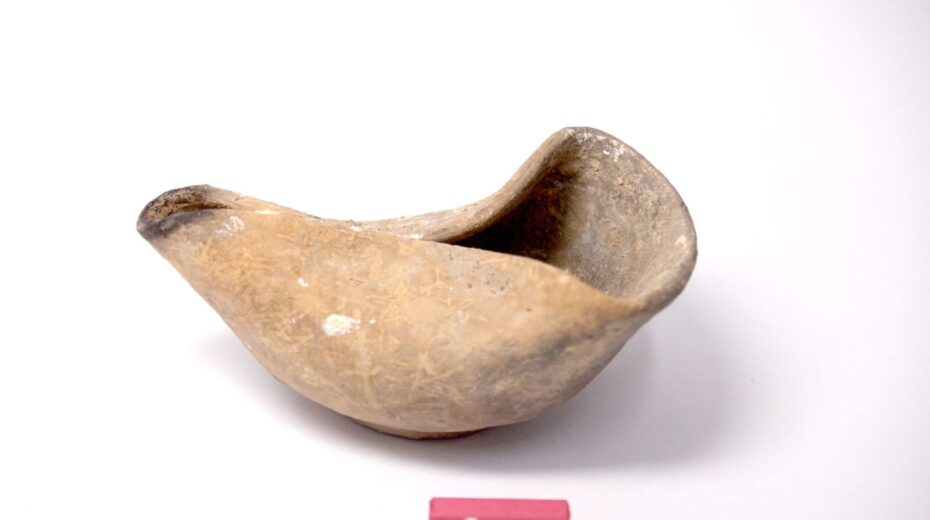

As the first Hanukkah candle was lit, an extraordinary archaeological discovery came to light near Jerusalem. At the historic site of Nabi Samuel, northwest of the capital, a 2,000-year-old clay oil lamp from the Hasmonean period was unearthed. The find is considered powerful evidence of Jewish presence and continuity in the Land of Israel during the time of the Second Temple.
The discovery was made during archaeological work by the Israeli Civil Administration, officially the Coordination of Government Activities in the Territories (COGAT). This body, under the Israeli Ministry of Defense, oversees civil affairs, infrastructure, coordination, and archaeological matters in Judea and Samaria. Within COGAT, a specialized unit known as KAMAT Archaeology carries out systematic excavations, documents historical sites, and ensures their preservation.
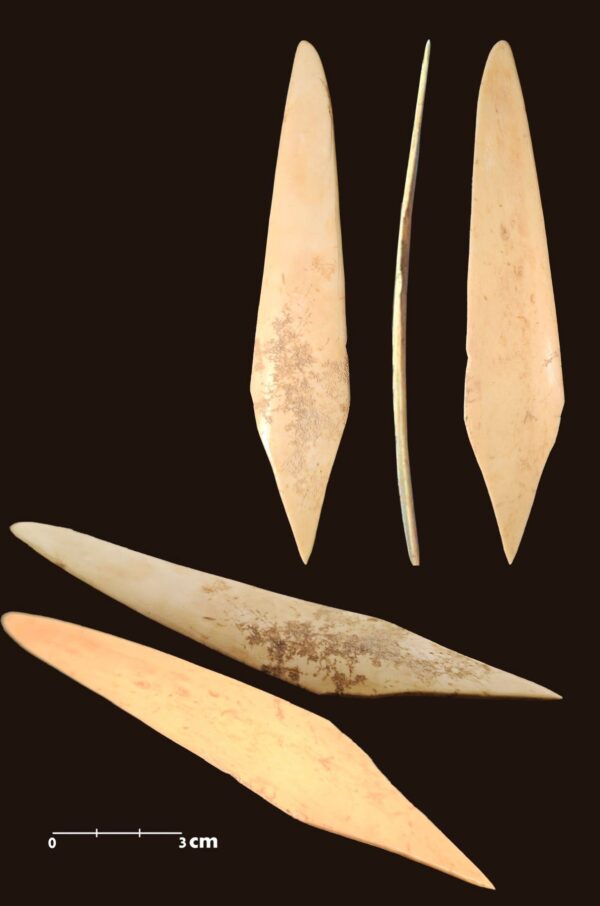
A stylus for writing on wax tablets. Image credit: Press Office of the Civil Administration (COGAT)
Alongside the clay lamp, a writing instrument from the same period was also uncovered at the site—a stylus used for writing on wax tablets. Both artifacts point to an organized daily life of Jewish society in the Jerusalem region during Hasmonean rule, shaped not only by religion but also by administration and culture.
The archaeological site of Nabi Samuel rises to about 885 meters above sea level and is one of the most significant historical locations in the region. Its strategic location provided natural control over the routes leading to Jerusalem for millennia, which is reflected in the rich archaeological remains unearthed there.
Excavations have revealed settlement layers from various eras—from Israelite and Persian times through the Hasmonean period, and up to the Crusader and Ottoman eras. Among the most important remains are the foundations of a large Crusader fortress and a mosque traditionally associated with the burial place of the prophet Samuel. The diversity of finds makes Nabi Samuel a key location for understanding the political, religious, and military history of Jerusalem’s surroundings.
The newly uncovered clay lamp and Hasmonean writing tool add to a series of significant archaeological discoveries made in recent years through the research, documentation, and preservation efforts of KAMAT Archaeology throughout Judea and Samaria. Using modern methods and precise documentation, the unit works to uncover, preserve, and make historical layers accessible to the public.
Benjamin Har-Even, head of the KAMAT Archaeology unit in the Civil Administration, emphasized the special symbolism of the discovery during the Hanukkah holiday. As the first candle is lit—a holiday that symbolizes the resilience of the Jewish people in their land—the find again reveals how deeply the Jewish people’s historical roots are embedded in the Land of Israel. Artifacts from the Hasmonean period strengthen the Jewish people’s historical and cultural connection to their land and highlight the importance of ongoing archaeological research for future generations.
Thus, the light of the Hanukkah candles this year connects in a special way with the light of history—made visible in a small clay lamp that, after two millennia, once again tells the story of Jewish life in the Land of Israel.
Want more news from Israel?
Click Here to sign up for our FREE daily email updates