

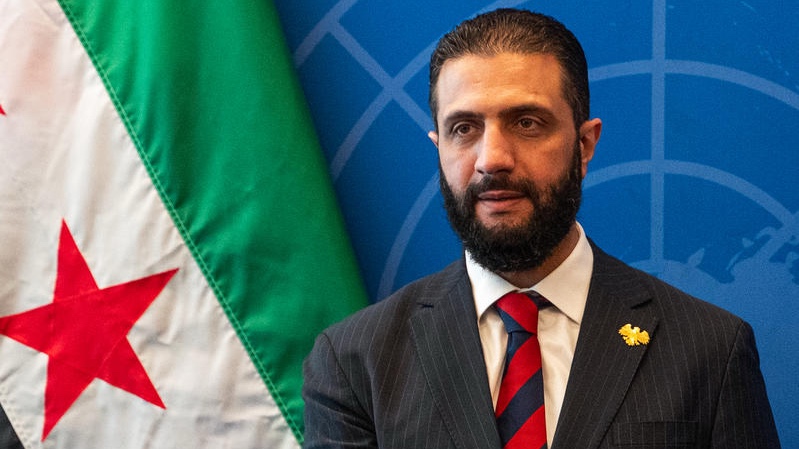

Israeli media reports that in a rare and pointed security assessment, senior Israeli military officials warned that Iran—alongside other hostile actors—is actively working to assassinate Syria’s new president, Ahmad al-Sharaa, amid rising instability in the regime’s inner circle.
The intelligence assessment, presented in closed Israeli defense forums and reported by Israeli news outlet Walla, suggests that al-Sharaa, who assumed power in a transitional capacity following the removal of Bashar al-Assad, is facing real and escalating threats to his life. According to Israeli sources cited by Walla, the Syrian leader is now investing substantial resources in personal security and internal regime stabilization.
The IDF’s warning comes at a sensitive moment, as indirect contacts between Israel and Syria have quietly resumed in recent weeks—suggesting that Jerusalem is closely watching regional realignments in the wake of October 7.
Why Iran wants al-Sharaa gone
Israeli defense officials believe that Tehran views al-Sharaa as a weak link in its network of influence across the Levant. Unlike Assad, whose regime served as a reliable corridor for Iranian weapons transfers and Hezbollah entrenchment, al-Sharaa’s rise is perceived as a potential pivot point—one that could jeopardize Iranian strategic depth.
This assessment aligns with growing signs of fracture within the Syrian power structure. Sources describe al-Sharaa’s immediate entourage as tense and fragile, with competing factions vying for influence as external pressure mounts.
Israel’s position: No withdrawal from security buffer
In response to the shifting dynamics, Israel has formally reaffirmed its refusal to withdraw from the security zones it maintains inside Syrian territory, particularly in the Hermon sector. Defense Minister Israel Katz has reportedly led multiple high-level discussions in recent months with IDF brass, culminating in a consensus that Israeli military presence must remain active and visible on the Syrian front.
One senior IDF official confirmed that the general staff has endorsed the defense minister’s position, underscoring the importance of forward deployment as a deterrent and early warning shield for communities along the northern border.
The three-tier doctrine: How Israel operates in Syria
Israeli operations in Syria, according to defense sources, are now being organized around a three-zone strategic model:
-
Contact Zone – This includes Israeli territory and the immediate border area. IDF forces are tasked with direct defense of Israeli communities and infrastructure.
-
Security Envelope (approx. 15 km into Syria) – This area includes towns, villages, and transport corridors. IDF operations here aim to prevent terrorist entrenchment and the movement of hostile militias.
-
Zone of Influence – Extending from southern Sweida to the outskirts of Damascus, this demilitarized belt is monitored for attempts by Iran, Hezbollah, or other proxies to smuggle advanced weapons, build military bases, or destabilize local governance.
Strategic continuity after October 7
The renewed emphasis on maintaining these buffer zones reflects a broader shift in Israeli defense doctrine post-October 7: proactive depth defense and terrain control rather than reactive containment.
As Tehran escalates its activities in the Syrian theater—and eyes the potential replacement of a less-compliant Damascus regime—Jerusalem is signaling that it will not relinquish the operational space that has, for now, prevented Hezbollah or Iranian forces from reaching Israel’s doorstep.
The message is clear: sovereignty begins with security, and security starts beyond the fence.
Want more news from Israel?
Click Here to sign up for our FREE daily email updates







Such a policy by Iran would indeed represent a dramatic shift in the balance of power in the Middle East.
Al-Shara’a is certainly not the best solution for Israel. However, he is helpful insofar as he is weakened by internal power struggles and is also trying to get out of the sanctions internationally. In other words, he is capable of making deals.
Structurally, however, it shows the collapse of the old lines of conflict between Sunni and Shiite states. In fact, a new line of conflict seems to be emerging between jihadist groups and reasonable, modern groups.
This also endangers Israel, but even more so the Middle Eastern states in the Abraham Accord. The conflict is thus becoming a “social” struggle between the upper and lower classes.
One can even speak of a dissolution of religious ties in favor of a political orientation based on the right/left scheme of Western states.
In such a situation, Israel MUST no longer think in religious terms, but should seek strong allies in the respective ethnic, religious, and social groups that reject jihadism.
One focal point here is Gaza, or rather the “New Vision for Gaza.” Saudi Arabia and even Turkey may not be involved militarily (that should be done by Israel), but they can be involved with their construction industries. Yes, even Turkey, whose system of rule is mainly based on a capitalist construction industry. So it’s a win-win situation.
But for this to happen, Hamas must not only be disarmed. It must be completely expelled, along with all its supporters and clan chiefs who originate from the former Mandate of Palestine.
Otherwise, peace will fail.