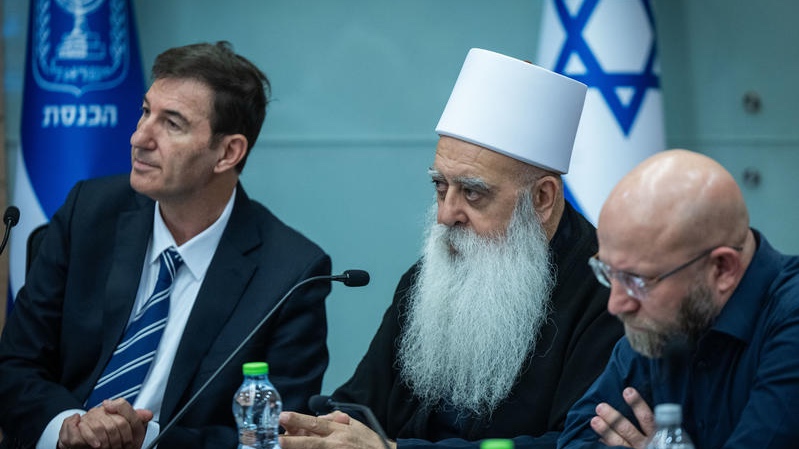

In a watershed moment for the battered Druze of southern Syria, Sheikh Hikmat al‑Hijri, the spiritual leader of the Druze community in Sweida province, has publicly articulated a vision that challenges Damascus’s claims over its minorities and reframes regional security dynamics: full independence for Sweida, backed by a strategic alliance with the State of Israel.
Al‑Hijri’s remarks to the Israeli daily Yediot Achronot mark a sharp departure from the traditional stance of Syrian Druze leaders, who long preferred cautious symmetry with Damascus. But after brutal sectarian violence swept through Sweida last summer — with al‑Hijri describing executions, rapes, and villages burned during clashes involving regime loyalists and militias — the calculus for his community has fundamentally shifted.
“We see ourselves as an inseparable part of the State of Israel’s existence,” al‑Hijri declared, framing the relationship not as opportunistic but historic, rooted in blood ties and shared tribal connections with the Druze of the Golan Heights.
He warned that Syria is moving toward de facto partition, and that the only viable future for Sweida’s 300,000‑plus Druze is autonomy — eventually sovereignty — secured under an external guarantor. For al‑Hijri, Israel is that guarantor.
“The only crime for which we were murdered is that we are Druze,” he said, characterizing the transitional government in Damascus as a jihadist‑aligned system indistinguishable from ISIS‑style brutality. He singled out Israel’s July 2025 airstrikes — undertaken under the auspices of defending Druze communities — as the only military intervention that halted the killing.
This language is stark, but it signals a strategic pivot. Al‑Hijri’s claims of genocide and existential threat to minorities echo a broader tectonic shift in the Levant: minority groups are breaking from the old centralist Arab state model and seeking new alignments to secure their survival.
From a geopolitical vantage point, the Druze appeal to Israel is not just symbolic. It reflects a profound realignment driven by war, demographic change, and the collapse of the Syrian state’s legitimacy in much of the south. Tehran’s proxies and Sunni jihadist factions have filled the vacuum left by Damascus, leaving minorities like the Druze with a stark choice: acquiescence to subjugation or strategic autonomy with Israel’s shield.
Al‑Hijri also voiced disappointment with the Arab world, claiming not a single Arab government condemned the violence in Sweida or offered meaningful support — underscoring the breadth of isolation that has pushed his community toward Israel.
This announcement comes at a time when Israel is recalibrating its regional posture: moving from defensive containment on its borders to proactive engagement with sympathetic minorities within failing states. The Druze appeal dovetails with an Israeli strategic interest in preventing hostile actors from consolidating control across the Syrian front, while fostering buffer entities committed to coexistence and deterrence.
The road ahead is precarious. Damascus rejects any notion of partition, reinforcing sovereignty claims over Suwayda, and the specter of fragmentation looms large for Syria’s territorial integrity. But for the Druze of Sweida, who have endured mass slaughter and state abandonment, independence — with Israel as guarantor — is no longer a theoretical aspiration: it is a security imperative.
This moment recasts the Druze not merely as a minority caught in the crossfire, but as a strategic actor with agency — choosing partnership with a sovereign Israel over lethargy under a collapsing Arab order. It is, in every sense, a new chapter in the Levant’s realignment.
See: The David Corridor: Geopolitics in the shadow of biblical kings
Want more news from Israel?
Click Here to sign up for our FREE daily email updates