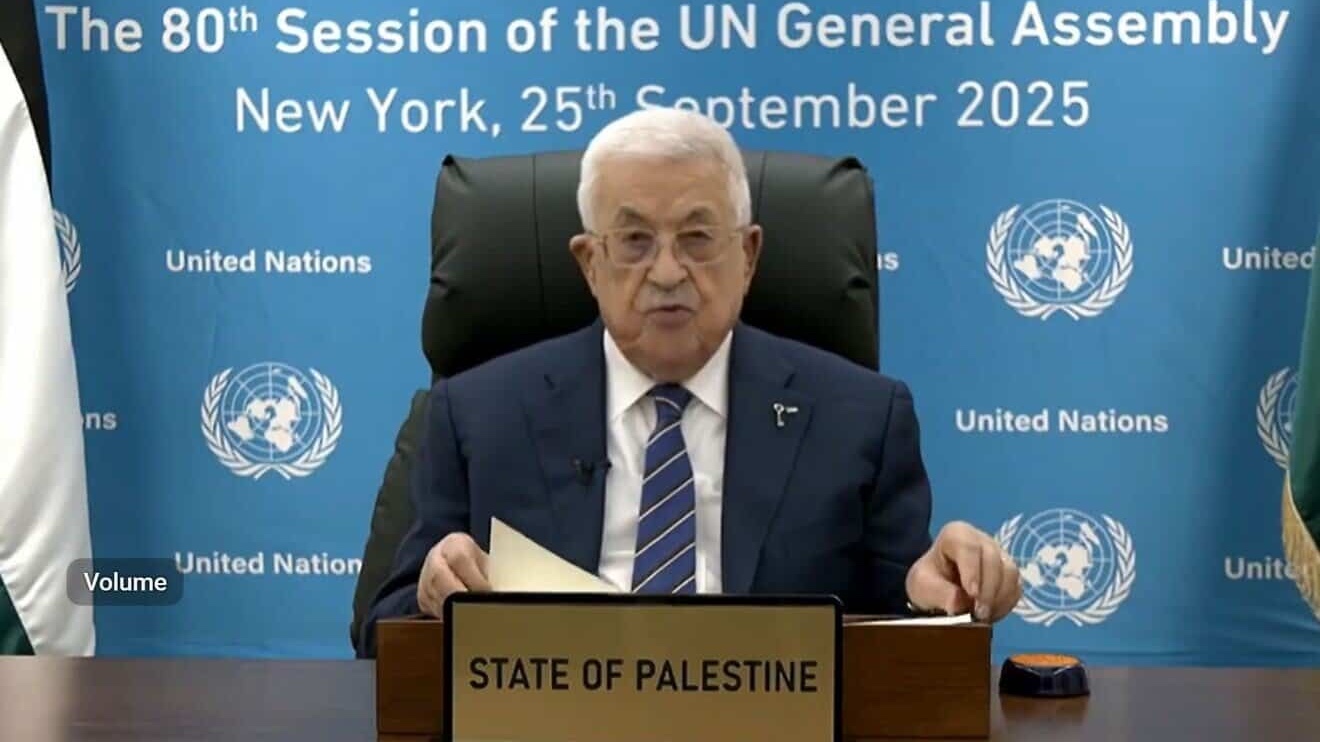

(Israel Hayom) The Ramallah office of Palestinian Authority Vice President Hussein al-Sheikh is constantly hosting visits of Western diplomats and heads of state, as political moves are being prepared toward ending the war in Gaza.
Al-Sheikh, a kind of crown prince to Mahmoud Abbas, the aging and almost perpetually ruling PA president, is firmly managing efforts to bring the PA into control of the Strip and, beyond that, to advance the establishment of a Palestinian state.
The horizon for such a state was set out in President Donald Trump’s 20-point peace plan, that was endorsed by the UN Security Council and which Israel did not oppose.
There is, however, a crucial caveat—reforms within the Palestinian Authority, including the end of payments to terrorists that continue even now, and the critical reform of the PA education system.
The Oslo Accords themselves included the requirement to instill content of peace, acceptance of the other and tolerance within the Palestinian education system.
Yet no one, including all Israeli governments to date, ensured that any of this was implemented. The European Union, the main funder of this education system, has repeatedly rejected Israeli demands to condition its funding on the necessary changes.
The required change is dramatic—from kindergarten onward, Palestinians undergo an educational indoctrination that teaches them to hate Israel, Zionists and, above all, Jews, with antisemitic motifs and direct incitement to terrorism.
Every few years, under international pressure, the PA announces changes, but those made are cosmetic in nature.
In his talks in Ramallah and meetings in Gulf states, Al-Sheikh has been trying to argue that over the past year there has also been a change in this area and that education officials are working on a new program.
Last week, Israel Hayom reported on the Saudi move to assume supervisory responsibility over these reforms, in exchange for the release of tax revenues that Israel is withholding.
Israeli and international leftist groups, such as J Street and Peace Now, are also helping the PA market the story of educational reform, even though the lie is a massive obstacle to genuine peace.
The reforms, in fact, never occurred. Israel Hayom has learned that during Al-Sheikh’s visit to the United Arab Emirates, examples of incitement in current textbooks were presented to him, and his request for financial assistance for the PA was rejected.
During 2025, Abbas’s office examined the possibility of a comprehensive change in the education system and sought assistance from international organizations involved in such efforts, even receiving examples of textbooks. Abbas, however, demanded that changes be introduced into those books that ran counter to principles of tolerance and the aspiration for peace, and the initiative did not move forward.
Arnon Groiss, who has been researching attitudes toward Israel, Jews and peace in PA textbooks for a quarter of a century, found that even now, in the current textbooks that were supposedly revised, their principles are indistinguishable from those of the Hamas terrorist organization.
Groiss, an associate at the Nahum Bedein Center for Near East Policy Research in Jerusalem, said that the treatment of the conflict in these textbooks is based on three core principles—opposition to the existence of the State of Israel anywhere in the land and to the very presence of its seven million Jewish citizens; harsh demonization of Israel and of Jews, including on religious grounds; and a call for violent struggle for total “liberation,” which at times hints at the need for their destruction.
“The State of Palestine” is presented as the sovereign over the entire land in place of Israel, both in text and on maps, and the name Israel is replaced with the term “the Zionist occupation.”
According to Groiss, there is a complete denial of Jewish history in the land and of the existence of Judaism’s holy sites, foremost among them the Western Wall.
Demonization is carried out by portraying Jews as “infidels, helpers of Satan and enemies of God’s prophets,” who in the past betrayed Mohammed and who today pose an existential threat to the Palestinians. Jews are also accused of being driven by Jewish religious thought to commit massacres with the intention of exterminating Palestinians.
The educational ideals promoted are jihad and istishhad (martyrdom for the nation and Islam) in order to “liberate” the land.
In Palestinian textbooks, including the current ones, terrorism—illustrated by examples such as the 1978 Coastal Road bus attack—is presented as an integral part of the “struggle for liberation”, as is the “return of refugees.”
The PA’s textbooks are mandatory in all schools in Judea and Samaria and Gaza, including UNRWA schools and private schools. Many schools in eastern Jerusalem also use these books.
A pilot for change
Ironically, it is precisely the education system in the Gaza Strip that could serve as a pilot for the change so desperately needed in the education of Palestinian youth and in halting the institutionalized incitement of the Palestinian education system.
Since the start of the Israel-Hamas ceasefire in October, various bodies have been trying to renew schooling in the Strip. Most schools were destroyed during the war, and international organizations are organizing makeshift classrooms. In the absence of a functioning governing authority, most of the material is not based on the PA curriculum with its Hamas flavor, as it was previously.
At the US headquarters in Kiryat Gat that is preparing for “the day after” in Gaza, there is an entire department dealing with the rehabilitation of education infrastructure, including future curricula.
Two countries stand out in these preparations: the United Arab Emirates and Morocco. Innovative curricula that omit the familiar incitement against Israel and Jews are being prepared, ahead of the establishment of a governing body that will take responsibility from Hamas, if and when that happens.
In the meantime, in areas controlled by clans opposed to Hamas, makeshift schools have been established that require curricula, textbooks and other materials.
The most prominent is in the territory of the Al-Shabab clan in the southern Strip, where several hundred children are studying in temporary structures according to an advanced education program run by one of the international organizations operating in the area. The program was written by education experts from across the Arab world and is now being examined by additional clans seeking to adopt it.
Originally published by Israel Hayom.