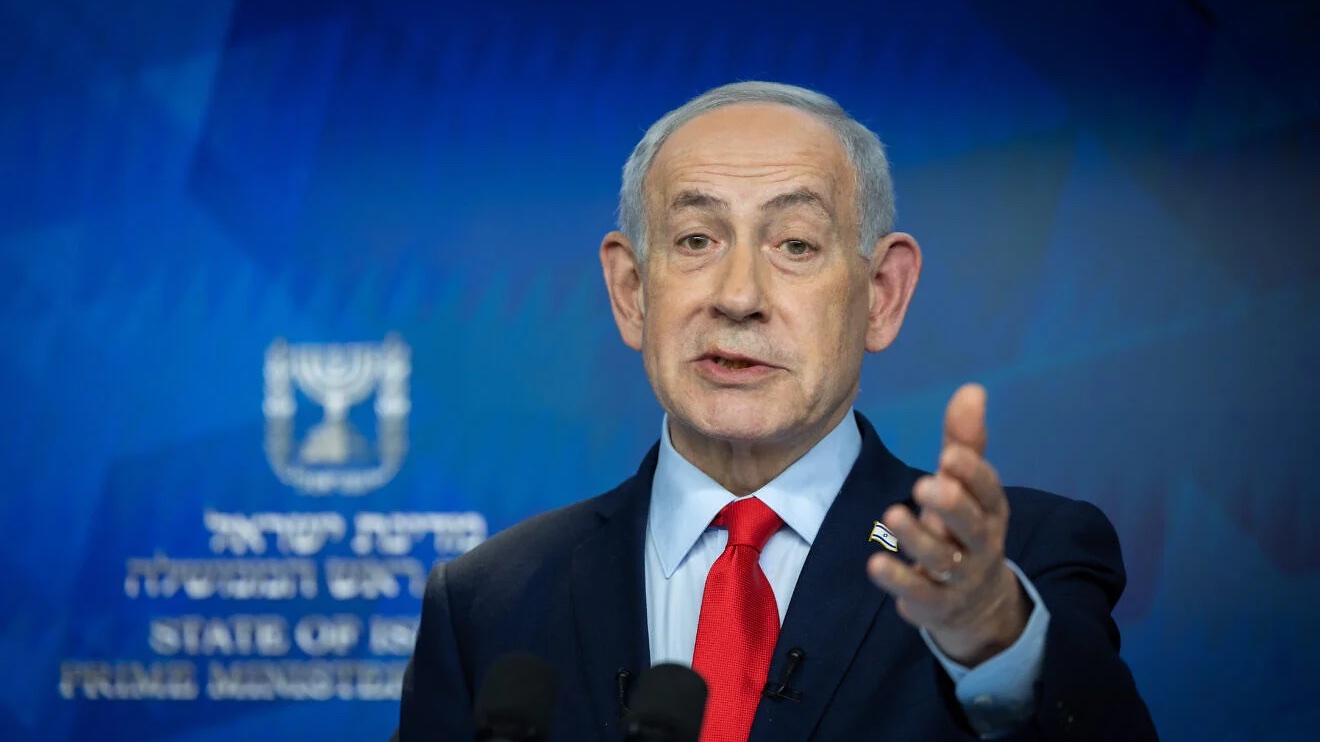
(JNS) Israeli Prime Minister Benjamin Netanyahu on Friday released to the public his response to State Comptroller Matanyahu Englman’s investigation into the failures surrounding the Oct. 7, 2023, Hamas-led attacks, urging the immediate resumption of the probe halted by the High Court of Justice and the establishment of a national commission of inquiry.
The Israeli leader stressed that the comptroller’s probe was not a substitute for an official inquiry, calling for the establishment of what he described as an “equitable and democratic” national commission, saying he would be the first to testify before such a body.
“This will be a democratic and equitable commission,” he said. “Half of its members will be selected by the opposition and the other half by the coalition.”
In a statement posted on X, Netanyahu said he was releasing his full response to the state comptroller in the interest of uncovering the truth about the events of Oct. 7 and what preceded them.
“The document I am holding contains the responses I provided to the state comptroller during his probe into the events of Oct. 7,” the prime minister said, adding that he answered the comptroller’s questions during a four-hour meeting held in his office on Dec. 25, 2025.
Netanyahu noted that on Dec. 31, the High Court of Justice issued an interim order halting the comptroller’s work.
“For nearly two years, the comptroller worked with full autonomy, without any interference from the judiciary or anyone else,” he said. “Yet just six days after I submitted this response, the High Court decided to grant the attorney general’s request to immediately halt the comptroller’s work—work aimed at uncovering the truth.”
Netanyahu said that some security-sensitive portions of the document had been redacted, but that authorized officials would be able to review them. He added that he had transferred all relevant materials to the Intelligence Subcommittee of the Knesset.
He said the document includes transcripts of security discussions and numerous documents spanning 12 years, from Operation Protective Edge in 2014 through the morning of Oct. 7, 2023, and that the comptroller questioned him directly about his own conduct and decision-making, including on the day of the attack.
Netanyahu said that had the High Court not intervened, former officials would have been granted access to the comptroller’s materials and been able to address the issues raised.
The released material consists of a 55-page document in Hebrew. In the document, Netanyahu places primary responsibility for the Oct. 7 failures on the defense establishment and on previous governments.
According to the contents as presented by the prime minister, the responses describe a broader systemic failure in the years preceding Oct. 7, portraying how a long-standing strategic “conceptzia” (governing assumption) permeated Israel’s political and security leadership, contributing to intelligence blindness, institutional arrogance and a failure to accurately assess the threat.
The publication includes only partial excerpts of security discussions approved for release, including selected quotations from Netanyahu and senior security officials. Here is an example:
The security discussion during Operation Protective Edge—and the consensus around the table: No to conquering Gaza
Deputy Chief of Staff Maj. Gen. Gadi Eizenkot:
“I think that conquering Gaza and Gaza City is well within the IDF’s capabilities. But one does not need to be a great strategist to understand that it would be a grave mistake. I believe it would be a mistake militarily, morally and economically.”
IDF Chief of Staff Lt. Gen. Benny Gantz:
“I think that conquering Gaza would be a first-order strategic mistake. I also think that no one around this table wants that.”
Shin Bet Director Yoram Cohen:
“The question is whether we should move in a different direction … that ‘different direction’ means governing Hamas. It would be wrong to take that step. I do not think it would be appropriate to take that step. I recommend to the Cabinet not to decide—or to stop deciding—on having no interest in conquering or toppling [Gaza].”
Prime Minister Benjamin Netanyahu:
“That is also the reason I did not want to hold this discussion until now, but now it obligates us—unless there is a majority here to conquer Gaza.”
Economy and Trade Minister Naftali Bennett:
“Then don’t bring it to a vote, and everything will be fine.”
Prime Minister Benjamin Netanyahu:
“I will not bring it to a vote. Really—I think it would be a strategic mistake. I truly do not think we want to get closer to that.”
Justice Minister Tzipi Livni:
“I would try the question. Is there anyone here who wants to conquer Gaza today?”
Economy and Trade Minister Naftali Bennett:
“No, but you don’t want—”
Justice Minister Tzipi Livni:
“I am actually in favor of asking the question. I would like to know. I think there would be unanimous agreement here that no one wants that.”
Shin Bet Director Yoram Cohen:
“I strongly do not recommend carrying out any significant ground maneuver. We would pay a very high price, and it is not certain that we would achieve the desired result.”
Economy and Trade Minister Naftali Bennett:
“Tzipi asked earlier whether I support conquering Gaza. Initially I was against it, and I remain against conquering Gaza. I am not eager for battle. I am against ‘Hanit [that is against sending IDF ground forces through the Hanit sector, i.e., crossing the border there],’ against conquest—against entering that zone.”
Situation assessment—10 days before the massacre
IDF Intelligence Directorate representative:
“In the Gaza Strip, we are in a sequence of days marked by demonstrations. These demonstrations are the result of a policy directed by [Hamas leader] Sinwar. His directive is to apply pressure along the fence in order to generate negotiations—to improve the situation in the Gaza Strip. He is trying to keep this restrained, based on their understanding that they do not want to escalate. Most of their discourse centers on a desire to lower the flames in order to create the conditions for reaching understandings around his demands. Most of these demands are related to daily life in the Gaza Strip. His demands are authentic, meaning there is real harm.”
Shin Bet Director Ronen Bar:
“I would summarize this as partial satisfaction on Hamas’s part. They very much do not want to enter another round of fighting, and therefore they are trying to formalize this.”
Defense Minister Yoav Gallant:
“I think Hamas is signaling its desire for a prolonged arrangement. I believe this issue has matured—at least for me. Our interest is to reach a prolonged arrangement in the Gaza Strip and certainly not to enter into fighting now. In my assessment, Hamas also does not want that, as I said. My recommendation is to advance along the track of an arrangement with Hamas, with the goal of striving for sustained calm and improving the humanitarian situation in the Gaza Strip. In the short term, this involves workers and various projects; in the long term, it involves energy and water infrastructure, and so on.”
Prime Minister Benjamin Netanyahu:
“At this moment, we are required to limit the campaign while applying controlled force. You can see that this is working on them. The list of arrangement demands that I saw they passed to the Qataris is an absurd list.”
Want more news from Israel?
Click Here to sign up for our FREE daily email updates