

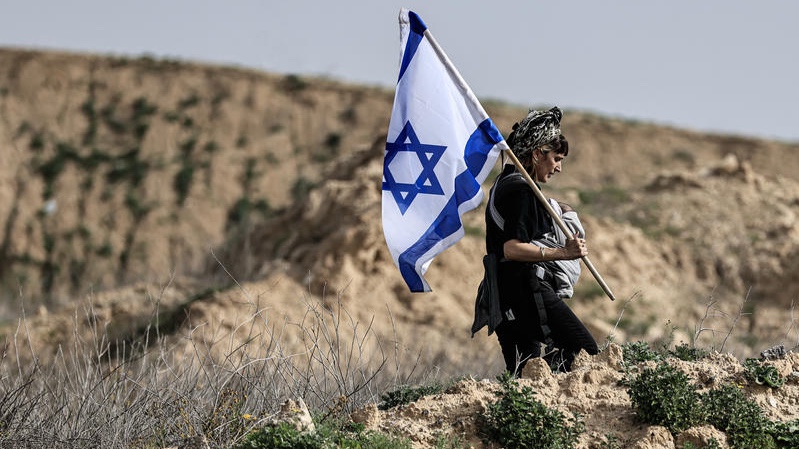

A small group led by Knesset member Limor Son Har-Melech (Otzma Yehudit) crossed into the Gaza Strip on Thursday night, defying military orders in an incident the Israel Defense Forces said endangered both civilians and troops operating in the area.
The IDF said soldiers dispatched to the scene apprehended the group and returned them to Israeli territory, after which the civilians were transferred to the Israel Police for further handling. The military added that IDF surveillance tracked the civilians throughout the incident and issued a sharp condemnation of unauthorized crossings into the Strip.
Son Har-Melech, who is also a deputy speaker of the Knesset, described the entry as a “privilege” and posted that “Gaza is ours forever,” framing the move as part of an effort to promote Jewish resettlement in the coastal enclave. Images shared by participants showed activists planting trees and raising an Israeli flag, gestures the Nachala Settlement Movement cast as symbolic “settling” acts.
בפתחו של חודש אדר,
אשר נהפך להם מיגון לשמחה ומאבל ליום טוב,זכינו בהודיה לה’ יתברך להיכנס לחבל עזה, ביחד עם תנועת “נחלה” ועוד עשרות משפחות, נשים, גברים, וילדים.
עזה שלנו לתמיד. רק כך נבטיח ניצחון וביטחון אמיתי לעם ישראל.🇮🇱 pic.twitter.com/QN4iLvWTMa
— לימור סון הר מלך (@limor_sonhrmelh) February 19, 2026
Nachala, a long-standing settlement advocacy organization, said the group entered, planted trees, danced, and departed.
Earlier this month, a larger Nachala-organized event near the border reportedly drew around 1,500 activists, with some attempting to approach or breach the fence while calling for Jewish resettlement and rejecting an “international Gaza” framework.
The broader campaign: from “fringe” to public political pressure
The breach lands amid an expanding Israeli political argument—especially on the right—that Gaza’s “day after” should include direct Israeli control and renewed Jewish communities.
Nachala has organized major public events advocating settlement in Gaza, including a January 2024 conference in Jerusalem where multiple government ministers appeared, and an October 2024 gathering billed around preparations for resettlement.
More recently, the idea has been amplified by senior coalition voices. Finance Minister Bezalel Smotrich has publicly argued for full Israeli control and the reestablishment of Jewish communities, while criticizing foreign-led postwar mechanisms for Gaza.
In January, Smotrich urged Prime Minister Benjamin Netanyahu to dismantle a US-led Civil Military Coordination Centre (CMCC) based in Kiryat Gat, warning that international involvement in Gaza’s postwar arrangements could undermine Israeli sovereignty and security. The CMCC was established by the US in late 2025 as part of broader postwar coordination and humanitarian facilitation connected to US President Donald Trump’s plan for the future of Gaza.
The Nachala movement’s messaging during its February mobilization echoed that critique, explicitly rejecting “international” governance concepts and insisting only Jewish rule can bring security—language that Thursday night’s participants repeated after the breach.
Military friction: operational risk and strategic messaging collide
For the IDF, the immediate issue is tactical: civilians inside Gaza can complicate operations, trigger confusion under fire, and force troops to divert resources to extraction—while also increasing the risk of hostage-taking, injury, or death.
For the activists, the goal is strategic messaging: to make resettlement feel not hypothetical but inevitable—an “on-the-ground” assertion, however brief, intended to pressure Israel’s political leadership and shape public expectations about Gaza’s future.
The clash between these two approaches has become a recurring feature of Israel’s internal debate over what “victory” means after Oct. 7, and what long-term posture the country should adopt toward Gaza.
Want more news from Israel?
Click Here to sign up for our FREE daily email updates






How about these people being allocated a few square kilometres in the Beit Hanoun corner of the Gaza Strip, which they are allowed to farm, conditional on it being fully fenced by them from the rest of the Gaza Strip.