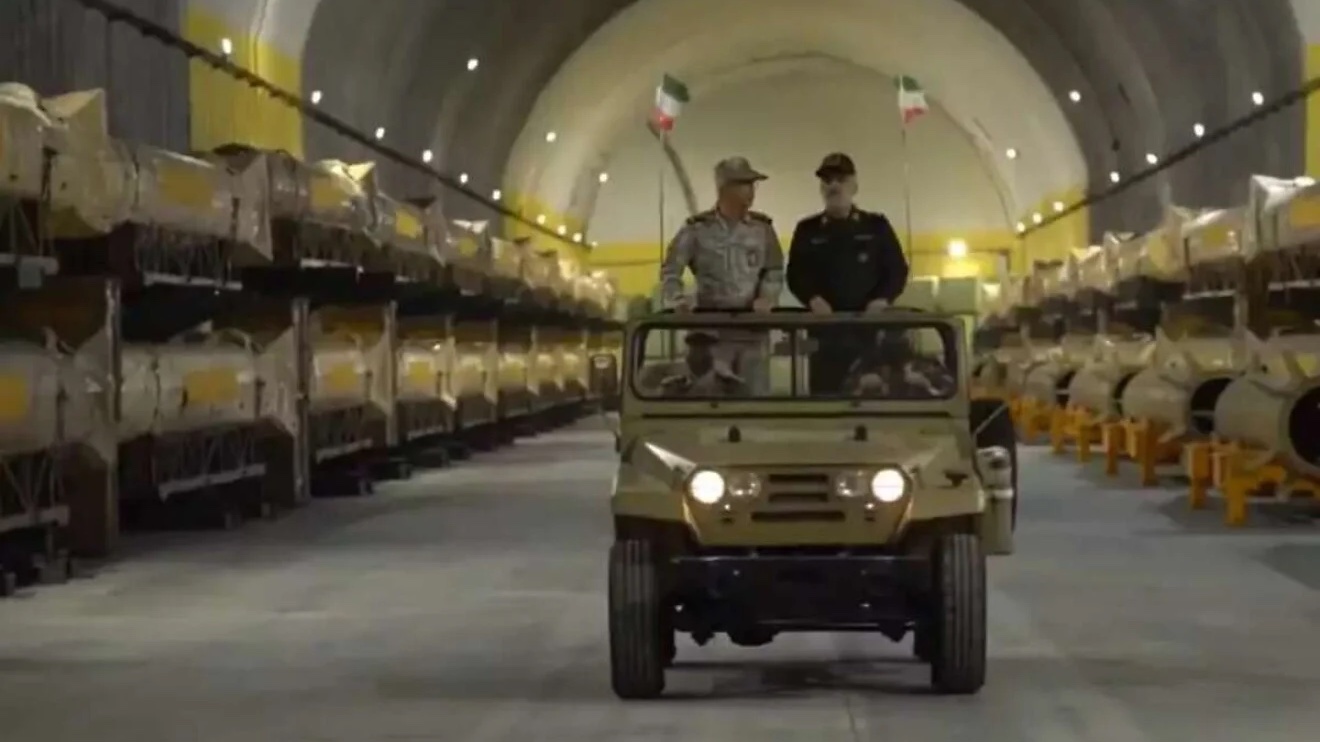
(Israel Hayom) The Islamic Republic spent decades building underground bunkers to protect its vast missile arsenal from destruction from the air. Less than a week into the war with its two most powerful adversaries, the strategy is beginning to look like a mistake.
US and Israeli fighter jets and armed drones are circling above dozens of massive bases, striking missile launchers as they emerge to fire, according to a comprehensive report in The Wall Street Journal. Meanwhile, waves of heavy bombers have dropped munitions on the sites, apparently burying Iranian weapons underground in several locations.
Satellite images taken in recent days show the burning remains of several Iranian missiles and launchers destroyed in US and Israeli airstrikes near the entrances to what Iranian officials call “missile cities,” the underground facilities.
Tehran has managed to fire more than 500 missiles toward Israel, US bases and other targets in the Persian Gulf region since the conflict began last Saturday, although many were intercepted, according to governments in the region. Since the early days of the conflict, however, there have been fewer large barrages, a sign that the US-Israeli strikes are damaging Tehran’s ability to respond.
“We are hunting down the last remaining ballistic missile launchers Iran has to eliminate what I characterize as their sustained ballistic missile capability,” CENTCOM chief Adm. Brad Cooper, the top US commander in the Middle East, said in a video briefing on Tuesday. “We are seeing Iran’s ability to strike us and our partners declining.”
Tehran appears to have moved some of its missile launchers and trucks out of the bunkers before the war began, hoping to protect them from attack by dispersing them. Cooper said the US and Israel had destroyed hundreds of missiles and drones. US Central Command said Wednesday that Iran’s missile launches had fallen by 86% in four days.
A significant portion of Tehran’s remaining stockpile of thousands of short- and medium-range missiles likely remains inside underground bases whose locations are largely known to the US and Israeli militaries, analysts said. That highlights a fundamental flaw in the missile city concept.
“What used to be mobile and difficult to find is no longer mobile, and is easier to strike,” said Sam Lair, a research fellow at the James Martin Center for Nonproliferation Studies, a research organization in Monterey, California.
After Iran’s air defense batteries were largely neutralized, the US and Israel began leaving slow surveillance aircraft flying above known missile bases in some locations, analysts said. Strikes, by manned fighter jets or armed drones, are carried out only when signs of activity are detected.
Originally published by Israel Hayom.