

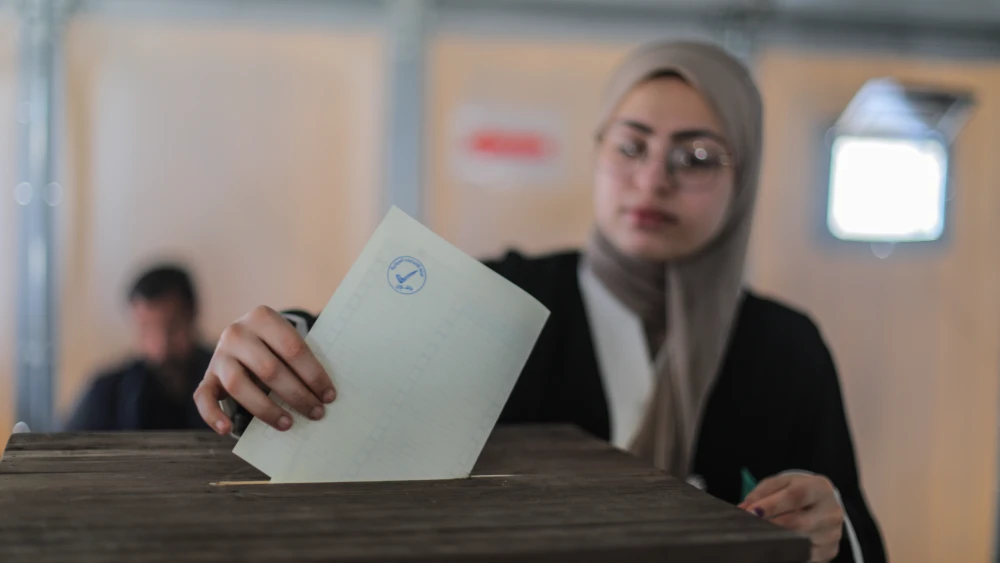
(JNS) Palestinian national elections are set for Nov. 28. Hamas will run, just not as Hamas; it will campaign, instead, as part of a broad coalition. If successful, some Mideast experts warn, Hamas will position itself within the Palestinian Authority, its Islamist terror cells peppered throughout Judea and Samaria.
Driving Hamas’s decision to run on a coalition slate is a precondition set by the Palestinian Liberation Organization (PLO), the group that dominates the PA, requiring all candidate lists to accept the PLO’s program. This includes its agreements with Israel.
The PLO hoped to create a barrier to prevent Hamas from running while not barring the group outright so as not to appear “undemocratic,” observers told JNS.
Hamas could never accept the State of Israel because doing so would cut to the core of its ideology. “Hamas’s political identity is rooted in radical-Islamist rejectionism and uncompromising hostility to the Oslo Accords,” Amine Ayoub, a fellow at the Middle East Forum, a US-based think tank, told JNS.
“Signing a pledge accepting the PLO platform, recognizing Israel, and renouncing violence would destroy its standing with its fundamentalist base and alienate its patrons in Tehran,” he said.
The precondition in the PA’s eyes appeared “insurmountable,” Ayoub explained recently in an Aug. 15 analysis for Ynet Global. Yet, Hamas found a way around the problem.
“Rather than running under an explicit Islamist banner, Hamas is orchestrating front slates under neutral titles like ‘National Unity’ or ‘Change,’” he said. By fielding proxy lists, a mixture of tribal figures, technocrats and local factions, Hamas sidesteps the PLO’s condition, avoids ideological compromise and preserves its “Islamist brand.”
It creates “a procedural buffer” that allows its candidates to bypass demands by the PA’s Central Elections Commission, Ayoub said.
It also creates enough ambiguity to deflect international sanctions. According to US President Donald Trump’s 20-point ‘Comprehensive Plan to End the Gaza Conflict,’ unveiled on Sept. 29, 2025, Hamas isn’t supposed to participate at all. Point 13 reads: “Hamas and other factions agree to not have any role in the governance of Gaza, directly, indirectly, or in any form.”
Hamas intends to undermine Trump’s post-conflict plans from within, filling the Palestinian Legislative Council with proxies. “Hamas achieves legislative veto power, financial access and legal immunity—paralyzing international efforts to establish clean, non-factional civilian administration,” Ayoub said.
Hamas is borrowing from its 2006 election playbook. Hamas won that election, the last held by the PA, under the electoral list, “Change and Reform.” In June 2007, it staged a coup, ejecting the PA from the Gaza Strip.
Mordechai Kedar, a senior research associate at the Begin-Sadat Center for Strategic Studies, agreed that a 2006 scenario is possible. “Hamas will do whatever it can to take part in political life to show the world, especially the Americans, that the Palestinian state is going to be a normal state. And then, once there is a Palestinian state, Hamas will take over and turn it into another Hamastan, as it did in Gaza.”
There’s a question whether Palestinian elections will take place at all. The PA under its chairman, Mahmoud Abbas, is deeply unpopular. In a hypothetical presidential campaign, Abbas wins only 14% of the vote, according to a recent survey by the Ramallah-based Palestinian Center for Policy and Survey Research (PCPSR). Seventy-nine percent of Palestinians want him to resign.
“The question is whether the PLO will allow Hamas to run for the presidency or parliament knowing Hamas might win,” Kedar said.
Kobi Michael, a senior researcher at Tel Aviv’s Institute for National Security Studies (INSS), told JNS that he does not believe the PA will hold elections “unless something happens in Gaza and Hamas is out.”
Michael conducted an analysis of local elections held on April 25 that took place in Judea and Samaria and in Deir al-Balah within the Gaza Strip. Fatah was quick to declare a “sweeping victory.” A closer look at the results throws doubt on Fatah’s claim.
Michael said that Fatah may have won “on paper,” but the reality is more complex. In many municipalities, clan-based lists came out on top. In cities such as Hebron and Tulkarm, local lists unaffiliated with the PA prevailed. In others, lists may have bore Fatah’s name, but the candidates themselves were not “publicly recognized as active Fatah members or genuine supporters of the movement.”
Most important, Hamas boycotted the elections, unwilling to agree to the precondition that it recognize the PLO’s sole legitimate authority.
The reason Hamas boycotted the local elections but insists on participating in the general elections is that the former demands “actual civic governance” without bestowing real political power, Ayoub explained. Legislative elections, however, offer a raft of benefits, including parliamentary immunity, a door to state budgets, and “a platform to undermine both the PLO and secular institutions from within.”
Ayoub doubts elections will take place. Hamas retains a 30%-to-35% ideological core of supporters. “In a deeply fragmented field where Fatah’s vote is splintered, that disciplined base is more than enough to capture a dominant legislative bloc,” he said.
PCPSR’s latest poll on Aug. 12 found Hamas tied with Fatah at 24% support apiece. Hamas’s support had cratered from 35% since its last survey 10 months ago. But if a Hamas proxy surge becomes apparent, Abbas will cancel or “indefinitely postpone” the election, Ayoub said. “Retaining Fatah’s authoritarian hold on the Palestinian Authority always takes precedence over genuine democratic accountability or institutional reform.”
Then it will be Abbas borrowing from a playbook. In 2021, Israel’s refusal to allow balloting to take place in eastern parts of Jerusalem provided a convenient pretext to cancel elections. “The moment Israel enforces security bans in east Jerusalem or targets proxy candidates, Ramallah will declare ‘electoral interference’ to halt the vote, weaponizing Israeli counterterrorism actions to mask Fatah’s political cowardice and avoid an electoral defeat,” Ayoub said.
That might be the better alternative. Predicting the result if elections took place, he said: “Expect a Trojan Horse scenario: Hamas proxies and opportunistic allies winning a major legislative bloc, paralyzing governance, preserving armed militia structures and cementing a dual crisis of Islamist radicalism and Fatah authoritarianism.”
Want more news from Israel?
Click Here to sign up for our FREE daily email updates







The only thing hatred does is destroy, and in the end, it even destroys itself.