
The father had already been identified and buried when Yehuda Avidan asked for the grave to be opened.
The man’s daughter, a girl with special needs, was still listed as missing. Avidan, director-general of Israel’s Religious Services Ministry, told Kikar HaShabbat this week that he refused to believe she had been separated from her father. He had raised a daughter with special needs himself. “The girl didn’t leave her father,” he recalled telling the team.
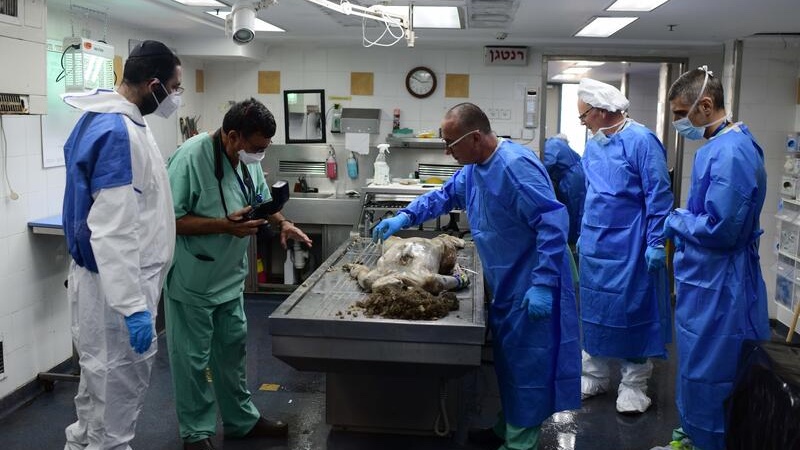
After police checks, the grave was opened and the remains were taken to the forensic institute. Father and daughter were found together.
Avidan told the story in interviews marking three years since the massacre. They describe a part of October 7 that rarely enters the national argument.
The work behind the funerals
Israel’s debate over October 7 has largely centered on who failed and what must change. Far less attention has gone to the work that began once the massacre ended: establishing, beyond doubt, who was dead.
On the morning of October 8, Avidan says, he ordered the major burial societies to begin digging 50 graves each. He estimated the country would need around 2,000. He told his staff there were no rules: do whatever is necessary, and he would answer for it later.
Identification took place at Camp Shura, the military rabbinate’s base near Ramla. Soldiers were relatively quick to identify because their DNA and fingerprints were already on file. Many civilians’ were not, including foreign workers and Israelis who never served.
Families could not simply identify their loved ones. Avidan said many bodies were burned or had been horrifically abused, so coffins could not be opened. Some families waited two, three and even four weeks for an answer.
Identification also served an intelligence purpose. By Avidan’s account, each day began with 400 to 500 people unaccounted for. Every body identified meant one fewer person who might be a hostage.
The panel no one knew about
The hardest cases had no body at all.
Under Jewish law, a married woman whose husband disappears cannot remarry until his death is established. Without that determination she is an agunah, a “chained” wife, bound to a marriage that may already have ended.
Avidan says the ministry formed a civilian panel to determine death in such cases, the first to parallel the army’s own process. It was headed by Rabbi Yitzhak Yosef, then Israel’s Sephardic Chief Rabbi, and supported by police, military and Health Ministry officials who supplied the evidence. According to Avidan’s account to Kol Chai radio, it determined the fate of 35 people whose remains were in Gaza. Nothing leaked.
“We were telling a family to sit shiva, to tear kriah, to release agunot,” Avidan said, describing the seven days of mourning and the rending of garments that follow a death. There could be no margin for error.
That is the weight of the work. In Jewish life, a declaration of death begins mourning, ends a marriage and allows a family to move forward.
Harder than it sounds
Avidan says the ministry left no stone unturned. The record shows how difficult that standard proved to meet.
In 2024, the remains of Elyakim Libman, a Nova festival guard who had been presumed a hostage, were found in the grave of fellow guard Victoria Gorlov. Israel’s Kan public broadcaster reported that a State Comptroller review, later frozen, found CT scans had been skipped for civilian victims to speed identification. As a result, some body bags held more than one person.
Avidan tells the father-and-daughter story as one of instinct. It also shows that the system’s first answer was incomplete.
In April 2025, Ynet reported that about 350 bags of unidentified remains were still sitting in two containers at Shura.
The IDF’s chief rabbi wanted every bag retested. Chief Rabbi David Yosef ruled there was a full obligation to retest. Avidan, backed by Dr. Chen Kugel, head of the national forensic institute, opposed retesting every bag. He preferred that remains that could not be identified be buried in a common grave. His side argued that repeated sampling destroys remains that should be buried, and that shared graves for unidentifiable fragments are standard practice.
The ministry said every bag had been handled professionally and that further tests were being prepared according to professional criteria.
Want more news from Israel?
Click Here to sign up for our FREE daily email updates