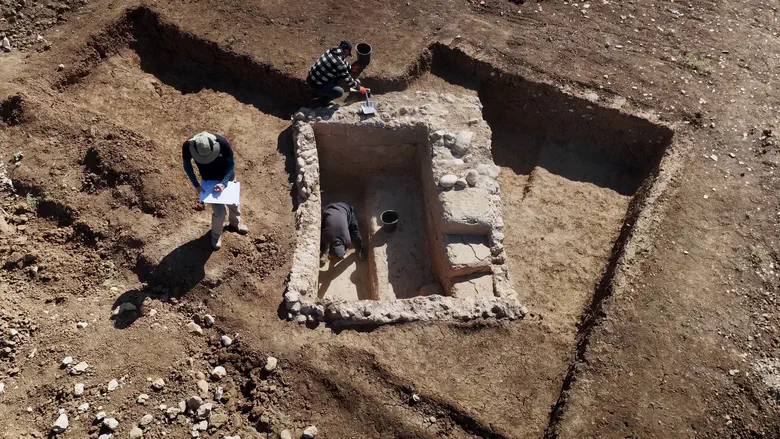

In an extraordinary rescue operation, the Israel Antiquities Authority has fully and intact recovered a 2,000-year-old ritual bath from the Second Temple period from the ground of the new Carmei Gat neighborhood in Kiryat Gat – a rare example of Jewish history that is to be reinstated directly at its original site.
A Colossus from the Second Temple Period
The mikveh – the Jewish ritual bath used for ritual purification – dates from the Second Temple period, that is, from the era before the destruction of Jerusalem by the Romans in 70 CE. It weighs around 25 tons and was discovered during salvage excavations carried out by the Israel Antiquities Authority (IAA) in the course of developing the new residential neighborhood of Carmei Gat in Kiryat Gat. The costs of the salvage excavations – totaling around 28 million shekels – were borne by the Israel Land Authority.
The discovery of the ancient mikveh provides clear evidence of the existence of a Jewish settlement in this area some 2,000 years ago. During the excavation of the settlement, stone measuring cups were also uncovered – according to Jewish law, stone vessels cannot contract ritual impurity, which is why they were widely used in the Jewish community of the Second Temple period.
A Technical Masterpiece of Heritage Conservation
The real challenge lay not in the discovery, but in the transportation: how do you bring a 25-ton ancient ritual bath out of the ground intact without damaging it? The conservation department of the Israel Antiquities Authority developed a complex engineering procedure for this purpose. The mikveh was first fully excavated, then secured in a specially constructed steel frame, and finally lifted out of the ground as a whole.
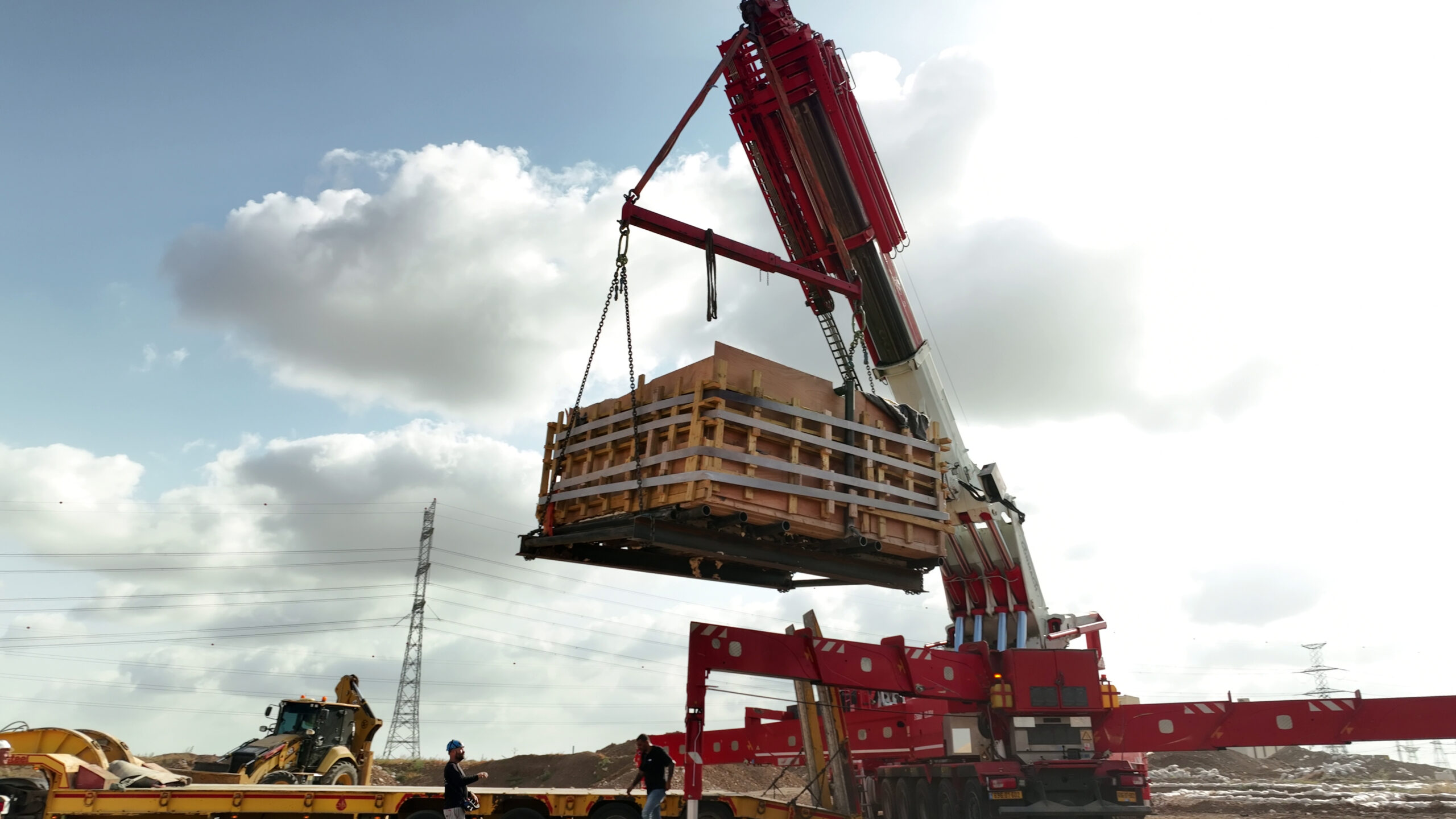
Even after the mikveh had been lifted from the ground, the challenge was far from over. Due to the distance between the crane’s base and the mikveh, a massive crane with a lifting capacity of 300 tons was required to raise the 25-ton structure. The unusual width of the mikveh – approximately 4 meters – also necessitated the use of a heavy transport vehicle.
The transportation of the mikveh to the warehouse in Beit Guvrin became an operation in itself. To transport this oversized load, the road was closed to traffic, and escort vehicles drove in front of and behind the truck.
“Once you have lifted such a structure, there is no going back,” says Eyal Kaho, chief conservator at the Israel Antiquities Authority, who led the operation. “If it falls apart – we have lost the mikveh. That is why every detail must be thought through in advance. The night before such an operation, you don’t sleep. You are under pressure, because the responsibility rests with you, and mistakes are simply priceless. Even after 36 years at the Israel Antiquities Authority, the adrenaline rises every single time.”
The object is now being stored in the national treasury of the Israel Antiquities Authority – until construction work in the new Carmei Gat neighborhood is complete. Afterward, the mikveh is to be returned to its original location and integrated into a public open space at the heart of the new neighborhood. A solution that combines urban development with historical heritage – and one that is as unique in Israel as the find itself.
The excavation directors Elena Kogan-Zahavi, Maayan Margulis and Shira Lifshitz emphasized the historical significance: the discovery shows that 2,000 years ago, a Jewish community lived in the Kiryat Gat region – ancient Philistine Gath – that oriented its religious life according to the purity laws of the Torah. A mikveh is for archaeologists an unmistakable hallmark of Jewish settlement – for no other people of antiquity built such structures.