
Iran marked the third anniversary of October 7 by promising, once again, to finish what Hamas started.
The IRGC called the operation “the beginning of the end of Zionism” and vowed to keep fighting until Israel is destroyed. State broadcaster Radio Tehran went further, describing the massacre as “the first phase of the total elimination of Israel”.
The armed forces chief of staff, Maj. Gen. Ali Abdollahi, said October 7 “accelerated the decline of the usurping, child-killing, and oppressive Zionist regime.”
It’s a familiar forecast. Abdollahi is the third man to hold his job since October 7.
His two predecessors said the same thing. Mohammad Bagheri, chief of staff when Hamas attacked, declared the next day that the operation had turned Israel’s feared collapse into a certainty. Abdolrahim Mousavi, then commander of Iran’s regular army, said within days that Israel had suffered an irreparable defeat that hastened its collapse.
Bagheri died in Israel’s 12-day war in June 2025. Mousavi, who replaced him, was killed on the first day of this year’s US-Israeli war against Iran, the same day a strike killed Supreme Leader Ali Khamenei.
This week’s IRGC statement quoted the late Khamenei calling October 7 a “future-making event.”
The prediction has outlived the men making it.
Where Tehran has a point
Iran’s boast isn’t pure fantasy. Israel’s international standing has taken a real beating over three years. In Western capitals, on campuses and in international forums, Israel is more isolated than it was before the war.
But isolation is not collapse. And on the home front, the picture looks quite different, in Tehran.
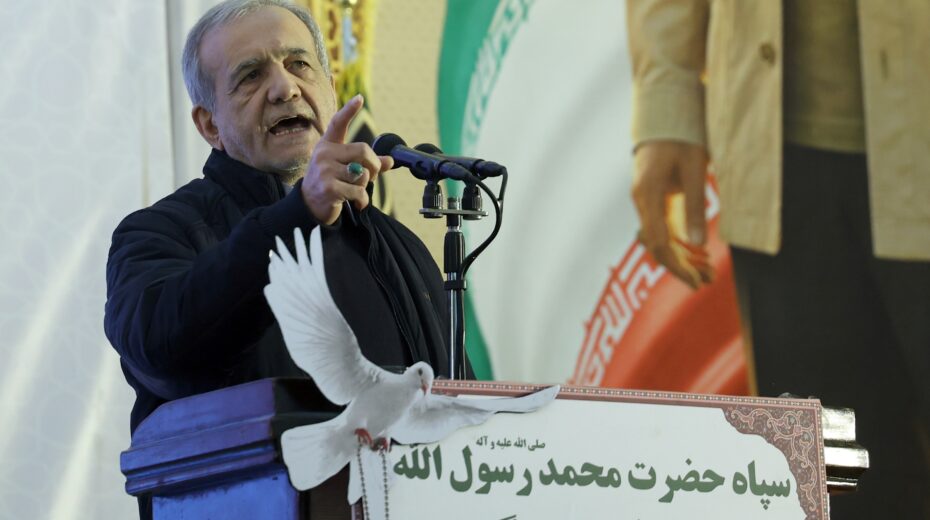
On Wednesday, as the generals celebrated, President Masoud Pezeshkian told his cabinet that unused buildings and cultural and sports facilities may be temporarily closed if necessary to keep production going, and that the government will cut its use of electricity, gas, gasoline and water.
Last month he ordered state agencies to prepare remote work for employees to save fuel, two weeks after the government doubled the top-tier gasoline price. In April, he went on state TV with a request: “Instead of 10 lights at home, only two should be switched on.”
Pezeshkian himself now says Iran is engaged in a full-scale war.
Meanwhile, Reuters reported that Iran sent Hezbollah $200 million last month.
So Iranians are asked to switch off eight bulbs out of ten, and the regime still finds $200 million for Lebanon.
Marco Rubio on Iran:
Every dollar and every penny that that regime gets, they don’t spend it on roads or bridges or helping improve the lives of the Iranian people.
They spend that money on Hezbollah and Hamas and militias that fire rockets out of Iraq and the Houthis.
They should have spent their money on their people, and instead they spend their money on terrorism and on weapons.
— Clash Report (@clashreport) October 7, 2026
Whose decline?
If October 7 accelerated someone’s decline, it’s fair to ask whose.
One country is rationing energy to keep its factories open and filling its general staff by decree. The other holds a national election on October 27.
Even Hamas’s man in Tehran sounded less sure than the generals. Khaled al-Qaddoumi insisted October 7 was a strategic victory, but blamed the losses suffered by Iran’s alliance on regional countries that failed to join the fight and on insufficient support.
A strategic victory rarely needs an alibi.
Khaled Qaddoumi, the Hamas representative in Tehran, called the Al-Aqsa Storm Operation a necessary step that redrew the region’s equations, delivered a strategic victory for the Palestinian people, and demolished the notion that Israel cannot be defeated. https://t.co/NOMxpjBPpz
— IRNA News Agency ☫ (@IrnaEnglish) October 7, 2026
Not only in Tehran
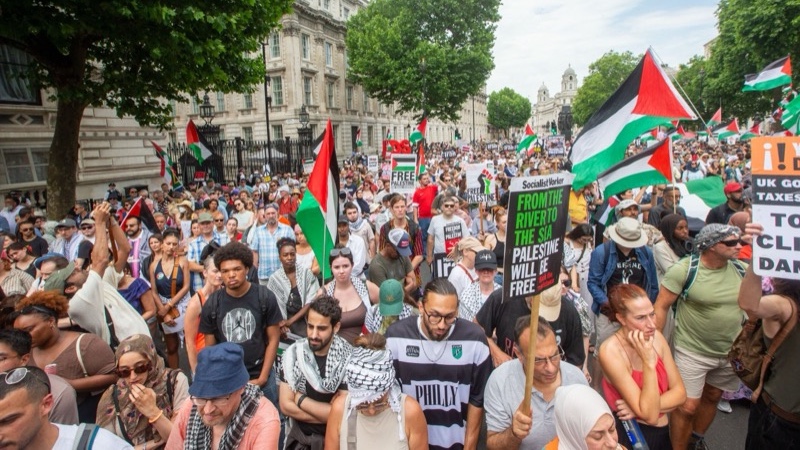
Iran wasn’t celebrating alone. Hamas issued a statement calling the battle an honorable historic milestone. The spokesman for Hamas’s military wing told Gazans the price had been high, but their deeds were spectacular. Hezbollah said the wave unleashed three years ago still threatens to drown the tyrants. An Iran-aligned Iraqi militia praised the “Axis of Resistance” and rejected efforts to disarm it.
Those are Iran’s proxies. Their cheering proves little about the wider Arab world. And not every Arab outlet cheered: Saudi-owned Al Arabiya covered the moment of silence at Kfar Aza and tied the anniversary to Israel’s election.
The polling is harder to dismiss. In a survey of 8,000 people in 16 Arab countries, 67% called October 7 a legitimate resistance operation; just 5% called it illegitimate. 89% rejected recognition of Israel. That poll was taken in the war’s early months by a Doha-based institute, but sentiment has changed little since. As recently as last fall, 53% of Palestinians still told pollsters Hamas was right to attack.
Qaddoumi’s complaint and those numbers belong side by side. Arab governments stayed out of the war. Much of the Arab public applauded from the stands.
Anyone still describing the region as a quiet moderate majority waiting for peace needs to explain both facts, not just the convenient one.
Meanwhile, Tehran’s generals are still promising to wipe Israel off the map.
Want more news from Israel?
Click Here to sign up for our FREE daily email updates