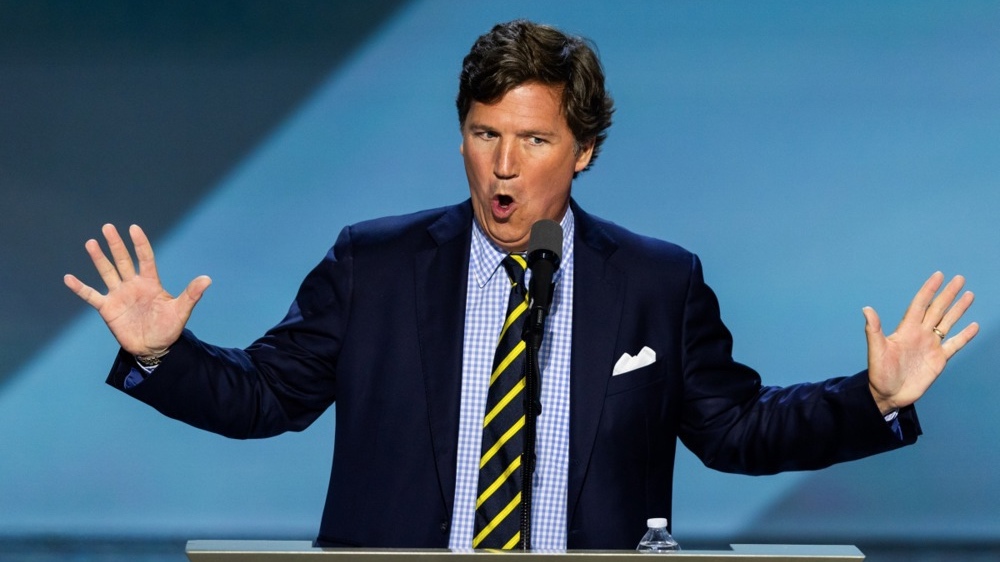
(JNS) During an interview with Israel’s Channel 12 that aired on Monday, released hostage Alon Ohel, 24, said he is alive today because he made a conscious decision to survive.
“My story started when I chose life. I had the choice at any given moment to give in, and I chose not to,” he told Channel 12 reporter Almog Boker.
Though bound, starved and sexually abused, Ohel held strong. His desire to return to his family kept him going. “I knew I’m getting back to my mother,” Ohel said. “Whatever happens, I’m coming home.”
Ohel said it was impossible to explain, but there was an almost mystical connection between him and his mother. He would speak to her at nights, and his mother would repeat his very same words at demonstrations. “I felt him all the time. I felt his presence,” his mother told Channel 12.
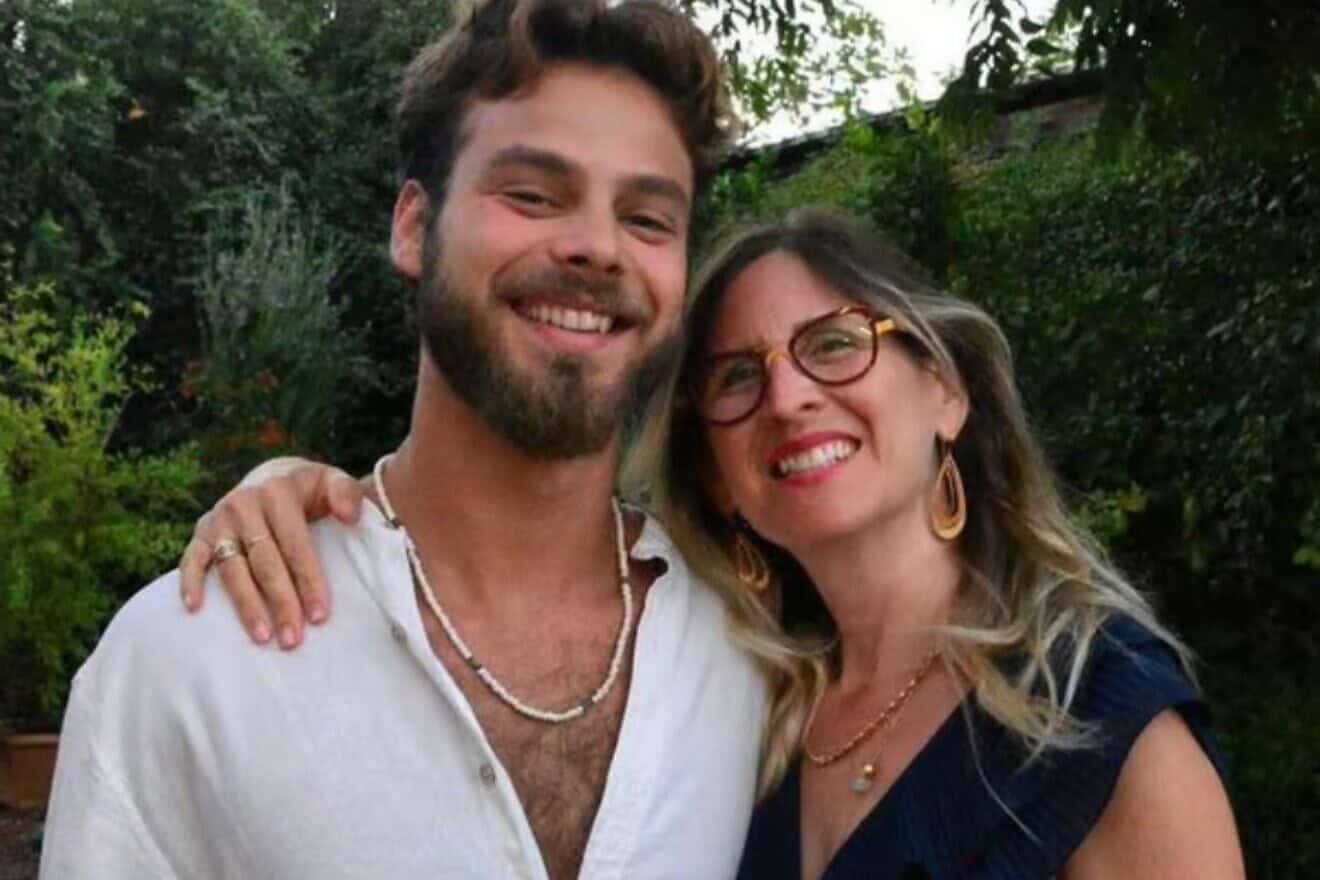
Alon Ohel with his mother, Idit Ohel. Credit: Courtesy.
Ohel was captured at the infamous “Death Shelter” at Re’im junction on Route 232 where 27 young men and women, who had fled the Nova Music Festival, hid when the Oct. 7 attack started. Ohel wanted to keep going, but the others wanted to stay in place until the Hamas aerial bombardment subsided. Instead, they started to hear the approaching sound of machine guns.
When the Hamas terrorists reached the shelter, they threw in grenades. He recounted how one young man, Aner Shapira, 22, heroically threw back grenade after grenade until he was finally killed. Then Hersh Goldberg-Polin took Shapira’s place, but he delayed in throwing back a grenade. Ohel shouted, “Throw the grenade.” Goldberg-Polin managed only to throw it a few centimeters before it exploded, taking off part of his arm.
Ohel, who has trouble seeing in one eye due to shrapnel, said it was from that blast that his eye was injured. His vision in the damaged eye has improved since undergoing surgery in Israel.
The terrorists entered the shelter and Ohel, along with others who hadn’t been killed, was thrown into a truck “like a sack of potatoes.” He was taken to Gaza, crossing the fence within seconds, wondering why the Israeli army hadn’t arrived. He was taken to a hospital. On the way in, he passed through masses of Gazans who beat him.
“What they call the ‘innocent,’” Channel 12’s Boker said.
“Innocent? Nobody there is innocent,” Ohel replied.
At the hospital, the staff stitched up his eye in a superficial way, leaving the shrapnel in place. He was given a pill, which knocked him out for 24 hours. When he woke, he was with other hostages. They were forbidden to speak. For two weeks, no one spoke.
After 52 days, Alon was moved underground. There he met fellow hostages Eli Sharabi, Almog Sarusi, Ori Danino and Goldberg-Polin. The latter three would later be murdered by Hamas.
Sharabi helped Ohel. “Eli and I, we connected instantly. He hugged me like a dad. Longing kills you there. That hug kept me alive,” Ohel said. “Eli would say to me that it’s OK to be broken. It’s good to break down, to cry. But don’t ever lose hope.”
Sharabi was like a father to him, he said.
Sharabi, 53, said in a separate interview to Channel 12, “He touched my heart. From my point of view, I adopted him from the first moment.” Sharabi said he encouraged Ohel “to give him the ability to survive.”
Sometimes he would hug Ohel. Sometimes he would employ tough love, saying, “Grow up. Stop crying.”
אלון אהל בחר בחיים. עכשיו הוא חוזר לראות, חוזר לנגן ובריאיון ראשון לאלמוג בוקר מספר בפעם הראשונה את הסיפור שלו | הערב ב-20:00 בקשת 12@bokeralmog pic.twitter.com/inJefTyiHA
— החדשות – N12 (@N12News) December 1, 2025
“He would tell me about his daughters,” Alon said, breaking down during the interview at the thought that Sharabi’s entire family had been killed. Sharabi only learned this after his release.
Ohel was also bolstered by a glimpse of the outside world. His captors opened a laptop at one point, showing a photo of a stranger from a demonstration holding a sign with Ohel’s picture on it. “I said to myself: if people I don’t know stand in the streets for me, I can’t give up.”
Ohel said he was chained by his legs for a year and a half, “like a monkey.” Part of the time, he and Sharabi were chained together. Daily rations were a pita and a few spoonfuls of peas. “There was a period when we’d only eat dry dates, that’s it.”
“You know that they [the terrorists] have food. It’s just their decision,” Ohel said.
“At the start, you said, ‘Fine, you get used to hunger.’ [But] you don’t get used to hunger. There’s pain over the whole body, all the time. You look like a skeleton,” he said. “You see only bone. And they’re happy. They’re smiling. It makes them feel good.”
The Channel 12 interviewer said that even after speaking to many hostages, it’s still difficult to understand what it was like to be there.
Ohel said, “It’s impossible to explain it. I can’t describe it in words. Only someone who was there can understand. In your lives, you haven’t experienced starvation; what it means when they take away your freedom of movement.”
“You’re not a person there. You’re an animal,” he said. “Even in a jail, in a prison, there’s a system. I wasn’t in a prison. I was in captivity with crazy people. If you’re not strong mentally, you can freak out.”
Ohel is a musician. He had been set on entering music school when the Oct. 7 attack derailed his plans. Ohel would move his fingers as if he was playing piano during his captivity. Sharabi said, “I remember the terrorists looking at us and they asked, ‘What’s he doing?” He’s always moving his fingers on his body.”
To stay sane, Alon sang quietly. “I told them I play piano. They didn’t know what a piano was. They’re not allowed to listen to music or dance.”
Then in February, Eli Sharabi and Ohel were separated. Sharabi was freed in a ceasefire deal. Before they parted, Sharabi told him not to worry, that his own freedom would come soon, “in a matter of days.” It would be another eight months.
“All my fears were realized. I remained alone in that hell,” Ohel said.
In one respect, his situation improved. The skeletal-like appearance of Sharabi and two other hostages released with him caused worldwide outrage. US President Donald Trump said they “looked like Holocaust survivors.”
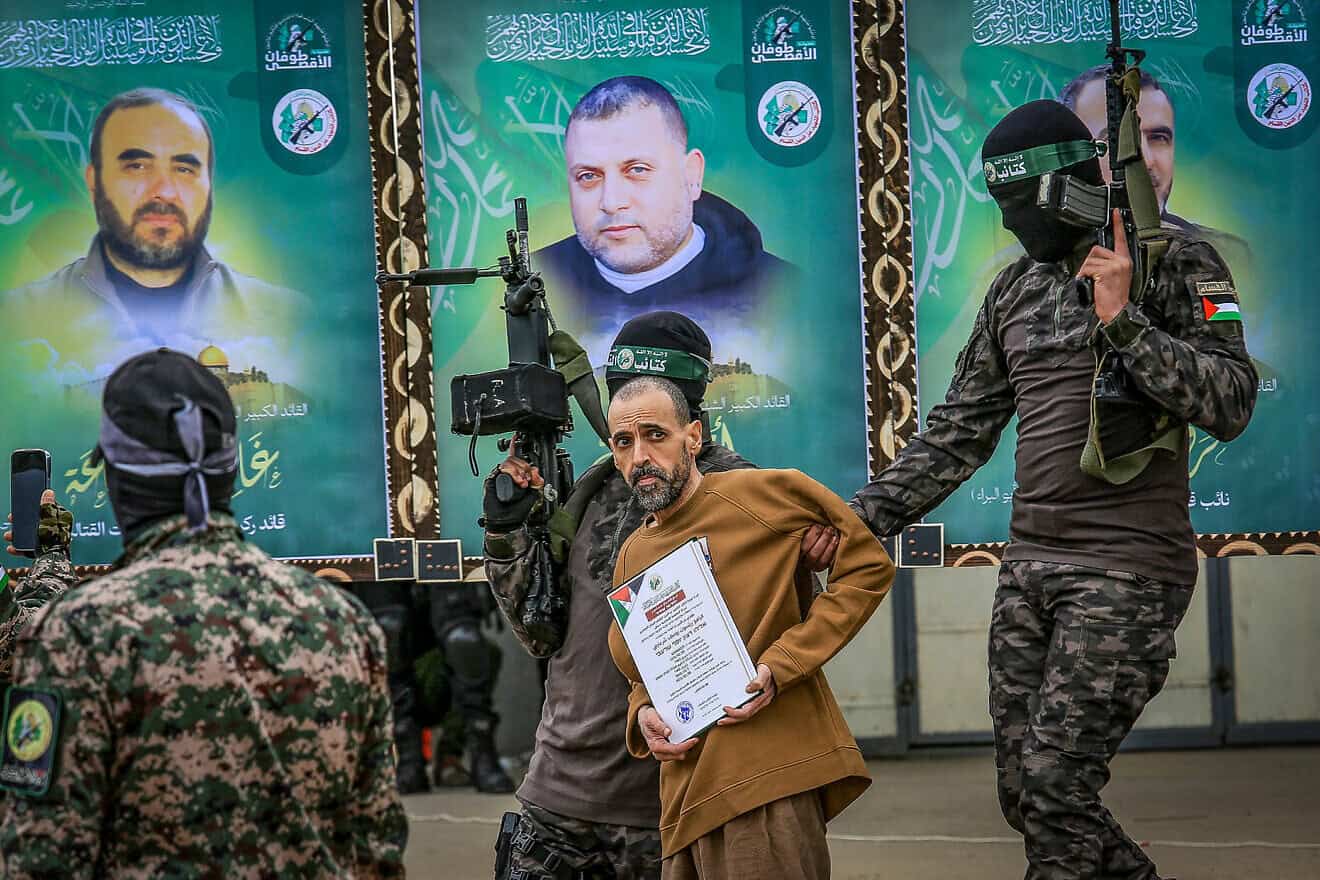
Hamas’s Al-Qassam Brigades parade Israeli captive Eli Sharabi in Deir al-Balah, the Gaza Strip, before handing him over to the International Red Cross, Feb 8, 2025. Photo by Abed Rahim Khatib/Flash90.
Ohel said the terrorists suddenly took an interest in seeing that he ate. He asked for a book and they brought him one from the Harry Potter series. He read it many times over, just not the final chapter. “I read the last chapter, about Dumbledore’s death, once, and that was it. I said, ‘I can’t. This is not the end of me.’”
Ohel also endured sexual molestation. “In the shower, one terrorist came in. He put shampoo on my body, touched me. I tried to pull away. I told him, ‘I can do it myself.’ He said it was ‘important’ so I wouldn’t get a rash. Luckily for me, it didn’t continue.”
At one point, he met another Israeli hostage, Guy Gilboa-Dalal. They were both shocked to see each other as they had been comrades in an Israel Navy course.
Ohel was released as part of the US-brokered Gaza peace plan on Oct. 13, 2025, more than two years, exactly 738 days, from when he was abducted on Oct. 7, 2023, the date of the Hamas invasion. He was one of 20 remaining living hostages to be released. Gilboa-Dalal would also be freed as part of the Oct. 13 deal.
It was the new Hamas commander in Gaza, Izz al-Din al-Haddad, who came to tell him he was to be freed. Al-Haddad asked if he knew who he was and Ohel hadn’t the slightest idea, leaving al-Haddad disappointed.
Ohel was escorted out by a Red Cross worker, who was abashed and apologized to him. (The Red Cross came under sharp criticism from Israelis for failing to help the hostages.) “A disgraceful organization,” Alon said. “No different from the UN.”
When he saw Israeli reservists, he felt a wave of emotion. He saw they were adults, parents of children who had endangered their lives to help set him free. “For two years, I was a dead man. I prayed for this light, that someone would save me.”
“What did you discover about yourself?” Channel 12’s Boker asked.
“That I’m strong. That I am capable of anything,” Ohel responded.
Want more news from Israel?
Click Here to sign up for our FREE daily email updates