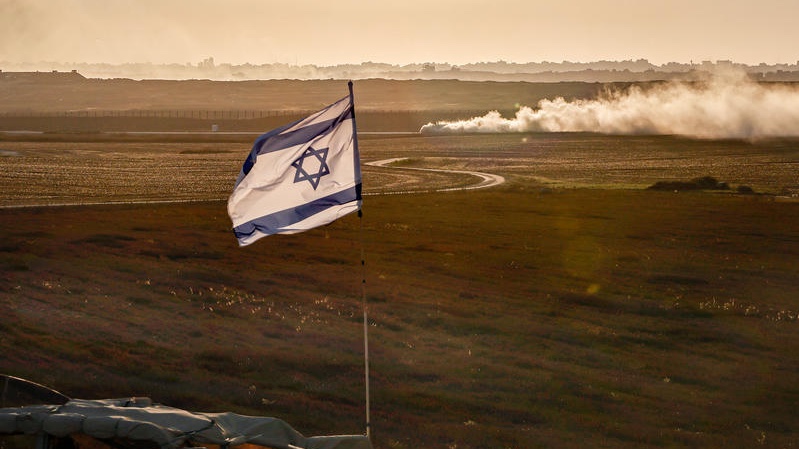

A small group of Israeli civilians crossed into the northern Gaza Strip on Wednesday evening, calling on the government to establish a permanent Israeli presence there—a move that, while brief and swiftly reversed by the Israel Defense Forces, signals a deepening shift in Israeli public sentiment about Gaza in the aftermath of the Oct. 7 Hamas massacre.
According to Channel 12 News, between seven and nine civilians entered the area controlled by the IDF’s so‑called “Yellow Line,” filmed themselves on location, and urged the government to authorize permanent Jewish settlement in the territory, which they described as “the best answer to terror.” The IDF returned the group to Israeli territory soon after and reminded the public that anyone entering a combat zone endangers themselves and interferes with security operations.
“We came to plant trees and say that the entire Land of Israel belongs to us,” one of the activists filmed himself saying while in northern Gaza.
עשרות ישראלים נכנסו הערב בחסות החשיכה לרצועת עזה – במטרה ליישב מחדש את יישובי גוש קטיף.
צה”ל הצליח להוציא את מרביתם והודיע כי השיב אותם ארצה, אך לטענת המארגנים: יש קבוצה שעדיין מצליחה להישאר בשטח ולא מצליחים לפנות אותה. pic.twitter.com/KxHNBYqni2
— ינון שלום יתח (@inon_yttach) December 10, 2025
Beyond the immediate legal and security issues, the incident highlights a broader and growing mindset among many Israelis—especially those who have lived on frontlines near Gaza and have endured decades of rocket fire, terror tunnels, and war—that retreat and disengagement have failed, and that a strategic presence rooted in settlement is now viewed as the only viable path to lasting security.
From Disengagement to resettlement: A southern voice
Yariv Hag’bi, a farmer from the Gaza envelope whose brother was killed on Oct. 7, has become one of the most resonant voices articulating this shift. Like many residents of the kibbutzim bordering Gaza, Hag’bi once believed in coexistence with a neighboring Palestinian state and supported the removal of Jews from Gaza. Now, he argues that withdrawal brought vulnerability, not peace, and that uprooting the Jewish civilian presence from Gaza in 2005 was a strategic error whose consequences are still unfolding.
“Those looking from the outside think this war is over,” Hag’bi recently told an Israeli outlet, “but those who live here understand it is still far from over.” He insists that Israel’s security cannot be anchored in temporary military deployments alone, but requires a civil‑societal presence—ordinary families, farmers, schools, communities—that embodies deterrence, permanence, and rootedness.
For Hag’bi and others in the south, the idea of resettling former Jewish towns in Gaza is not emotional nostalgia, but strategic logic: where people live, work, and defend, there Israel’s presence is permanent—and its enemies know they cannot reclaim the land by force.
This sentiment is no longer confined to fringe voices. In southern communities, many residents who once supported two‑state frameworks have recalibrated their views following the trauma of Oct. 7 and the long shadow of persistent threats. The result? A grassroots imperative for settlement, sovereignty, and presence over withdrawal or demilitarized solutions.
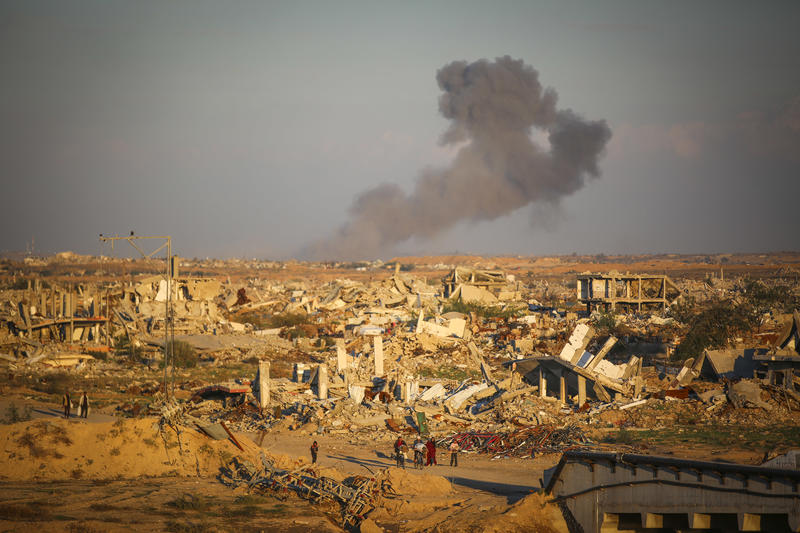
Gaza remains an active war zone, and civilian incursions disrupt critical military operations. But a realistic discussion needs to be had about what happens to Gaza after the war. Photo by Ali Hassan/Flash90
Civilian action and national debate
This week’s small civilian incursion into northern Gaza—planting symbolic roots and calling for presence—echoes this national reckoning. While the IDF immediately acted to prevent uncoordinated civilian entry into an active combat zone, the message from the ground is clear: there is a growing constituency in Israel that sees presence as prevention and roots as defense.
Official policy debates around Gaza’s future—whether humanitarian corridors, demilitarized zones, or transitional governance—are now intersecting with a popular demand for sovereignty and settlement. For many Israelis, the question is no longer whether Gaza needs peace; the question is what kind of peace can be sustained without presence, without people, without community?
Strategic implications
This emerging narrative has deep implications:
- Re‑settlement as security architecture: Embedding civilians alongside the army creates layered deterrence—not just a military buffer, but a society anchored in the land.
- Civil‑military integration: True defense requires that civilian life and military readiness be intertwined, not segregated.
- Public legitimacy: When the very citizens who have borne the brunt of violence call for sovereignty and presence, policymakers must reckon with that shift.
- Reevaluation of past strategy: The disengagement of 2005—once widely accepted—now stands as a cautionary tale that absence invites aggression.
Conclusion: Toward a new strategic realism
The symbolic civilian incursion into northern Gaza may have lasted minutes—but the story it tells lasts years. At its core is a profound transformation in Israeli public sentiment since Oct. 7: a movement away from the old paradigm of withdrawal toward a new one of presence, sovereignty, and rooted security.
In the words of those from the frontlines, the land is not merely territory to be managed—but a reality to be inhabited, defended, and woven into the nation’s future.
Presence brings security; absence invites threat. And in the post‑Oct. 7 era, Israel’s soul and strategy are increasingly converging on that truth.
Want more news from Israel?
Click Here to sign up for our FREE daily email updates