

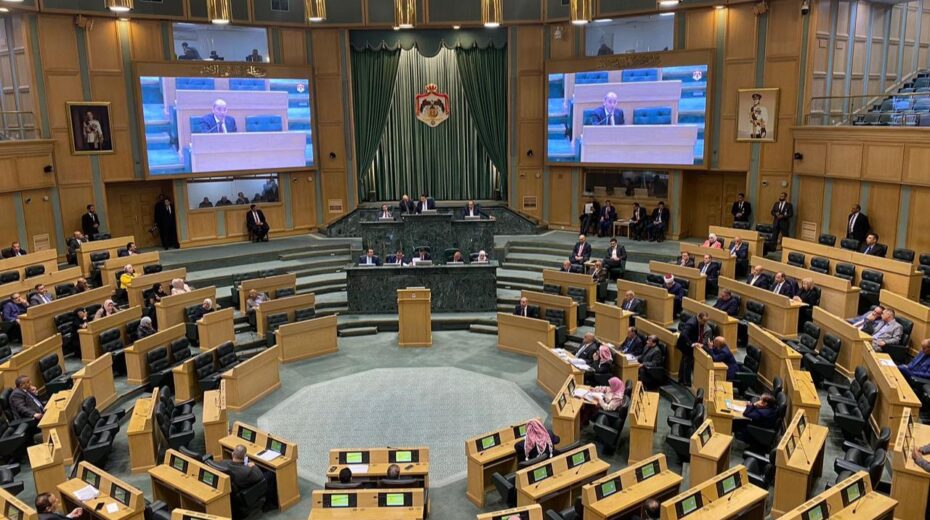

Sometimes it is not military threats or diplomatic crises that reveal the true state of relations between states. Sometimes a seemingly formal, almost incidental parliamentary decision is enough.
The Jordanian parliament has decided to remove the name “Israel” from its official records. A state with which Jordan has maintained a peace treaty since 1994 will no longer be explicitly named in parliamentary documents. Some members of parliament even went further, proposing to refer to Israel with terms that fundamentally question its state legitimacy.
One might dismiss this step as mere symbolic politics. Yet in the Middle East, symbols are rarely without meaning.
Because in the Middle East, peace is not created by signatures alone, but only where the other is also accepted as a legitimate partner.
A stable treaty, yet distance remains
The Israeli-Jordanian peace treaty remains one of Israel’s most strategically important agreements to this day. For more than three decades, the shared border has remained calm. Security issues are coordinated, water resources are shared, interests are aligned—often discreetly and far from public attention.
Anyone familiar with the region knows how extraordinary that is.
And yet this peace has always remained a sober, frequently described “cold peace.” While governments cooperated, societal acceptance in Jordan remained limited. Israel was an official partner, but rarely an accepted neighbor.
The current decision makes visible what has long existed beneath the surface.
Between strategic reality and public pressure
Jordan has been under considerable domestic political pressure for years. A large part of the population strongly identifies with the Palestinian cause. Developments in Gaza or Judea and Samaria have an immediate impact on the political mood in the kingdom.
The leadership in Amman therefore tries to maintain two realities simultaneously: strategic cooperation with Israel on one side, and demonstrative political distance toward its own public on the other.
The parliamentary decision fits precisely into this pattern.
Behind the scenes, Israel remains a partner. Publicly, distance is demonstrated.
Trigger or pretext?
There was, however, a specific trigger.
The debate was sparked by statements from the US Ambassador to Israel, Mike Huckabee, who referred to areas in Judea and Samaria as part of Israel. Several Arab states reacted with sharp criticism; Washington later clarified that this did not represent a change in official US policy.
Yet the step from Amman can hardly be explained by that alone.
Since the Hamas massacre of October 7, 2023, and the subsequent war, the political room for open relations with Israel has narrowed in many Arab societies. Even states with clear shared security interests must act more cautiously domestically.
Normalization remains fragile.
The real significance of this step
Israel responded accordingly sharply, stating that the decision contradicts the spirit of the peace treaty. This assessment is understandable. The Israeli Foreign Ministry declared on X that the step contradicts the spirit of the peace treaty that has existed for over three decades and must be condemned by all who seek a region of tolerance and understanding.
Because peace treaties are not based solely on strategic interests. They also rest on mutual legitimacy.
When a parliament begins to remove the name of its treaty partner from official documents, it sends a message—both inward and outward.
The peace continues. Cooperation continues as well.
Yet the step once again reveals a reality that repeatedly becomes visible in the Middle East: treaties can create stability. Trust, however, develops more slowly and can disappear just as quietly.
Sometimes all it takes is a name crossed out in a protocol.




It seems that rather than being members of what is called “The Board of Peace,” most members of the irrational organization are simply BORED of Peace and want war, with Israel being the bull’s eye.