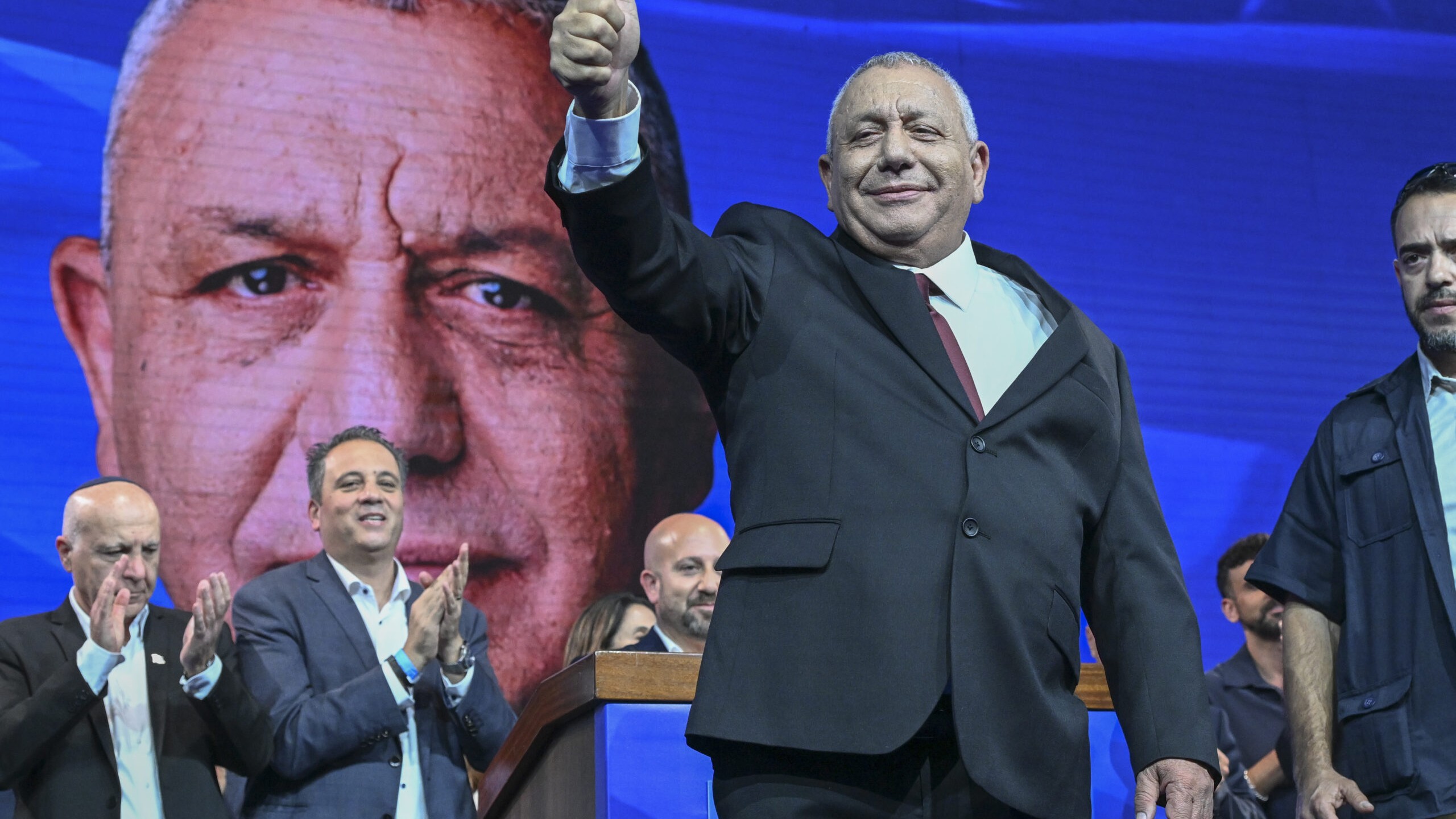

Israel’s political future remains uncertain for the time being. On Saturday evening, President Isaac Herzog announced that Gadi Eisenkot, chairman of the Yashar party, is to receive the mandate to form a government. The official handover of the mandate will take place on Sunday at 5 p.m. at the President’s residence in Jerusalem.
Eisenkot will then have 28 days to form a coalition. If necessary, Herzog can extend the deadline by up to 14 days. Should Eisenkot fail, Prime Minister Benjamin Netanyahu could subsequently be tasked once again with forming a government.
During the president’s consultations, representatives of parties with a combined total of 67 members of parliament declared their support for Eisenkot. Netanyahu received recommendations from parties with a combined 46 seats. A majority in the 120-member parliament requires at least 61 votes. However, the recommendations do not automatically mean that all the parties in question will join an Eisenkot-led government.
Netanyahu campaigns for a national unity government
Even before the official handover of the mandate, Benjamin Netanyahu called in a video message for the formation of a national unity government. This should include all parties of the national camp and the Zionist parties. However, he made clear that his current coalition partners would also have to be included. These include the ultra-Orthodox parties Shas and United Torah Judaism, as well as the right-wing nationalist parties Religious Zionism and Otzma Yehudit.
This is barely acceptable to Eisenkot’s camp. The new government-forming designate has repeatedly stated that he will not work with Netanyahu. He also demands that all politicians who held key leadership positions on October 7, 2023, take political responsibility and withdraw from public life.
Eisenkot’s party stated that Likud could also participate in a new government — but without Netanyahu and without the current extremist coalition partners. The prerequisite would be Eisenkot’s four core political principles: the recognition of Israel as a Jewish and democratic state, commitment to the values of the Declaration of Independence, the dismantling of Hamas’s military and political power, and mandatory military or civilian service for all citizens.
Ultra-Orthodox parties could become the decisive factor
One possible alternative to cooperation with the Arab parties is a coalition with the ultra-Orthodox parties. A surprising rapprochement appears to be emerging here.
The chairman of Yisrael Beiteinu, Avigdor Liberman, stated that he is willing to make compromises on the issue of military service in order to enable a government without Netanyahu and without Arab parties. In doing so, he opened the door for the first time in years to cooperation with the ultra-Orthodox parties.
United Torah Judaism also signaled a willingness to engage in talks. Sources close to the rabbis who decide on the political direction of the Shas party also indicated that Shas would not oppose such a move if the spiritual leaders of United Torah Judaism agree to cooperate.
The two parties together hold 13 seats. Combined with the 48 members of parliament from the opposition camp, a majority of 61 seats could thereby be achieved. However, such a coalition would depend on numerous compromises.
The biggest point of contention is military service. Eisenkot and his partners had called during the election campaign for an end to the far-reaching exemptions for ultra-Orthodox men. State support payments for families of conscientious objectors are also under discussion.
The chairman of the Democrats, Yair Golan, also showed openness to talks with the ultra-Orthodox parties. However, he demanded that they make concessions on issues of military service, integration into the labor market, and public life.
Cooperation with Arab parties remains controversial
Another possibility would be cooperation with the Arab parties Ra’am and the Joint List. Both could help Eisenkot form a government or at least secure a majority in parliament.
However, key representatives of his political camp reject a government that depends on the votes of Arab parties. Eisenkot himself must therefore strike a difficult balance between the differing positions of his partners.
Netanyahu, meanwhile, once again warned against a government supported by Arab parties. He described them as supporters of terrorism and stated that such a government would not be able to effectively defend Israel against Hamas.
Intense coalition negotiations lie ahead in the coming weeks. Eisenkot must not only rally enough members of parliament behind him, but also establish a common foundation for the future government. Should he fail to achieve this within the allotted timeframe, Herzog can reassign the task to Netanyahu.