
A new in‑depth study (Hebrew) by Israel’s Meir Amit Intelligence and Terrorism Information Center has concluded that a significant majority of individuals identified as journalists and media workers killed during the Gaza war were not neutral news gatherers, but were affiliated with terrorist organizations, including Hamas and Palestinian Islamic Jihad.
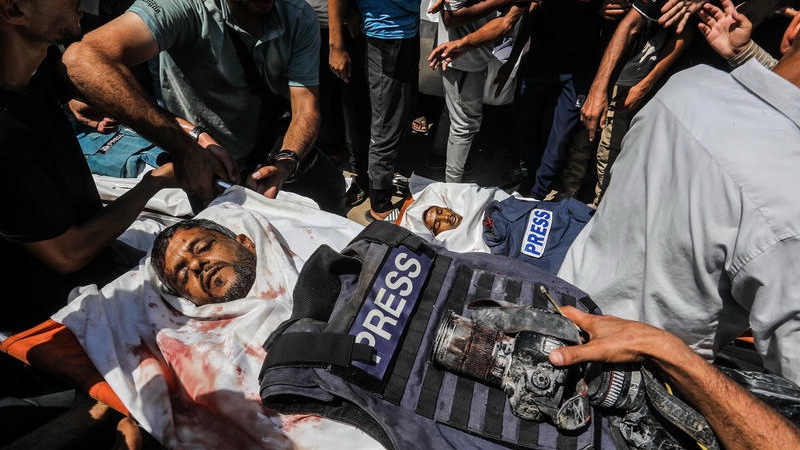
The research reviewed 266 Palestinians described in various press reports and official lists as journalists or media personnel who were killed between the outbreak of hostilities on October 7, 2023 and late 2025. According to the findings, at least 157 of those casualties — roughly 60 percent — were members of or clearly tied to terror groups, including roles in both propaganda and operational activities.
Among them, 104 individuals were linked to Hamas, while 45 were associated with Palestinian Islamic Jihad, and a smaller number had associations with the armed wings of Fatah, the Popular Front for the Liberation of Palestine, the Democratic Front for the Liberation of Palestine, or the Popular Resistance Committees.
Blurring the line between media and militancy
The intelligence center’s analysis underscores that these were not merely isolated or coincidental cases. Rather, many of those counted as journalists were embedded within terror networks — employed by outlets run by Hamas or its affiliates, or actively involved with military units. In a number of documented instances, individuals described as media professionals also served as combatants or operatives, reflecting a deliberate strategy by terror groups to integrate media outreach with operational objectives.
See related: How many journalists have been killed in Gaza? The answer is zero
For decades, Hamas has invested heavily in its information apparatus, treating media as a central front in its ideological and tactical campaigns. Its own publications and channels are tightly controlled by the movement, not independent press bodies, cementing the nexus between media work and political warfare. These channels often broadcast in real time from conflict zones, amplifying narratives while shielding operational leadership.
Complicating the casualty narrative
International press freedom organizations and human rights groups have repeatedly cited casualties among journalists in Gaza as evidence of disproportionate force or deliberate targeting by Israeli forces. Last year, Reporters Without Borders claimed that Israel was responsible for a large share of journalist deaths worldwide, noting dozens of Palestinian media workers killed in the conflict. Such assessments have been used to paint Israel as uniquely hostile to media personnel.
But the intelligence center’s study complicates that narrative by showing that a significant portion of the individuals labeled as journalists were not independent or neutral reporters, but rather were interwoven with terror group structures. A number of those counted were affiliated with outlets effectively controlled by Hamas or other militant factions, making them part of those organizations’ wider political‑military apparatus rather than autonomous observers.
Implications for international discourse
This analysis has already entered the broader debate over how journalist casualties are categorized and contextualized. The presence of terror‑linked operatives among those killed challenges simplistic interpretations of the Gaza casualty figures and underscores the complexity of information warfare in modern conflicts, where boundaries between media roles and militant roles are increasingly blurred.
By revealing the overlap between media work and organizational affiliation with terror groups, the study forces a reconsideration of how casualties are reported, understood by international audiences, and used in legal and advocacy arenas. Whether in tribunals, UN forums, or human rights campaigns, the category of “journalist” in Gaza can no longer be assumed to denote neutrality without careful verification of individual affiliations and roles.
Want more news from Israel?
Click Here to sign up for our FREE daily email updates