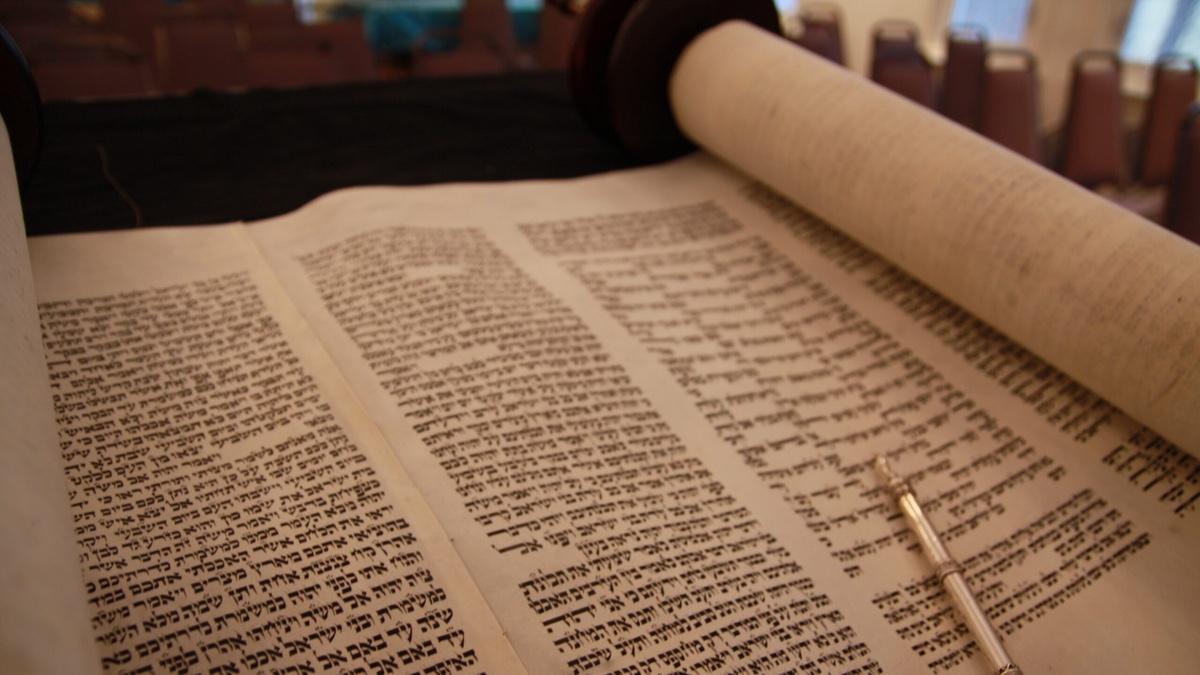
On the road to Emmaus, Yeshua met with two of His disciples and, beginning at Moses and all the Prophets, He expounded to them in all the Scriptures the things concerning Himself. (Luke 24:27). For our Torah studies this year, therefore, week by week we will seek to discover how all of Torah prepared the way for the coming Messiah.
21st February 2026 (4 Adar)
Terumah (Offering): Exodus 25:1-27:19
Before reading this week’s portion, consider the world around us. Look at the trees, breaking forth in their seasonal colours. Consider the birds, each with its own specific beautiful design. What else do you see as you look out of your window at the world that God created and ordered – all designed in the mind of God and made through the power of His Word.
This same Creator God designed the Tabernacle and all that was to be in it, with precise measurements, specifications of materials for construction and appearance. He designed it as the specific place where He would dwell in the midst of His people and meet with them in a carefully ordered way. We learn something of the heart of our Creator, Who has made all things well, as we meditate on His instructions to Moses.
How wonderful that He who spread out the heavens and all that is in them involved mankind in the construction of the place where they would meet with and worship Him.
We do not know what Moses saw on the mountain. Did he have sight of a heavenly reality which was to be brought down as an earthy representation? Did he see something like Ezekiel saw in the form of a Temple (Ezekiel 40-48), where reference was given to setting their threshold by My threshold, and their doorpost by My doorpost (Ezekiel 43:8)? Does this describe how the three-dimensional representation of the physical reality is within the unseen heavenly reality, each part alongside the other, three earthly dimensions alongside three heavenly dimensions? What we know, is that Moses was given an exact design of a heavenly reality, knowing that this was to be built with precision for God in Heaven to be also among His people on earth.
Of itself, the design is magnificent with architectural excellence, yet simplicity, creating an understanding of how God chooses to be among His people. That Creator God could design a means whereby He will come down to earth is awe-inspiring.
We are able to consider every part of the structure in this and, in succeeding weeks of our readings, wonder at the symbolism of each part. Every detail is worthy of careful and prayerful meditation. This can become a Dayenu moment (it would have been enough). Who wouldn’t want to construct this Tabernacle, learn about the priestly ordinances, carry them out day by day and be satisfied that God is among us?
Yet, as always with God, there is more! The writer to the Hebrews saw this clearly, when he compared the temporary nature of the Old Covenant with the fulfilment of the New Covenant in Messiah. It might seem as almost heresy as we are only just beginning to read about the glorious Tabernacle in the wilderness, to imply that there is something greater to consider. Yet the Tabernacle was a representation of a heavenly truth that we now know prepared the way for what Hebrews 9 unashamedly describes as coming in another, infinitely more wonderful way:
The first covenant had ordinances of divine service and the earthly sanctuary. For a tabernacle was prepared: the first part, in which was the lampstand, the table, and the showbread, which is called the sanctuary; and behind the second veil, the part of the tabernacle which is called the Holiest of All, which had the golden censer and the ark of the covenant overlaid on all sides with gold, in which were the golden pot that had the manna, Aaron’s rod that budded, and the tablets of the covenant; and above it were the cherubim of glory overshadowing the mercy seat. Of these things we cannot now speak in detail.
Now when these things had been thus prepared, the priests always went into the first part of the tabernacle, performing the services. But into the second part the high priest went alone once a year, not without blood, which he offered for himself and for the people’s sins committed in ignorance; the Holy Spirit indicating this, that the way into the Holiest of All was not yet made manifest while the first tabernacle was still standing. It was symbolic for the present time in which both gifts and sacrifices are offered …… But Messiah came as High Priest of the good things to come, with the greater and more perfect tabernacle not made with hands, that is, not of this creation……
This all takes a bit of digesting if we have never thought of it before – and that is why Yeshua met such opposition when He declared:
Destroy this temple, and in three days I will raise it up. (John 2:19)
The beautiful Temple in Jerusalem, being modelled on the Tabernacle, performed the same purpose. No wonder:
the Jews said, “It has taken forty-six years to build this temple, and will You raise it up in three days?” (John 2:20)
The reason was:
… He was speaking of the temple of His body. (John 2:21)
At the beginning of his Gospel account, John said of Yeshua:
He was in the beginning with God. All things were made through Him, and without Him nothing was made that was made. (John 1:2-3)
From the heart and mind of our Creator God came, through His Son, the design of the Tabernacle, but this was only the beginning of the teaching of how He would eventually live among us. Just as the whole of Creation came through Yeshua HaMashiach, so the Tabernacle and Temple speak of Him.
Paul the Apostle understood this too, writing to the community of disciples in Colosse concerning Yeshua:
He is the image of the invisible God, the firstborn over all creation. For by Him all things were created that are in heaven and that are on earth, visible and invisible, whether thrones or dominions or principalities or powers. All things were created through Him and for Him. And He is before all things, and in Him all things consist. (Colossians 1:15-17)
Beginning with the Tabernacle in the wilderness, opportunity was given for God’s people to learn to live with God in their midst. However, we know, by reading on through the biblical Prophets how there were many failures, making the way for the New Covenant. The Tabernacle and Temple were put aside hundreds of years after the time of Moses, but their pattern was still to be fulfilled, because God determined that He would dwell among His people.
Psalm 84 expresses our heartfelt yearning for God in our midst. It is a psalm that bridges between the Old and New Covenant. It can be read as a desire to be in the Tabernacle or Temple with Him – or the even greater fulfilment of His purposes, to find our abiding place in Yeshua:
How lovely is your dwelling place,
Lord Almighty!
My soul yearns, even faints,
for the courts of the Lord;
my heart and my flesh cry out
for the living God. (Psalm 84:1-2)
If God could come to earth and dwell in a temporary place constructed by men, glorious as it was, how much more glorious to come to earth and dwell among us in the form of a human being!
Mankind can be set in its ways and settle for the familiar, so the fall of the Temple in 70 CE, though foretold by Yeshua (Matthew 24, Mark 13, Luke 21), can take time to sink in as the beginning of a glorious new era. Yet, with 2000 years to consider this, we have had enough time to realise that Yeshua is indeed the Son of God.
The invitation to come to God our Father in Him is personal and so much greater than the Tabernacle where access was only through the Levitical Priesthood.
Moses surely rejoiced when he was privileged to meet Yeshua HaMashiach, when shortly before the Feast of Tabernacles that year, Yeshua went up on a mountain with three of His disciples. It is described in Matthew 17:
Jesus took Peter, James, and John his brother, led them up on a high mountain by themselves; and He was transfigured before them. His face shone like the sun, and His clothes became as white as the light. And behold, Moses and Elijah appeared to them, talking with Him.
In Exodus, we read that Moses met with God and received instructions for the building of the Tabernacle. He was also one of the two witnesses who identified Yeshua as its fulfilment.
Yeshua issued a most wonderful invitation. The Tabernacle and Temple were established as the place of meeting God in prayer. His invitation was to a personal fulfilment of the same meeting with God in prayer, but listen to the strength of the invitation:
Abide in Me, and I in you. As the branch cannot bear fruit of itself, unless it abides in the vine, neither can you, unless you abide in Me.
I am the vine, you are the branches. He who abides in Me, and I in him, bears much fruit; for without Me you can do nothing. If anyone does not abide in Me, he is cast out as a branch and is withered; and they gather them and throw them into the fire, and they are burned. If you abide in Me, and My words abide in you, youwill ask what you desire, and it shall be done for you. By this My Father is glorified, that you bear much fruit; so you will be My disciples. (John 15:4-8)
If, as we study the Tabernacle and its ordinances in the next few weeks with discernment, we can discover that every element, every precious thing, every colour, every ornament and design is fulfilled in Yeshua. There is always so much more with the God of Israel whose creative mind and great love and desire to live among us, brought us both the Tabernacle and His Son, Yeshua.