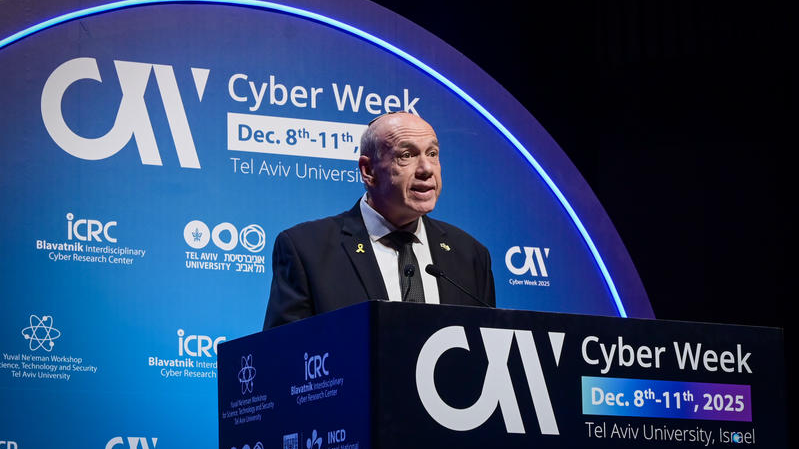
(JNS) This week saw CyberWeek 2025 kick off in Tel Aviv for the 15th consecutive year, after being postponed from its usual summer slot due to the 12-day war with Iran. The conference was a celebration of Israel’s thriving cybersecurity sector and an opportunity for young startups to showcase new technologies to cybersecurity experts, industry leaders, investors, academics, diplomats, and government officials.
CyberWeek 2025 took place following the industry news that Israel’s cybersecurity sector raised a record $4.4 billion in 2025, with the majority of funding coming from international investors across all stages for the first time. More than 11,000 attendees came from 99 countries to learn more about Israel’s post-war era at the end of a record-breaking year.
The power of AI as a weapon
This year, emphasis was placed on the significance of AI, quantum computing, influence operations, and encryption. It also raised important concerns relating to the future of cyber warfare on battlefields and democracies.
In opening remarks, Prof. Ariel Porat, president of Tel Aviv University, outlined two primary risks for global safety. “The combination of offensive cyber with AI, and disinformation with the rise of fake news. Some may say it is even the number one risk: that people cannot believe what is right or wrong. With generative AI and ChatGPT, these risks are more threatening.”
Yossi Karadi, director general of the Israel National Cyber Directorate, confirmed at the start of the day that 3.5% of global cyberattacks are directed at Israel.
“An astonishing figure for such a small country,” he told the international crowd, and warned against so-called ‘no-bullet wars’, dubbing them NBWs. “These wars will start and end in cyberspace,” he said. “The enemy will be defeated and surrounded without any kinetic energy being used. If we can’t imagine the first NBW, we won’t be able to prepare for it.”
Calls for data-driven defense, with smart migration to cloud services, would help protect against evolving threats. “We must fully embrace AI in Cyber,” he concluded.
Start-Up Nation’s cyber strength
Cybersecurity is perhaps one of Israel’s most dominant tech sectors, and its impact on the world is far-reaching. In 2025, Israeli cyber companies raised $4.4 billion across 130 rounds, the highest total ever recorded and a 46% jump in activity compared to 2024.
According to a new report from Israeli cyber VC YL Ventures, global VCs in 2025 invested more in Israeli cyber companies than local funds at every stage, proving the strength of the sector that is both maturing locally and remains in demand by the world’s top investors like Sequoia, Greylock, Mayfield, and General Catalyst. American-based investors led 44 seed rounds, compared with 35 led by Israeli firms.
In total, Israel’s cyber sector this year saw 71 seed rounds, nearly double 2023’s 36 rounds. The numbers show the resilience of the sector post-war, especially in the birth of new companies.
The threats facing Israel
Former Prime Minister Naftali Bennett gave a keynote address praising Israel as a “divine sandbox of a nation” that has repeatedly overcome enormous challenges since its founding: First, with a sudden population surge, followed by later generations of conflict triggered by hostile neighbors.
“I feel that we are placed again and again in a situation where we have to pave the way,” he said. “I think the next challenge is the challenge of the perfect storm of the confluence of cyber and AI. In the past 30 years, we’ve been dealing with rockets and mortars, physical ones, hitting our nation. But the fusion of cyber and AI presents a whole new order of magnitude of threats.”
The former prime minister cited three primary challenges Israel is facing in the cyber arena: Infrastructure protection, model poisoning, and the poisoning of the public discourse. “This has to be a national mission of Israel, and when we crack it, when we solve it, we’ll also share it with the rest of the world like we always do,” he concluded.
Prime Minister Netanyahu’s Remarks to Cyber Week 2025:
“Israel is a global cyber power. We receive a huge portion of the world’s cyber investments. I checked the data: we are, in terms of investments per capita, at a huge gap ahead of every other country”https://t.co/mxGpcGHEcB pic.twitter.com/CZtaxWPKUr— Prime Minister of Israel (@IsraeliPM) December 9, 2025
The rising threat of China
Another recurring theme was the growing cyber threat posed by China, particularly to America’s critical infrastructure.
“As President Trump has said repeatedly, our partnership with Israel is unbreakable,” said Nick Andersen, executive assistant director for the Cybersecurity Division (CSD), Cybersecurity and Infrastructure Security Agency (CISA). “This partnership is now absolutely essential more than ever before in cyberspace. Cyberspace is now a primary domain in strategic competition … and the most significant and comprehensive threat that we face is absolutely and unequivocally from the People’s Republic of China.”
As CISA’s senior cybersecurity official, Andersen is responsible for leading the agency’s mission to address the nation’s most significant cyber threats and vulnerabilities and to increase the security and resilience of US critical infrastructure.
He highlighted China’s long-term cyber campaign designed to gather intelligence and shape the battle space by pre-positioning within critical infrastructure such as energy grids, cloud environments, or telecommunication systems, intending to create “societal havoc and chaos”.
He cited similarities between the US and Israel, which see similar activity: persistent reconnaissance, low visibility intrusions, and attempts to access defense industrial and civilian networks.
“Their objective is to pressure democracies, to delay our forces’ mobilization, to disrupt daily life, and to weaken national resolve during a time of and leading up to a crisis,” he said. “US and Israeli intelligence and our cybersecurity efforts align in this regard … This is why our U.S.-Israel cyber partnership matters more now than at any other point in history.”
Matanyahu Englman, EUROSAI’s President & State Comptroller of Israel, highlighted that these concerns are specifically relevant to Israel as it enters an election year, a period when foreign actors often attempt to sow division and undermine democratic processes. “Accordingly, we are currently finalizing an audit report on the government’s response to foreign influence in the digital sphere,” he confirmed.
The event took place alongside AIWeek 2025 and was hosted by The Blavatnik Interdisciplinary Cyber Research Center (ICRC) at Tel Aviv University, Yuval Ne’eman Workshop, and the Israel National Cyber Directorate (INCD), a national-level agency responsible for advancing and implementing cyber policy. Sponsors included Shibolet Law Firm, Google, and Microsoft, with additional support from major Israeli and international cyber companies such as CyberArk and Check Point.
Want more news from Israel?
Click Here to sign up for our FREE daily email updates