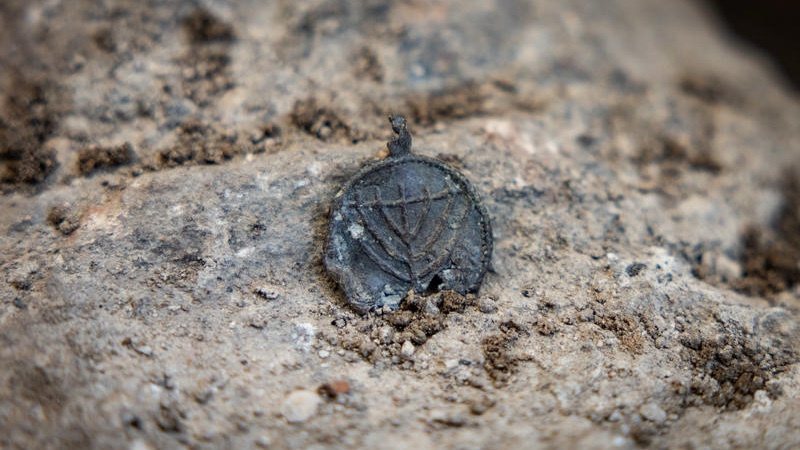

A rare and powerful discovery beneath the southwestern corner of the Temple Mount has once again illuminated the unbreakable bond between the Jewish people and their ancient capital.
The Israel Antiquities Authority (IAA) announced the discovery of a 1,300-year-old lead pendant adorned with the symbol of the seven-branched menorah—an unmistakable emblem of Jewish identity and faith. Unearthed during excavations in the Davidson Archaeological Park just north of the City of David, the artifact dates back to the Late Byzantine period (6th–early 7th centuries AD), a time when imperial edicts forbade Jews from entering Jerusalem.
Despite the ban, the pendant serves as a silent testimony: Jews never relinquished their spiritual connection to the Holy City.
Only one other known pendant of its kind exists—a lead menorah amulet of unknown origin currently housed at The Walters Art Museum in Baltimore, Maryland. The newly discovered artifact, however, was found in the heart of ancient Jerusalem, underscoring the resilience of Jewish presence even under oppression.
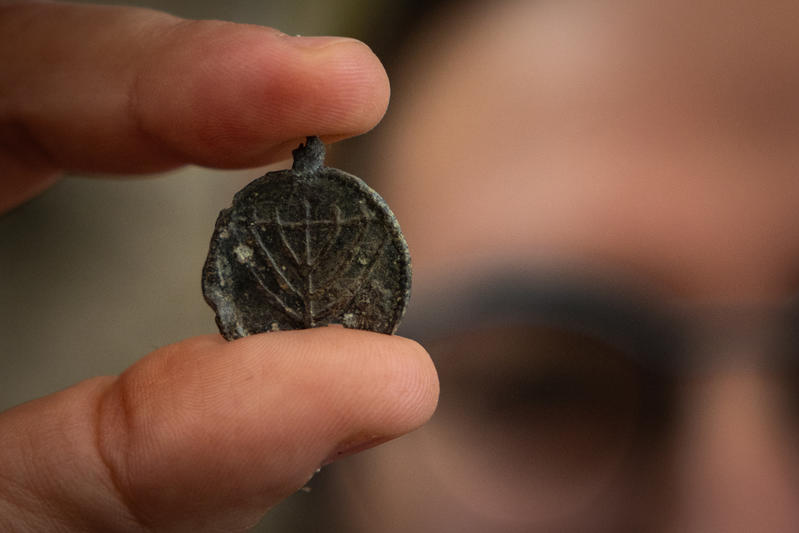
Photo by Yonatan Sindel/Flash90
Ayayu Belete, a worker with the City of David excavation team, was the first to lay eyes on the pendant. “I suddenly saw something gray among the stones,” he recalled. “When I picked it up and saw the menorah, I was deeply moved.”
IAA archaeologists believe the pendant was not worn merely as jewelry but as a personal amulet of faith. “The use of lead, a common material for amulets at the time, suggests it held spiritual significance,” explained IAA’s Yuval Baruch and his colleagues. “It symbolizes a personal act of devotion in defiance of imperial decrees.”
This discovery adds yet another layer to the growing body of archaeological evidence reaffirming the Jewish nation’s continuous and profound connection to Jerusalem—both religious and national. From the footsteps of the Maccabees to the silent defiance of a pilgrim bearing a menorah amulet, Jewish presence in the city has endured through exile, bans, and centuries of foreign rule.
In a symbolic gesture, the pendant is being displayed to the public for the first time this Hanukkah at the Jay and Jeanie Schottenstein National Campus for the Archaeology of Israel in Jerusalem—offering visitors a tangible glimpse into a miracle of memory and survival.
The excavation, led by the IAA in cooperation with the City of David Foundation and the Company for the Restoration and Development of the Jewish Quarter, continues to unearth remnants of ancient resilience, reminding the world that history and faith are not abstract—they are rooted in the very stones of Jerusalem.
Want more news from Israel?
Click Here to sign up for our FREE daily email updates