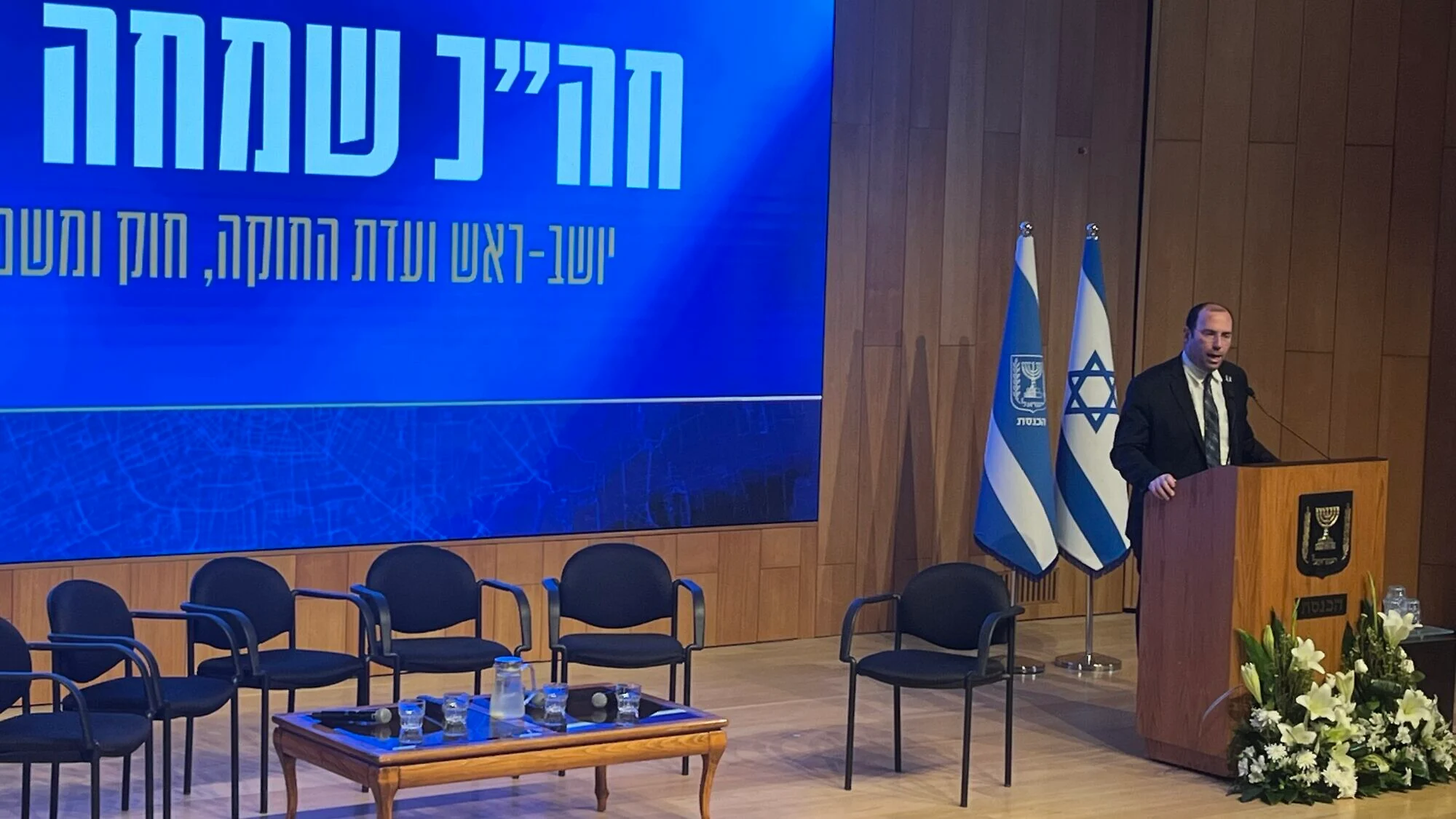
(JNS) The assertion that “Israel’s presence in Gaza must be permanent” was the prevailing sentiment at a half-day conference, held on Monday in the Knesset auditorium, titled “Gaza: The Day After—The Right’s Political Plan.”
Several hundred activists from the national camp gathered at the event to hear government ministers, members of Knesset, bereaved parents, a released hostage and others share their visions for the period following the war between Israel and Hamas.
The conference was organized by TKUMA, an Israel-based NGO advocating Israeli sovereignty, along with Religious Zionism MK Simcha Rothman, chair of the Knesset’s Constitution, Law and Justice Committee.
Rothman told JNS that Israel’s security situation is currently better than at any other point in the nation’s history, and that now is the time to consider what should happen once the war in Gaza officially comes to an end.
“We have to figure out how to make sure it never poses a threat to the State of Israel,” he said.
During a panel discussion, Rothman said he envisions a future Gaza under full Israeli sovereignty, with communities settled by Jews. He told the audience that Israel can no longer base its security doctrine on the “Iron Wall,” referencing Zionist revisionist leader Ze’ev Jabotinky’s 1923 paper on Zionism, in which he argued that since the local Arabs would never accept a Jewish majority in British-mandated Palestine, the Jews must live independently behind an unbreachable barrier.
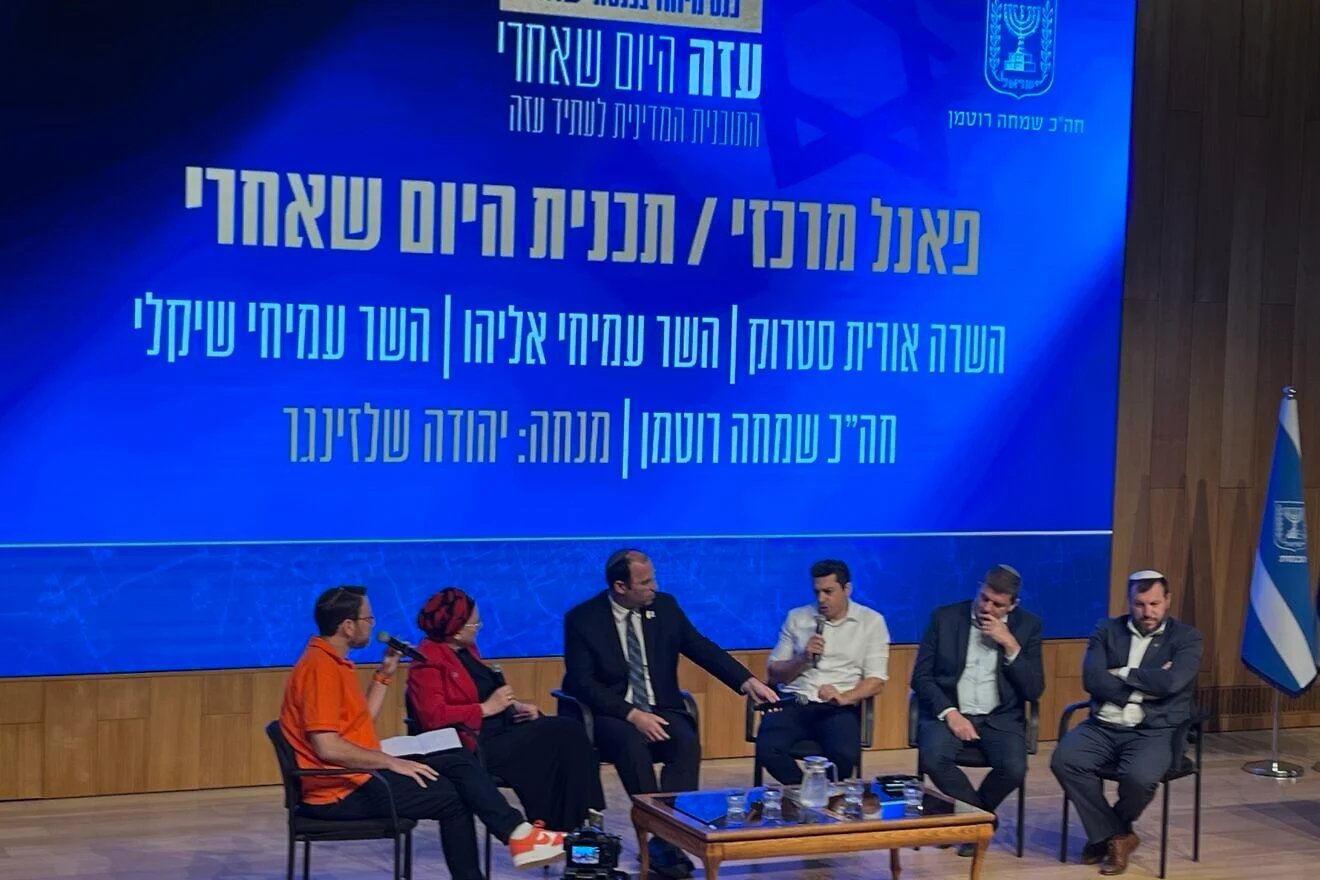
A panel at the TKUMA conference, led by journalist Yehuda Schlesinger. (From left): Settlements and National Missions Minister Orit Strook, MK Simcha Rothman, Minister of Diaspora Affairs and Combating Antisemitism Amichai Chikli, MK Amit Halevi and Heritage Minister Amichai Eliyahu, Jerusalem, Jan. 12, 2026. Photo by Josh Hasten.
“Oct. 7 taught us that the enemy is not just Arabs in Israel, but the entire axis,” he said, mentioning threats from Iran and its proxies.
He added, “You can build walls, but they don’t stop enemies, who go over them with drones and under them with tunnels. Walls don’t stop anyone—neither technologically nor spiritually.”
Rothman therefore suggested that the political doctrine of the right wing must be updated.
He said what is needed is a total victory in Gaza, including the eradication of the evil there, which he argued would serve as a model for the entire world in confronting similar enemies.
Berale Crombie, chairman of TKUMA, told JNS that his group is demanding clear war objectives—not vague statements, but explicit goals: the conquest and Israeli control of Gaza; the destruction of Hamas, which he said has not yet happened; and the return of the body of the last hostage, Ran Gvili.
He said there are many competing ideas for “the day after,” including the vision promoted by US President Donald Trump and his envoys, Steve Witkoff and Jared Kushner, who have spoken of a “New Gaza,” or a Singapore-like Riviera.
While expressing his appreciation for Trump’s friendship and his work to secure the release of the Israeli hostages, Crombie does not subscribe to the view that economic incentives for the Arabs will lead to peace.
“If Gaza is rehabilitated, will the residents there become good people, and will terrorism disappear?” he asked rhetorically.
“The first and most important thing is Israeli control. There is no substitute for Israeli control. We left Gaza 20 years ago; we lost the territory and we also lost our security,” he said.
Talik Gvili, mother of Ran Gvili, the last remaining Israeli hostage, whose body is being held by Hamas, told JNS, her focus wasn’t on the day after the war, or furthering of the ceasefire, but rather the release of her son’s body for burial.
“We want Ranni [Ran] back, we want him home before a phase two [of the ceasefire], and then we can do what is necessary in Gaza,” she said.
Gvili suggested to the audience that the conference should be renamed: “The Day After—After Ran Returns.”
She insisted there should be no progress toward the rebuilding or rehabilitation of Gaza until her son’s body is returned.
Gvili was adamant that Hamas knows where her son’s body is, and Israel must take steps to secure his release, including seizing territory, cutting off all humanitarian aid and other actions so that Hamas understands Israel isn’t stuck in a pre–Oct. 7 mentality.
“Had such steps been taken when [Hadar] Goldin and [Oron] Shaul were held [two Israeli soldiers killed by Hamas in 2014, and whose bodies were held for more than 10 years], I am certain Oct. 7 would not have happened,” she said.
Kibbutz Be’eri resident Avida Bachar, who lost his wife, his 15-year-old son and one of his legs on Oct. 7, told JNS his main message is that Israel must rehabilitate itself after two years of war marked by immense loss and both physical and emotional trauma.
“We have a duty to rebuild the nation and to protect the state, because quite simply, we do not have another country, and it is our responsibility to safeguard it. It isn’t easy here, but it is ours. Let us protect it,” he said.
He told the audience that for him, the “day after” involves true accountability for the sake of the State of Israel and its citizens, particularly the next generation.
“What will I do with a binder full of conclusions telling me that the head of Military Intelligence failed? We need answers that actually change reality,” he said.
Bachar also said that while Israel certainly reduced Hamas’s military capabilities, it did not take away the group’s intentions to try and destroy the country.
“There isn’t a single person [in Gaza] who is not Hamas. And if for a moment we think that tomorrow a baby will be born there and he will be a great Zionist, the answer is no. He will be a Hamas supporter,” he said.
Bachar said that Israel must therefore define what a complete victory would look like. In his view, Israel must establish 923 new Jewish neighborhoods in Gaza, one for every brave IDF soldier who died in battle.
“Either we are a sovereign state or we are not. Any compromise after Oct. 7 and the War of Revival is not victory; it is absolute defeat,” he said.
In Bachar’s view, Israel must return to intense fighting, similar to the first stage of the war, as he believes that under the cloak of the ceasefire, Hamas is growing stronger again: rebuilding, renovating, digging tunnels and recruiting thousands of new fighters.
Yehoshua Shani, the father of Capt. Ori Mordechay Shani, 22, who fell in battle on Oct. 7, 2023, and chairman of the Heroism Forum, told JNS he believes Israel should convey the message that Gaza must be under permanent Israeli control, not only for security reasons, but as part of the biblical inheritance of the Jewish people from God.
He said that what should be self-evident—namely, that it is the inheritance of the forefathers—must become part of the public discourse; only then, he argued, would absolute victory from a security standpoint also be self-evident, as the two depend on one another.
Shani added that Israelis who believe in a divine right to all the land of Israel for the Jewish people, including Gaza, should not be ashamed if called “messianic.”
“If they label us as such, so be it,” he said.
“This needs to start with our representatives in the Knesset and in the government, who must proudly say, both internally and externally, ‘Gaza is the inheritance of our forefathers,’” he said.
The conference concluded with an emotional onstage interview with Eitan Mor, an Israeli hostage who was held in Hamas captivity in Gaza for more than two years and was freed in the Oct. 2025 hostage deal, during which he recounted his harrowing ordeal.
Mor said that Hamas is “at this moment” resuming tunnel construction and still possesses thousands of missiles.
At the same time, he said, Hamas has food reserves above and below ground that can last a year.
However, he suggested that the only thing that actually could have an impact would be for Israel to target Hamas’s water supply, as it would eventually run out.
Mor said Hamas will never give up its fight against Israel. He recounted, “As many Hamas members told me, ‘Until you remove the last Gazan from here, we’ll carry out another Oct. 7.”
Mor added, “Basically, jihad is the highest commandment in their religion. They are obsessed with us at a very high level. Because that is basically the ultimate goal of their life. And I wish we were as obsessive as they are—just as they are obsessive about us—in security and in everything else.”
Want more news from Israel?
Click Here to sign up for our FREE daily email updates