

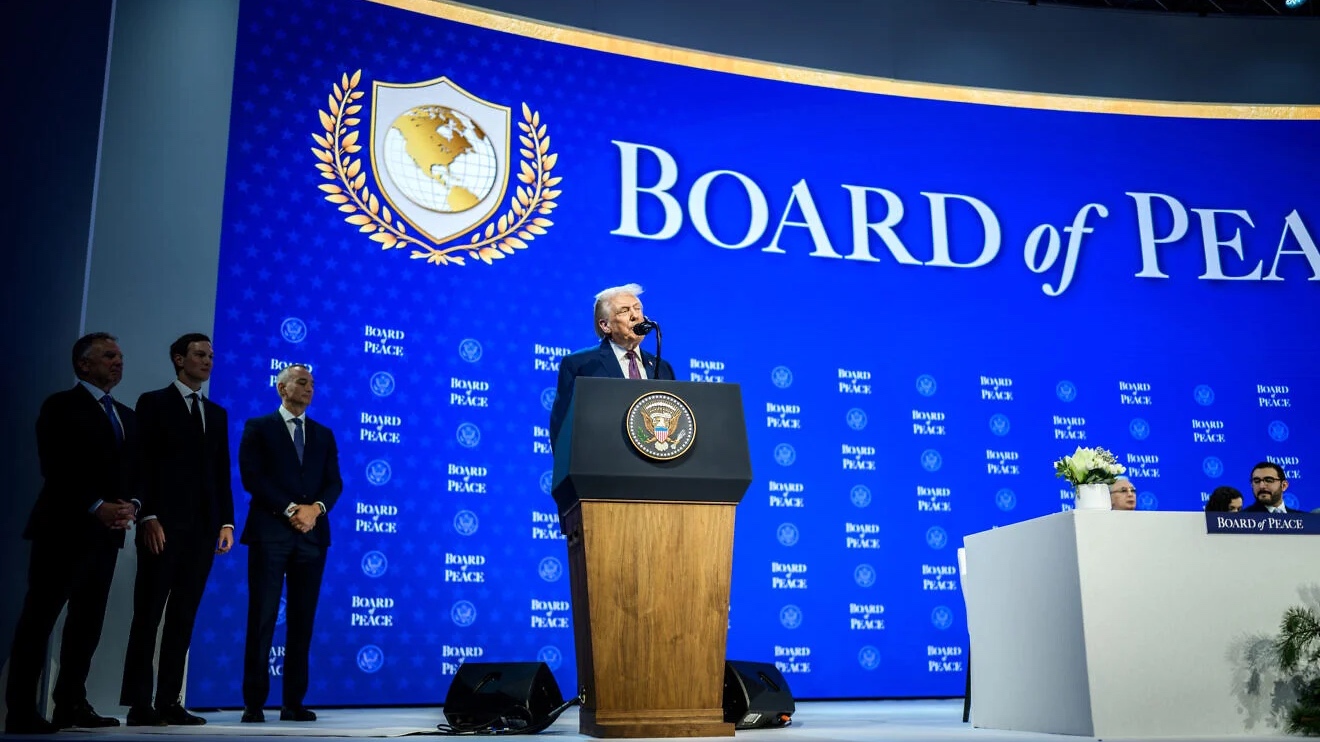

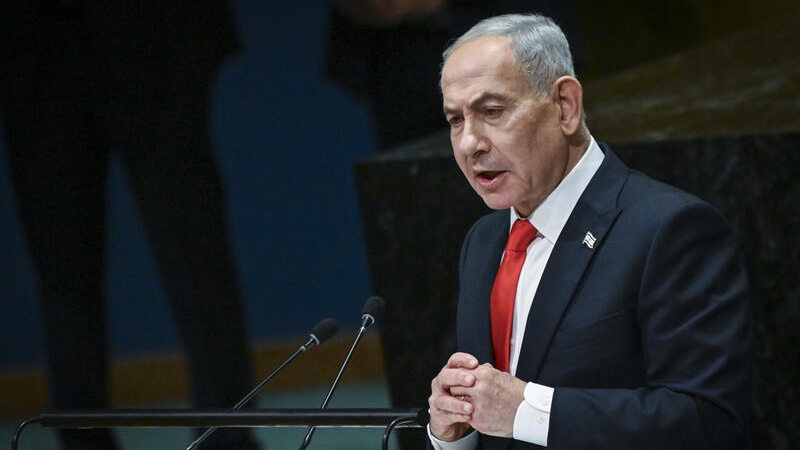
US President Donald Trump opened the inaugural meeting of his new “Board of Peace” in Washington on Thursday, pitching the forum as the engine for “Phase 2” of his Gaza plan: money, manpower, and a transitional administrative structure meant to replace Hamas rule in the Strip.
According to the Associated Press, representatives from more than 40 countries and the European Union confirmed attendance, though a notable bloc of US partners opted to attend only as observers rather than formally join the board.
The lineup underscored how seriously the White House wants to frame the initiative. Alongside Trump, the program included Secretary of State Marco Rubio, special envoy Steve Witkoff, US Ambassador to the United Nations Mike Waltz, Jared Kushner, former British Prime Minister Tony Blair, and the board’s High Representative for Gaza, Nickolay Mladenov.
The stated purpose of the meeting was to receive updates from the Gaza Executive Board—described by US officials as the link between the Board of Peace and the National Committee for the Administration of Gaza (NCAG), the transitional Palestinian body Washington hopes can assume civilian and security responsibility in Gaza.
Big pledges, hard conditions
Trump has repeatedly framed the board as a mechanism to translate diplomacy into logistics: reconstruction funding paired with an international stabilization footprint and local policing capacity. In public remarks and press coverage ahead of the summit, the White House highlighted multi-billion-dollar pledges toward humanitarian and reconstruction efforts, alongside personnel commitments for an International Stabilization Force and local police to deploy under the plan.
But the condition remains the same, and it is the condition everything else hangs on: Hamas must demilitarize.
Without demilitarization by Gaza terror groups, “Phase 2” is simply the international community paying for a new round of Hamas consolidation—this time with better infrastructure.
Mladenov has been unusually blunt on this point in recent days, warning that reconstruction is structurally impossible if the armed factions remain intact. Speaking at the Munich Security Conference, he argued that Gaza must be governed by a transitional authority authorized under a Security Council framework, exercising full civilian and security control—meaning armed groups cannot remain as a parallel power.
His warning was just as pointed: if Gaza returns to war, the entire architecture collapses back into rubble-management rather than governance.
The policing question reveals the real problem
The clearest test of whether any “transitional” authority is real is not in conference halls, but in who carries the guns on the street.
On that front, Reuters reported Thursday that the NCAG has begun recruiting for a new Gaza police force, drawing thousands of applicants in the early hours of the recruitment drive.
Previous reports suggested Hamas seeks to absorb large numbers of its existing personnel into the new structure. And this week, Israeli intelligence assessments—seen by Reuters—argue Hamas is actively entrenching its grip “from the bottom up” by placing loyalists into government offices, security apparatuses, and local authorities.
This is the strategic contradiction at the heart of the plan. You cannot build a “post-Hamas” Gaza by staffing it with Hamas.
“It is a Hamas car”
According to Reuters’ account, Hamas has named five district governors, all reportedly linked to its Qassam Brigades, and placed operatives into ministries that manage taxation and internal security.
One local source summarized the arrangement with a line that should haunt every diplomat assembling talking points about “technocratic governance”:
Ali Shaath, the NCAG’s chief commissioner, “may have the key to the car, and he may even be allowed to drive, but it is a Hamas car.”
Israel’s intelligence assessment reached the same conclusion: without Hamas disarmament—even under the cover of a technocrat committee—Hamas will preserve influence and control.
An unnamed Israeli government official dismissed the idea of any future Hamas role as fantasy, reinforcing Jerusalem’s public line that Hamas cannot be permitted to remain a governing authority in Gaza.
The view from Jerusalem: the “transition” problem
From Israel’s perspective, the debate is not whether Gaza needs reconstruction. It does. The debate is whether reconstruction becomes a strategic trap—financing the recovery of an armed movement that has already demonstrated how it uses civil systems as cover, leverage, and legitimacy.
Hamas does not need international recognition to function. It needs money, administrative continuity, and time. A “Phase 2” that delivers all three—without verified demilitarization—would not end the conflict. It would schedule the next outbreak of war.
That is why the Board of Peace meeting, for all the photo-ops and pledged billions, meets its first real test immediately: enforcement.
- Who verifies demilitarization?
- What happens when Hamas refuses?
- What happens if Hamas “agrees” in principle while rebuilding in practice?
Because on the ground, Hamas is already signaling the answer: it intends to remain.
The strategic bottom line
The Board of Peace is attempting to solve a problem that has swallowed decades of international initiatives: the gap between what donors want to fund and what armed factions want to control.
Washington can convene 40 countries. It can announce billions. It can draft transitional frameworks and recruit police. But none of that dislodges an entrenched terrorist army unless the core premise is enforced: demilitarization is not a “phase.” It is the entry ticket.
Until that is settled—verifiably, not verbally—every new governance structure risks becoming a façade: an international letterhead stapled onto a Hamas power reality.
Want more news from Israel?
Click Here to sign up for our FREE daily email updates







Absolutely!!