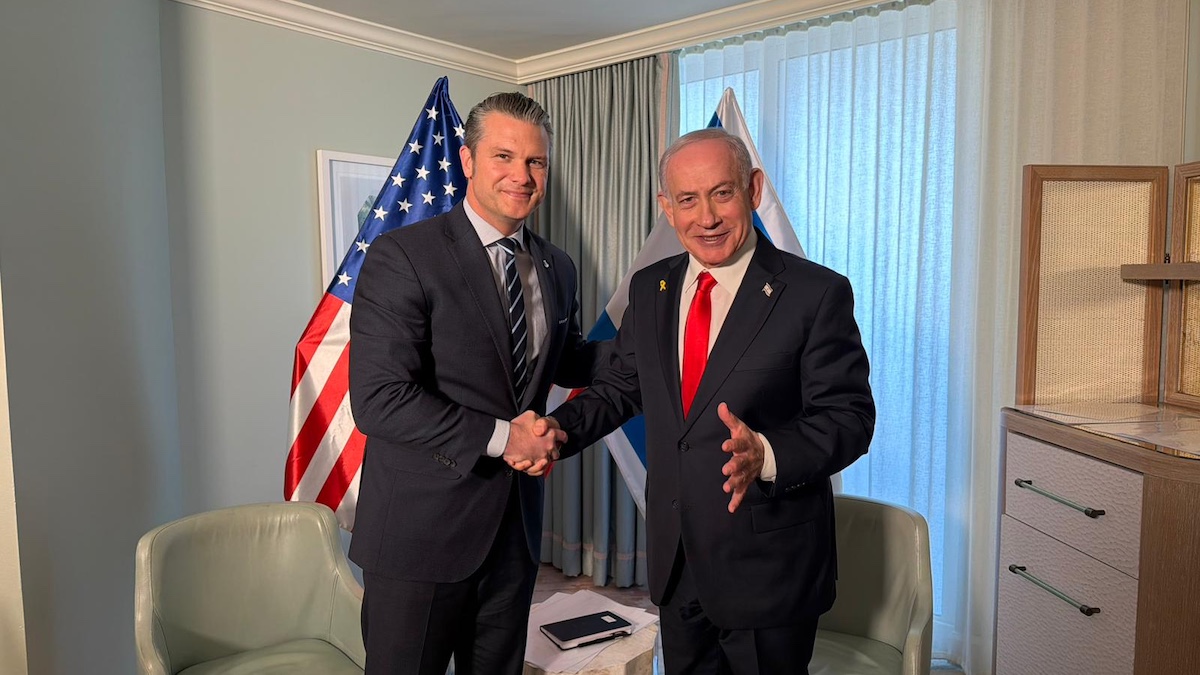
(JNS) US Secretary of Defense Pete Hegseth painted a picture of overwhelming American military might systematically dismantling the Islamic Republic of Iran, speaking during a press conference at the Pentagon in Washington, DC, on Thursday.
The US, which has struck “over 7,000 targets across Iran,” is ramping up its offensive, he said. “Today will be the largest strike package yet, just like yesterday was. As I’ve said, from day one, our capabilities continue to build, Iran’s continue to degrade,” Hegseth said.
The US has “flattened” Iran’s air defenses and its defense industrial base, including the factories and production lines supporting missile and drone programs. “Their ability to manufacture new ballistic missiles has probably taken the hardest hit of all,” he said, adding that ballistic missile launches and drone strikes are down 90% since the war’s start on Feb. 28.
Iran’s leadership also is under extreme pressure. “The last job anyone in the world wants right now—senior leader for the IRGC, or Basij—temp jobs, all of them,” Hegseth said, referring to the Islamic Revolutionary Guard Corps and the Basij, a largely voluntary force used to suppress internal dissent in Iran.
The US has devastated the Iranian Navy, sinking more than 120 of the enemy’s ships. Paraphrasing Adm. Ernest J. King, commander in chief of the US Fleet and chief of naval operations during World War II, Hegseth said, “We’ve decided to share the ocean with Iran. We’ve given them the bottom half.”
Despite the military gains, Hegseth would not offer a time frame for the conflict’s end. He said the advances made have allowed for improved intelligence, and faster and more precise strikes with increasing effectiveness. “So no time set on that, but we’re very much on track,” he said. Ultimately, US President Donald Trump will decide when the objectives have been achieved and the operation ends, Hegseth added.
For 47 years, Iran has posed a threat not just to the US, but to freedom and world civilization, he said. Its “core industries” are state-sponsored terrorism, proxy militias, missile programs and “a violent, messianic Islamist ideology chasing some sort of apocalyptic end game.”
He chastised America’s allies, the media and critics of the war. They should say “thank you” to Trump for putting a stop to Iran’s terror state, which has held the world hostage. “The media here, not all of it, but much of it, wants you to think just 19 days into this conflict that we’re somehow spinning toward an endless abyss or a ‘forever war’ or a quagmire. Nothing could be further from the truth,” he said.
“President Trump knows better,” he said, insisting “Operation Epic Fury” was different from other Middle Eastern wars. “It’s laser-focused. It’s decisive. Our objectives, given directly from our ‘America First’ president, remain exactly what they were on day one. These are not the media’s objectives, not Iran’s objectives, not new objectives—our objectives, unchanged, on target and on plan. Destroy missiles, launchers and Iran’s defense industrial base so they cannot rebuild. Destroy their navy. And Iran never gets a nuclear weapon.”
Both Hegseth and Gen. Dan Caine, chairman of the Joint Chiefs of Staff, who participated in the press conference, paid their respects to the six airmen, crew members of a KC-135 US Air Force refueling aircraft, who died in western Iraq on March 12. Their remains were returned to a Delaware military base on Wednesday.
Caine provided details on the military’s activities. He said 5,000-pound bunker-busting bombs had been used against underground missile facilities, and strikes were ongoing against ammunition depots, mine storage sites and other naval assets. Operations also were expanding deeper into Iranian airspace, and the US had introduced new types of aircraft into the war, including the A-10 Warthog and AH-64 Apache helicopters. The A-10s are being used to target fast-attack naval craft and other threats, he said. The Apaches were operating on the southern front against drones, among other targets.
Speaking of last week’s attack on Kharg island, he said more than 90 targets were hit, including all of the island’s military infrastructure, such as “air defenses, naval base, mine storage and deployment facilities.”
Kharg, about a third the size of Manhattan, is critical to Iran’s oil infrastructure, with some 90% of the country’s crude normally transiting through a terminal on the island.
In a question-and-answer following their remarks, the defense secretary was asked which partners had been most cooperative.
“Israel, from day one, has been an incredible and capable partner, willing and able. There’s nothing like capabilities and partners that are able to use them,” Hegseth said. He also praised the Gulf Arab states, noting that Iran’s reckless attacks had brought them closer into America’s orbit.
Want more news from Israel?
Click Here to sign up for our FREE daily email updates