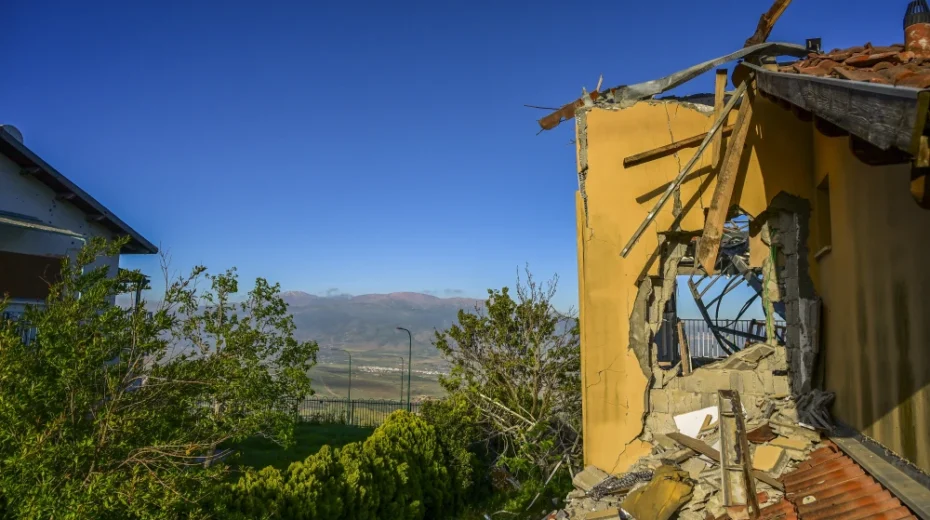

(JNS) A resident of Kibbutz Misgav Am in the Upper Galilee shakes his head as he describes a drone that exploded next to the village kindergarten.
“Only by a miracle was nobody inside,” he says. “But that does not stop families with small children from leaving or planning to leave. Here, you have to watch the sky all the time and run to shelters. If a drone appears over Tel Aviv, the whole country erupts. Here in the north, it is normal life.”
Israeli Prime Minister Benjamin Netanyahu’s declaration that “we are intensifying operations in Lebanon,” the Israel Defense Forces’ expansion beyond the eight-kilometer security line to intercept missiles and drones, destroy tunnels and terror infrastructure, reinforce the buffer zone and carry out increasingly deep incursions reaching Tyre—though not Beirut—have not silenced the cries of a country whose northern border remains under bombardment, evacuation and siege.
IDF Chief of Staff Lt. Gen. Eyal Zamir spoke plainly: Israel must be prepared to reach Beirut if Hezbollah is to be forced to honor the May 15 ceasefire, later extended by 45 days and reaffirmed by the United States as a necessary condition for continuing negotiations with Iran.
The hope that Lebanese President Joseph Aoun will fulfill his stated goal of dismantling Hezbollah—that cancerous “state within a state” that has drained Lebanon of sovereignty, prosperity and any realistic hope for peace—seems distant.
Aoun even attempted to expel Iranian Ambassador Mojtaba Amani after repeated Iranian interference in Lebanese politics. Yet Tehran continues to funnel money and weapons to Hezbollah even as its own people sink deeper into poverty and war.
Hezbollah remains Iran’s strategic weapon—the instrument through which Tehran keeps Israel under constant pressure while negotiations with US President Donald Trump continue. Israel, despite its obvious interest in removing the threat entirely, can for now only maintain an active defensive posture against attacks from Lebanon.
Meanwhile, residents of northern Israel cry out for help. They cannot sleep, cannot work and continue to bury their dead.
On Wednesday, Sgt. Rotem Yanai, 20, was killed in a Hezbollah drone attack. On Sunday, Sgt. Nehoray Leizer, 19, also killed in a drone strike, was laid to rest amid the anguish of his family. The previous day, another young man, Staff Sgt. Noam Hamburger, 23, suffered the same fate. Since the ceasefire began on April 16, 12 Israeli soldiers have been killed.
The drones arrive with a faint buzz that is often almost impossible to stop. They have wounded dozens during the ceasefire alone. Preventing such attacks would require striking directly at Hezbollah’s command centers and sensitive infrastructure, or taking steps severe enough to force the Lebanese government finally to deploy its own army to disarm the Shi’ite militia.
The silence of much of the international press on the situation of residents in northern Israel is extraordinary. Nearly 600,000 Israelis have endured displacement, drone attacks, destroyed communities and unrelenting fear, yet global headlines remain preoccupied not with the victims of Hezbollah aggression, but with the possibility that Israel might respond too forcefully.
Israel—on both the right and the left—cannot accept that the north should once again become the sacrificial lamb of Jewish history while Hezbollah exploits the ceasefire and the diplomatic restraints imposed by Trump’s negotiations with Iran.
But Netanyahu also cannot afford a serious rupture with Trump, especially at a moment of profound uncertainty in which Israel seeks above all a final arrangement guaranteeing that Iran will never retain the capacity to produce nuclear weapons. Still, Trump’s most recent statement reiterating that Iran will never obtain a nuclear weapon demonstrates that he and Netanyahu remain aligned on the most important issue of all.
This is Netanyahu’s painful contradiction. It is Netanyahu who embraced the doctrine of prevention and decisive action following the catastrophe of Oct. 7. He is the inventor, promoter and political warrior battling the disastrous conceptzia, the strategic mindset that blinded Israel to the threat building before Oct. 7.
Yet today, the same Netanyahu must also preserve Israel’s indispensable alliance with the United States, even when that alliance imposes limits on how aggressively Israel can act in Lebanon.
The opposition criticizes what it sees as Trump’s paralyzing embrace. Benny Gantz, from the political center, voices a widespread sentiment when he calls for strikes on Beirut. The left presses for stronger action, while hardliners inside the coalition pound their chests.
Now, however, Lebanon has become a critical node not only for Israel’s northern security but also for its relationship with the United States and for the broader future of the Middle East.
Netanyahu must remain cautious and focused. He knows that Lebanon is not simply a northern-front dilemma, but a central node in the larger regional confrontation—one that affects every cardinal direction of Israel’s security and diplomacy.
Want more news from Israel?
Click Here to sign up for our FREE daily email updates