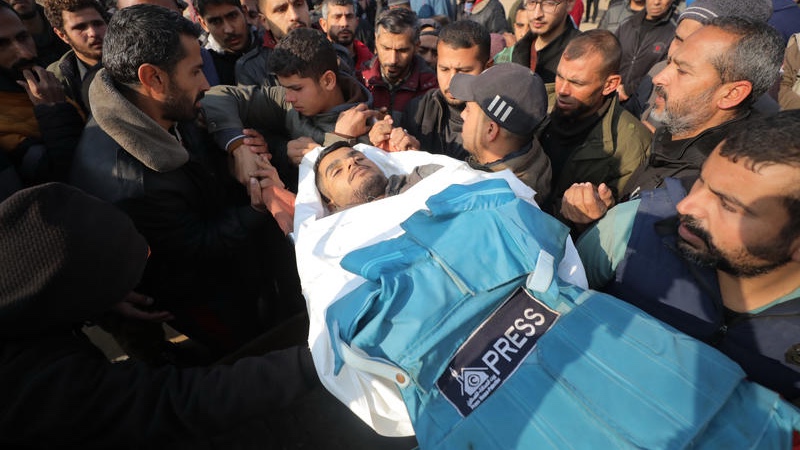

The international community will identify him as a “journalist,” but Ahmed Samir Muhammad Washah was more importantly a Hamas sniper responsible for numerous attacks on Israelis, an important distinction that forfeits his immunity under international law.
In addition to his terrorist activity, Washah also worked as a photojournalist for the Qatari outlet Al Jazeera.
According to the IDF, Washah was killed in a precise aerial strike along with two other Hamas operatives. The military said he served as a sniper in Hamas’s armed wing and had recently advanced sniper attacks and other hostile activity against Israeli troops in the Gaza Strip.
🔴AL JAZEERA JOURNALIST EXPOSED: Ahmed Samir Muhammad Washah, who served as an Al Jazeera photojournalist, was simultaneously a Hamas sniper operative and eliminated in a precise strike in central Gaza.
In recent months, he advanced sniper attack plans and worked alongside his…
— Israel Defense Forces (@IDF) June 20, 2026
Washah was not the first member of his family to operate in that gray zone between journalism and militancy. His brother, Muhammad Samir Muhammad Washah, was also linked to Al Jazeera and, according to the IDF, served as a key figure in Hamas’s rocket and weapons production headquarters. He was killed in April.
The case underscores one of the most uncomfortable realities exposed by the Gaza war: a press badge does not automatically turn a combatant into a civilian.
Hamas has spent years embedding itself inside civilian institutions, humanitarian networks, hospitals, schools, aid structures and media channels. Journalism, in such an environment, can become more than a profession. For some, it becomes cover. For others, it becomes a second income stream. For still others, it becomes part of the narrative battlefield—shaping perception abroad while armed factions operate on the ground.
That does not mean every Palestinian journalist is a combatant. It does mean Israel cannot be expected to treat the word “journalist” as a magic exemption from military scrutiny.
The law of armed conflict protects journalists who are civilians. It does not protect terrorists simply because they also carry cameras, publish photos or receive payment from media outlets. A Hamas sniper remains a legitimate military target whether he is wearing a vest, holding a rifle or filing images for an international network.
This is the reality many Western institutions prefer not to examine too closely. The narrative war against Israel is not secondary to the battlefield. It is part of it. Rockets attack Israeli cities. Gunmen attack Israeli soldiers. Propaganda attacks Israel’s legitimacy and freedom of action.
All three serve the same strategic purpose.
Want more news from Israel?
Click Here to sign up for our FREE daily email updates