(JNS) Fifty years after “Operation Entebbe,” Gadi Ilan still doesn’t first remember the gunfire. Or the explosions.
Or even the moment he saw his commander, Lt. Col. Yonatan (“Yoni”) Netanyahu, commander of the elite Sayeret Matkal (General Staff Reconnaissance) unit and the older brother of current Israeli Prime Minister Benjamin Netanyahu, struck by enemy fire.
He remembers the hostages.
“If there is one thing I need to single out about the operation,” Ilan told JNS in an exclusive interview marking the 50th anniversary of “Operation Entebbe,” “it’s the scene of the hostages when we broke in.”
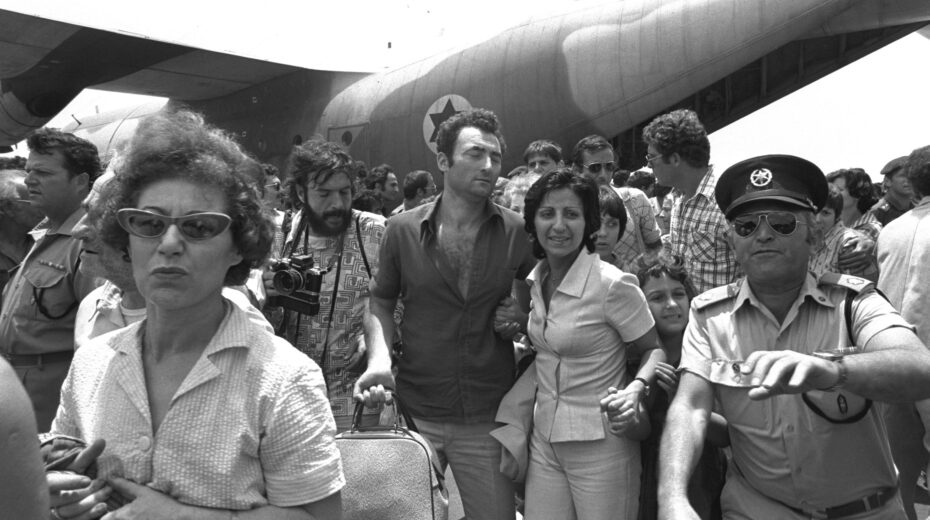
On July 4, 1976, Israeli commandos flew more than 2,500 miles to Uganda to rescue more than 100 hostages held by Palestinian and German terrorists at Entebbe Airport. The mission became one of the most celebrated hostage-rescue operations in military history.
For seven days, the hostages had lain on the floor of the old terminal at Entebbe Airport. They had barely slept. They had watched armed terrorists and Ugandan soldiers come and go. The deadline set by the hijackers would expire the following morning. Many believed they would not survive the night.
Then the explosions began.
“They instantly believed the time had come and they were about to die,” Ilan recalled. “They tried to cover their children, or just their own faces. Then they saw soldiers bursting inside wearing Ugandan uniforms, which they knew all too well after seeing them throughout the week.”
For one terrifying instant, they froze.
Then they heard Hebrew.
For the hostages, rescue arrived not with the sight of Israeli soldiers, but with the sound of their own language.
“All of a sudden, they started hearing us shouting in Hebrew, directing them to keep lying down and telling them we had come to take them home.”
Fifty years later, it is still their faces that return to him first.
‘A very different mission’
He was 26 years old in July 1976, one of 33 Sayeret Matkal commandos chosen for the assault force that would spearhead one of Israel’s most daring military operations. Sitting inside the black Mercedes that would later become synonymous with the operation, designed to resemble the vehicle used by Ugandan dictator Idi Amin, he and his teammates were among the first soldiers to storm the terminal and free more than 100 hostages held by Palestinian and German terrorists.
He speaks less about heroism than responsibility. Less about history than about people.
To mark the 50th anniversary of the operation, declassified Cabinet protocols released by the Israel State Archives on June 26 shed new light on the agonizing deliberations that preceded the rescue mission. They reveal a government weighing negotiations alongside military action until almost the very last moment.
But official records cannot capture what it felt like inside the terminal.
Ilan can.
“We realized this was a very different mission right from the moment we came back to the base and heard about it from Yoni,” he said.
The soldiers had already gone home. Their military service was drawing to a close when they were suddenly called back to base.
None of them imagined Uganda.
Even after boarding the C-130 Hercules transport aircraft, many remained convinced the mission would never happen.
Back in Jerusalem, Israeli Prime Minister Yitzhak Rabin’s government was still debating whether to negotiate with the hijackers or authorize an operation that would send Israeli commandos more than 2,500 miles into hostile territory.
The aircraft took off anyway.
The plan was to fly as far as Ethiopian airspace with enough fuel to turn back if approval never came.
‘If we don’t do it, nobody else will’
Before the planes departed from Sharm el-Sheikh in Sinai, then under Israeli control, Netanyahu gathered the commandos one final time.
“He gave a commanding speech of motivation,” Ilan recalled. “He summarized it with the words, ‘If we won’t do it, nobody else will.’”
Nearly five decades later, it is still the sentence that stays with him.
The second leg of the journey lasted about seven hours.
The Hercules flew low for much of the route to avoid radar detection. Inside, the cargo hold remained almost completely dark.
Having barely slept for the previous day and a half, Ilan climbed onto the hood of the Mercedes and fell asleep.
“The loud, boring noise of the C-130 was like a sleep machine,” he said with a laugh.
He slept through the moment the government finally approved the mission.
Someone woke him about an hour before landing.
As Entebbe drew closer, Netanyahu quietly walked the length of the aircraft.
There were no grand speeches.
He simply stopped beside each of the 33 commandos, shook every man’s hand and wished him good luck.
Looking back, it is another powerful image Ilan has never forgotten.
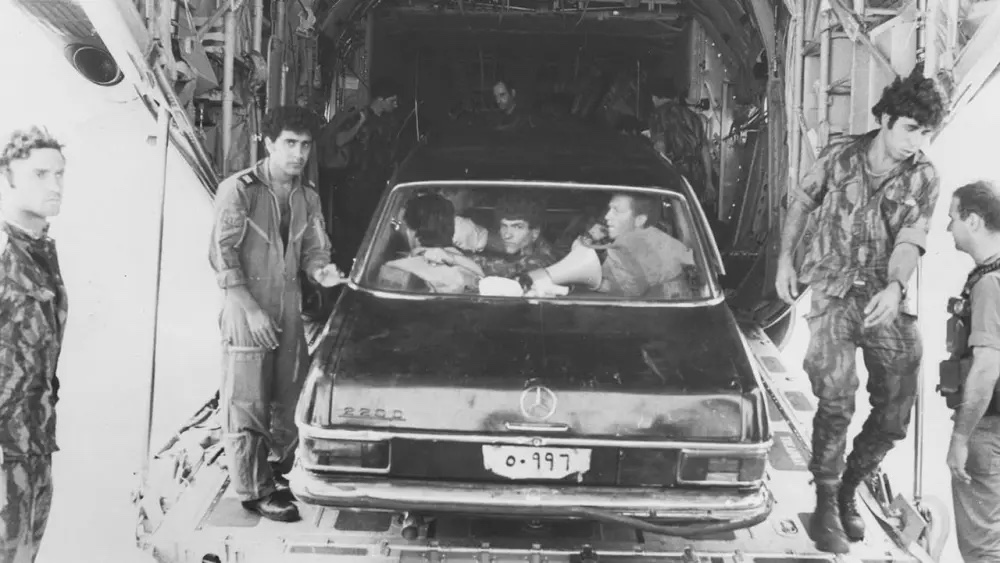
Sayeret Matkal commandos pose with the black Mercedes they used to deceive Ugandan troops during the hostage rescue at Entebbe Airport on July 4, 1976. Credit: IDF Spokesperson.
Fifty-three minutes that changed history
Everything that followed unfolded in just 53 minutes.
The Hercules touched down shortly after 11 p.m.
Its rear ramp opened.
The Mercedes rolled onto the runway, flanked by two Land Rovers.
For a few moments, the deception worked.
Then Ugandan soldiers near the control tower challenged the approaching convoy and opened fire.
“The silent approach had exhausted itself,” Ilan said.
“There was no more surprise.”
The commandos leapt from the vehicles and sprinted toward the terminal.
Inside were four terrorists guarding the hostages.
Outside, Ugandan troops had begun returning fire.
The greatest fear had always been that the terrorists would start executing hostages the moment they realized Israeli forces had arrived.
Instead, the assault team reached them first.
Within moments, all four terrorists inside the terminal were dead.
Only then did Ilan allow himself to look at the people lying on the floor.
“Once we secured the hall, understanding that we had killed the terrorists there, meaning no harm could be done to the hostages anymore, and realizing that the great majority of the hostages were alive and well, our tense posture suddenly fell away.”
What replaced it surprised him. Relief gave way to humor.
One bewildered hostage looked up and asked him how they were supposed to get home.
“Did you bring a plane?” she asked.
Even now, Ilan smiles at the memory.
“I told her, ‘What do you think? You want to walk home? It’s a bit far.’”
For a fleeting moment, amid the gunfire and confusion, people laughed.
Outside, the fighting continued.
Israeli forces secured the airport while engineers destroyed Uganda’s Soviet-made MiG fighter aircraft to prevent pursuit.
Somewhere during those frantic 53 minutes, Ilan saw Netanyahu struck by enemy fire.
He knew immediately that his commander had been hit.
What he did not know was that the wound would prove fatal.
Netanyahu was evacuated aboard one of the Hercules aircraft and later died of his wounds en route to Nairobi. He was the operation’s only Israeli military fatality, and the mission, originally named “Operation Thunderbolt,” was later renamed “Operation Yonatan” in his memory.
Yet when Ilan thinks back to that night, his thoughts return not to the battle outside, but to the silence that followed inside the terminal.
“Their faces,” he said quietly.
“I still see their faces.”
Remembering Yoni
Yoni Netanyahu had commanded Sayeret Matkal for only a few months before the operation. Ilan and his teammates were among the unit’s most senior soldiers, he admits with a smile, and they were not inclined to make life easy for their new commander.
“We were probably judging him every step of the way,” he said.
There simply wasn’t enough time for that relationship to grow.
The operation that made Netanyahu a national symbol also claimed his life.
Today, Ilan believes Israelis know the military hero. Fewer know the man behind the uniform.
“Yoni was, in addition to being a professional and outstanding soldier, a spiritual person,” he said. “Israelis became aware of that when his poems and thoughts were published after his death. Still, I believe that side of him remained more in the shadow.”
Ironically, “Operation Entebbe” is not the mission that left Ilan with the deepest scars.
Long before Uganda, he had already taken part in two hostage rescue operations that ended very differently. In May 1974, Palestinian terrorists seized a school in Ma’alot in the Galilee, killing 25 hostages, including 22 children, during the rescue attempt. The following year, terrorists seized Tel Aviv’s Savoy Hotel, killing eight civilian hostages and three Israeli soldiers after detonating explosives inside the building. Ilan participated in both operations.
“I don’t really have post-traumatic memories from Entebbe,” he said. “We had been through more traumatic events before.”
Entebbe, he said quietly, “went very smoothly.”
Courage beyond the commandos
Perhaps that is why, when asked what history has overlooked, Ilan doesn’t mention the Israeli commandos.
Instead, he speaks about the crew of Air France Flight 139.
When the non-Israeli passengers were released several days before the rescue, Captain Michel Bacos and his crew were offered the opportunity to leave.
They refused.
Knowing they might never leave Uganda alive, they chose to remain with their Jewish and Israeli passengers until the very end.
“For me,” Ilan said, “their bravery has always been overshadowed.”
A different hostage crisis
Nearly five decades later, another hostage crisis unfolded.
This one, Ilan watched from Texas.
On Oct. 7, 2023, his younger daughter was visiting Israel with her American boyfriend. They were staying in the country’s south, near Eilat.
“I woke up and had 10 missed calls,” he recalled.
At first, he assumed Hamas had launched another round of rocket fire. Only gradually did he realize Israel was facing something entirely different.
His daughter made it safely to his apartment in Netanya before returning to the United States two days later.
Others were not so fortunate.
Many people have drawn comparisons between Entebbe and Oct. 7.
Ilan does not.
“I was careful not to equate the Entebbe hostages with those of Oct. 7,” he said. “The reality is completely different.”
Entebbe lasted days.
The hostages taken on Oct. 7 endured captivity measured in months and, for some families, years.
“The times and circumstances were so different,” he said.
Then he paused.
“We were also lucky.”
He recalls what the pilot of the Hercules aircraft reportedly told Prime Minister Yitzhak Rabin after landing back in Israel.
“God worked overtime today.”
Yet despite everything that has changed over the past half century, Ilan believes one principle has remained constant.
Israel does not abandon its people.
Asked whether that commitment feels any different today than it did in 1976, he answered without hesitation.
“Not at all.
“It is the same promise. The same commitment. The same devotion.”
Preserving the story
For Ilan, preserving that story has become a responsibility of its own.
A decade ago, he joined fellow veterans in publishing Entebbe Declassified, a collection of first-hand accounts written by every participant in the operation, from commandos to pilots. Published by HaMasder, the Sayeret Matkal veterans’ association, the book helps support the organization’s work with at-risk youth, veterans and, since Oct. 7, wounded soldiers, trauma survivors and the widows of unit members.
Asked what he would say to the young commando climbing aboard a Hercules transport aircraft on July 3, 1976, Ilan doesn’t mention history, heroism or sacrifice. His answer is as practical as the act of heading to Uganda on a secret mission because it was simply the right thing to do.
“I’d say, ‘Go do the job. And come back in one piece.’”
Want more news from Israel?
Click Here to sign up for our FREE daily email updates