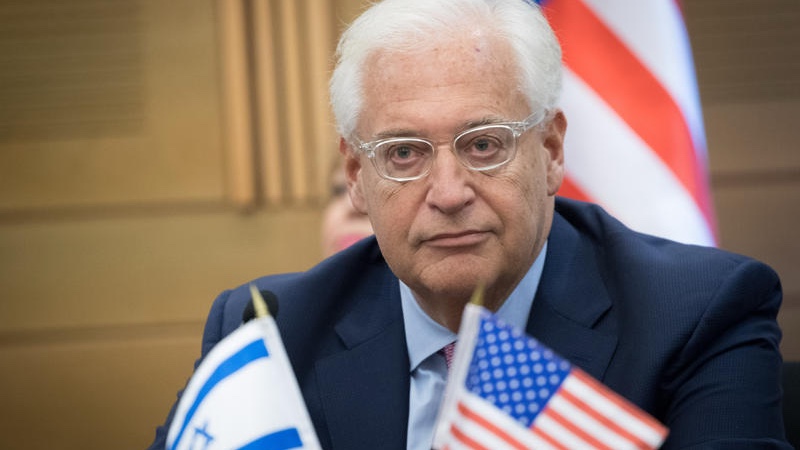

Former US Ambassador to Israel David Friedman is warning Congress that reviving the push for a Palestinian state would not expand the Abraham Accords. It would endanger them.
In written testimony released ahead of a Wednesday hearing of the House Foreign Affairs Committee’s Middle East and North Africa Subcommittee, Friedman argued that efforts to make Palestinian statehood the price of further Arab-Israeli normalization are detached from the post-Oct. 7 reality.
Friedman stressed that the Abraham Accords succeeded because they broke the old diplomatic formula that gave Palestinian leaders a veto over Israel’s relations with the Arab world.
That formula dominated Western diplomacy for decades. Israel, the argument went, could not be accepted by its neighbors until it first reached a final-status agreement with the Palestinians. The 2020 Abraham Accords shattered that assumption, producing normalization agreements between Israel and the United Arab Emirates, Bahrain, and Morocco, with Sudan also joining the framework.
Friedman says returning to the old model now would reward failure and invite more bloodshed.
In his submitted testimony, he wrote that Israel had already tried the two-state approach and paid a catastrophic price. Gaza, evacuated by Israel in 2005 under US “guarantees,” became a Hamas terror enclave. On Oct. 7, 2023, that enclave became the launching pad for the worst massacre of Jews since the Holocaust.
And even in the terrible aftermath of those events, the West still fails to absorb the lesson. A Palestinian state is in fact being discussed with even greater frequency in Washington and Europe as if it were the solution, and that having failed to establish a Palestinian state alongside Israel earlier was the reason for Oct. 7, an argument that plays right into Hamas hands. But Israelis know that a Palestinian state means rockets over Tel Aviv, tunnels under border communities, and Iranian-backed terror armies positioned closer to Israel’s population centers.
Some in Israel have been trying to get this message across for decades.
Benjamin Netanyahu, at 28 years old, warned the world:
“A Palestinian state means more war, not peace.”
He was right all along. pic.twitter.com/hf5yBiHgeP
— Vivid.🇮🇱 (@VividProwess) July 6, 2026
Friedman argued that prospective Abraham Accords partners, including Saudi Arabia, understand the regional danger more clearly than many Western officials. Arab states that fear Iran, jihadist movements and regional instability are not looking for another failed entity run by extremists or corrupt Palestinian factions. They are looking for security, technology, intelligence cooperation, and access to Israel’s economic and strategic weight.
That is why tying Saudi normalization to Palestinian statehood would not be a clever compromise. It would be a strategic mistake.
The Abraham Accords were built on the simple recognition that the Middle East does not need to wait for Palestinian leaders to accept Israel before the region moves forward. The agreements told Ramallah and Gaza that rejectionism would no longer freeze the entire Arab world in place.
That message remains essential after Oct. 7.
The war has only strengthened the case that Palestinian political culture must change before sovereignty can be responsibly discussed. Hamas is still a threat. The Palestinian Authority still lacks legitimacy, still glorifies terrorists, and still refuses to prepare its people for coexistence with the Jewish state.
Statehood under those conditions would not produce peace. It would internationalize the conflict, harden Palestinian maximalism, and force Israel to deal with yet another hostile border.
Friedman’s testimony is likely to sharpen a growing debate in Washington over whether the next phase of Arab-Israeli normalization should build on the logic of the Abraham Accords or surrender it.
For Israel and its allies, the answer should be obvious. Peace in the region advances when Arab governments deal with Israel as a legitimate power and partner, not when Palestinian rejectionism is rewarded with sovereignty.
Want more news from Israel?
Click Here to sign up for our FREE daily email updates