
It takes a special kind of moral confusion to look at the Middle East in 2026 and decide that one of the urgent threats to peace is a Jewish community putting up a fence inside its own municipal boundary.
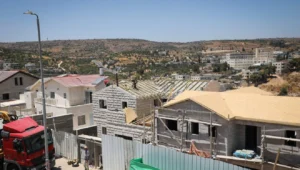
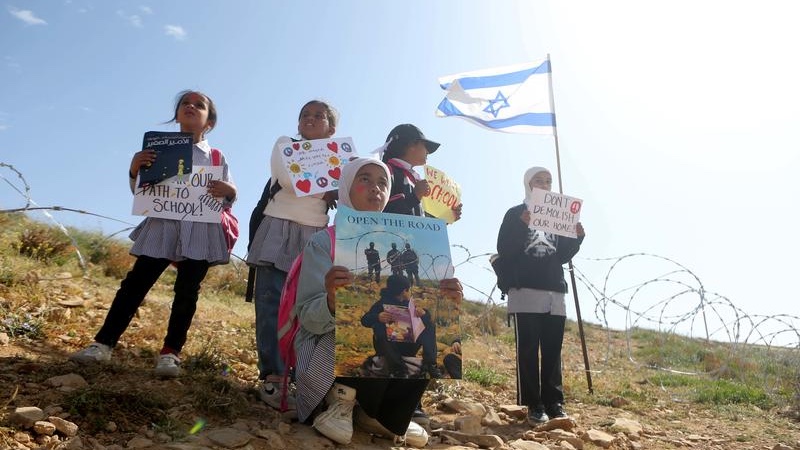
Yet that is precisely where 111 House Democrats landed last week, urging Prime Minister Benjamin Netanyahu to order the removal of a barbed-wire fence near the community of Carmel in the South Hebron Hills.
Their complaint: Children from the nearby Bedouin village of Umm al-Khair can no longer use their preferred shortcut to school. The lawmakers branded Carmel residents “extremists,” accused the IDF of protecting the fence, and warned that this local dispute is damaging Israel’s relationship with the United States.
This is how “extremism” loses its meaning, one bout of manufactured outrage at a time.
According to Israeli officials and the Mount Hebron Regional Council, the fence was erected within Carmel’s municipal boundaries. The IDF has said there is a safe alternative route to the school that does not require Palestinian students to pass through the Jewish community. Regional council head Eliram Azulay even filmed himself driving the alternate route in about 70 seconds.
The lawmakers on Capitol Hill argue that the route roughly doubles the distance and creates more chances for “negative and traumatizing interactions with settlers.” But that is exactly the point of the fence: to prevent daily friction by keeping hostile foot traffic out of Carmel.
And the reaction of the local Jewish community cannot be chalked up to mere paranoia. Carmel residents point to repeated intrusions from Umm al-Khair and, most dramatically, a 2022 funeral procession that passed through the community with Hamas flags on display. Imagine white supremacists marching through a black neighborhood in America waving KKK flags, then watching Congress lecture the residents for wanting a fence.
There is another fact missing from the “poor villagers versus extremist settlers” script. The Mount Hebron Regional Council says Umm al-Khair, or parts of it, constitute an illegal outpost built on land belonging to Carmel. Israel’s Civil Administration has issued demolition orders for 13 structures there.
Pro-Palestinian voices will argue Umm al-Khair has existed since 1948 after Bedouins from the Negev region were displaced during Israel’s War of Independence, while Carmel was established nearly half-a-century later in the 1980s. But aerial photography from 1999 reveals that in that year there was no established Arab village adjacent to Carmel, only four makeshift dwellings used by Arab laborers who worked in the Jewish community.
80 years, you say? A village, you say?
Not quite.
“Umm al Khair” is a very old name – but that’s the only thing about it that wasn’t invented after the Israeli village of Carmel – a biblical community brought back to life by modern pioneers intent on reversing the ethnic… pic.twitter.com/yBDicXc7Q0— Regavim (@RegavimEng) February 19, 2026
In other words, the people being cast as victims of “settler extremism” are, by Israel’s account, the ones who illegally established themselves inside the Jewish community’s municipal area.
None of this means every local dispute is simple. But it does show how easily Western politicians flatten every story into the same tired morality play: Palestinians as helpless natives, Jews as aggressive intruders, Israeli security as oppression.
A fence built to stop provocations is turned into an international scandal. Hamas flags are treated as irrelevant. Jewish residents trying to secure their own community are branded “extremists.”
It’s not hard to see what’s happening here.
This isn’t serious diplomacy. It’s another round of ideological theater, this time dressed up as concern for children.
Want more news from Israel?
Click Here to sign up for our FREE daily email updates