

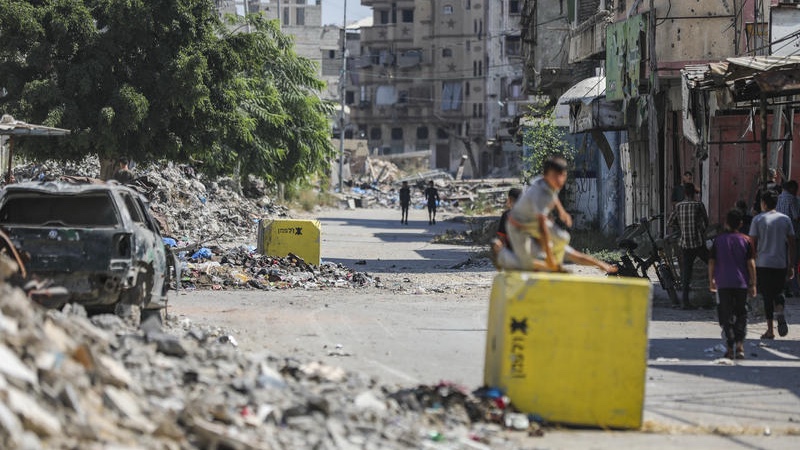

US President Donald Trump is calling the new 15-point roadmap for Gaza “a great breakthrough,” arguing that few believed Hamas could ever be brought to the point of accepting disarmament in principle.
But the document published by the Board of Peace appears less like a final agreement than a high-stakes implementation framework for the next stage of Trump’s broader Gaza peace plan.
In other words, this is not the original plan to end the war. It is the mechanism for trying to move from ceasefire promises to actual changes on the ground.
The roadmap reaffirms Trump’s Comprehensive Peace Plan for Gaza and UN Security Council Resolution 2803 as the agreed international framework. It calls for Israel to complete its remaining commitments under the Sharm Sheikh Protocol, especially the cessation of military operations, while Hamas and other Palestinian factions are likewise required to stop military activity.
Within 14 days of approval, the parties are supposed to prepare the timetable and mechanisms for implementation. Only then would the National Committee for the Administration of Gaza, or NCAG, enter the Strip and begin assuming responsibility.
The heart of the plan is the principle of “One Authority, One Law, One Weapon.” Civilian governance and security functions would be handed to the NCAG, which is described as an interim technocratic Palestinian governing body. Hamas and other factions would be barred from interfering in its work.
On paper, that is a dramatic shift. Gaza would no longer be ruled by Hamas, and heavy weapons, military production sites, weapons depots, and tunnels would be decommissioned under NCAG authority, monitored by an International Verification Committee, and supported by an International Stabilization Force.
But the fine print matters.
The roadmap says no weapons will be handed over to Israel or other non-Palestinian parties. It also says personal weapons will be regulated according to Palestinian law, a clause that could leave room for Hamas members or affiliated operatives to retain arms under another label.
That concern was reinforced by Hamas official Ghazi Hamad, who told Reuters the group accepted the roadmap’s conditions but did not commit to laying down its weapons before Israel stops operations and withdraws to the Oct. 7, 2023 border line.
Members of Prime Minister Benjamin Netanyahu’s coalition are already pushing back. National Security Minister Itamar Ben-Gvir said the draft is unacceptable, warning that halting targeted killings of wanted terrorists would allow Hamas to regroup for another massacre.
Trump says Israel is “very happy” with the roadmap. Perhaps. It has more teeth than past roadmaps, and Trump is a very different president from his predecessors. But Jerusalem will be watching one question above all others: Does this plan truly dismantle Hamas, or merely move its weapons and men into a new Palestinian framework?
That question will determine whether this is a breakthrough, or just another document promising Gaza a future while leaving Hamas a way back in.
Want more news from Israel?
Click Here to sign up for our FREE daily email updates







There is NO way Israel should make any deal with Hamas or it will be right back to King Saul’s disobedience when he did not totally wipe out the Amalekites!