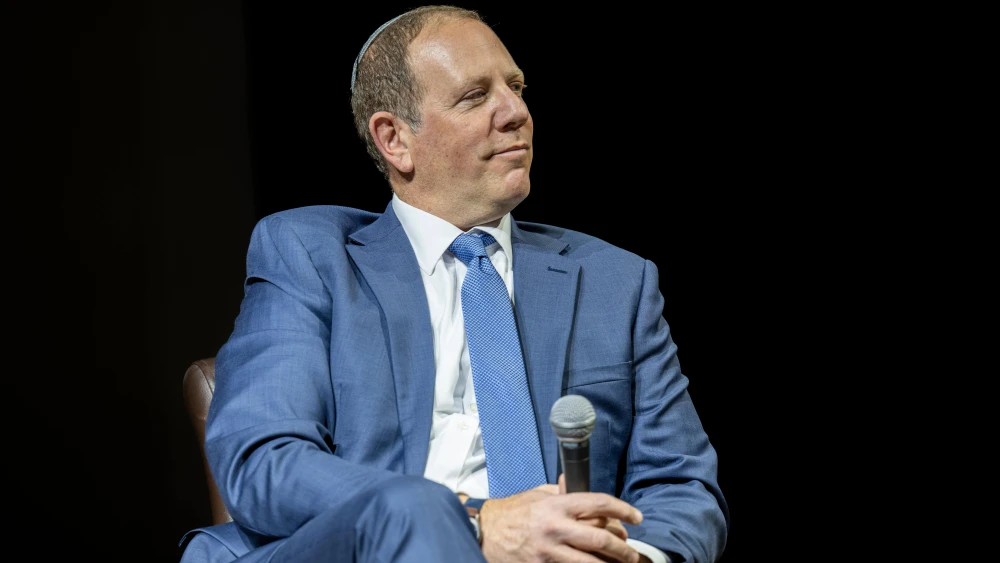
(JNS) Israel will unequivocally reject any Gaza Strip ceasefire framework that fails to require the total disarmament of Hamas, Prime Minister Benjamin Netanyahu’s new international spokesperson said on Monday, warning that the terrorist group must be completely stripped of its arsenal before Israel considers withdrawing it troops.
“The prime minister is not going to do anything that is going to put the Israeli people at risk,” Doron Spielman told JNS, emphasizing that Netanyahu is “aware of Hamas’s intentions” and that the group is “just as committed to terrorism today” as it was when it led the Palestinian massacre of Israelis on Oct. 7, 2023. “The only thing they’re lacking is the ability” to carry out another atrocity, he added.
Netanyahu insists the terrorist group must “truly disarm” before any agreement moves forward, the spokesperson said. “By truly disarming, I mean all of their weapons are going to be handed over and removed from the area, from Gaza,” Spielman said the premier told him.
Netanyahu on Sunday announced that Jerusalem rejects the roadmap on Hamas disarmament announced by US President Donald Trump’s Board of Peace on July 30.
If all of the weapons are not removed, it “would enable Hamas to reconstitute itself,” Spielman, appointed to the position on July 1, said in a phone interview from Ma’ale Adumim. “And therefore the 15-point plan is not accepted by Israel because it removes the teeth from the 20-point plan, which is that Hamas has to disarm before anything moves forward.”
Trump introduced the 20-point plan to end the Israel-Hamas war in September of last year, requiring Hamas to lay down its arms, and Jerusalem accepted the framework. The recent 15-point plan was reached with Hamas terrorists through Qatar, Turkey and Egypt, and Jerusalem is not a party to it.
Shift in national security doctrine
Spielman outlined a historic pivot in Jerusalem’s approach to the northern front in Lebanon, returning to the defense principles of Israel’s founding prime minister, David Ben-Gurion. To protect its citizens, the military is holding a critical buffer zone and engaging Hezbollah threats preemptively rather than waiting for attacks on Israeli soil.
“Ben-Gurion specifically said that Israel should not be fighting wars in its own territory. It should be fighting wars in the enemy’s territory,” Spielman said. “It is a fundamental shift in Israel’s security outlook, which is Israel is not responsive. Israel at this point is very much willing to initiate in order to protect Israeli citizens.”
Tehran only respects threat of force
Regarding the Iranian threat, Spielman pointed out that Tehran deepened its ties with Turkey and Pakistan over the last month, a dynamic that tested the trilateral Mecca Joint Defence Agreement signed by Ankara, Islamabad and Riyadh on Aug. 7.
He noted that after Yemen’s Iranian-backed Houthis fired missiles at Saudi Arabia over the weekend, the regime in Tehran would see any lack of a military response from Riyadh as a sign of weakness.
By contrast, Spielman said the Jewish state maintains its security through overwhelming deterrence and a clear willingness to act against the Islamic Republic.
“There’s only one country that Iran’s not shooting against, which is Israel,” he said. “Why aren’t they shooting against Israel? Because they know, as the prime minister said, we will deal them a blow that they will never forget.”
He praised the unique relationship between Jerusalem and Washington, noting that both nations have demonstrated the necessary resolve to respond forcefully to regional aggression.
“Iran understands one thing. One thing. The threat of force,” Spielman said. “And that is what’s keeping Israel safe.”
Warnings on Saudi nuclear program
Addressing broader Middle East developments, the spokesperson expressed grave concern over Saudi Arabia’s push for a civilian nuclear program. He confirmed that Netanyahu has discussed this issue directly with Trump, stressing the danger such a program could pose to regional stability.
“Every military nuclear program began with a civilian nuclear program. Every one,” Spielman said. “There have to be safeguards and guardrails in place that have to be clarified.”
Challenge to NATO regarding Turkey
Spielman delivered a sharp rebuke of Ankara, condemning Turkish President Recep Tayyip Erdoğan’s “duplicitous” foreign policy and regional expansionism. He noted that Turkey has taken over an enormous swath of territory in Syria and continues to occupy more than a third of Cyprus while concurrently deepening its alliance with the Iranian regime.
“They support terrorism, they fund terrorism, they fund extremism,” Spielman said. “You can’t be duplicitous and on one hand turn to the West and say you’re a member of NATO, and on the other hand turn to Iran and continue supporting terror. … I would leave the question at NATO’s doorstep.”
Resilience of the Abraham Accords
Despite the ongoing multi-front war and hostility from nations such as Pakistan, Spielman said there are “serious prospects” for expanding the Abraham Accords. He emphasized that existing normalization agreements have endured what he called “the most trying time the Middle East has faced, perhaps ever.”
“It shows that these are not just on paper. These are real agreements that have practical implications, security implications, intelligence implications,” Spielman said. “It’s a very positive thing and we look forward to expanding it.”
Want more news from Israel?
Click Here to sign up for our FREE daily email updates