

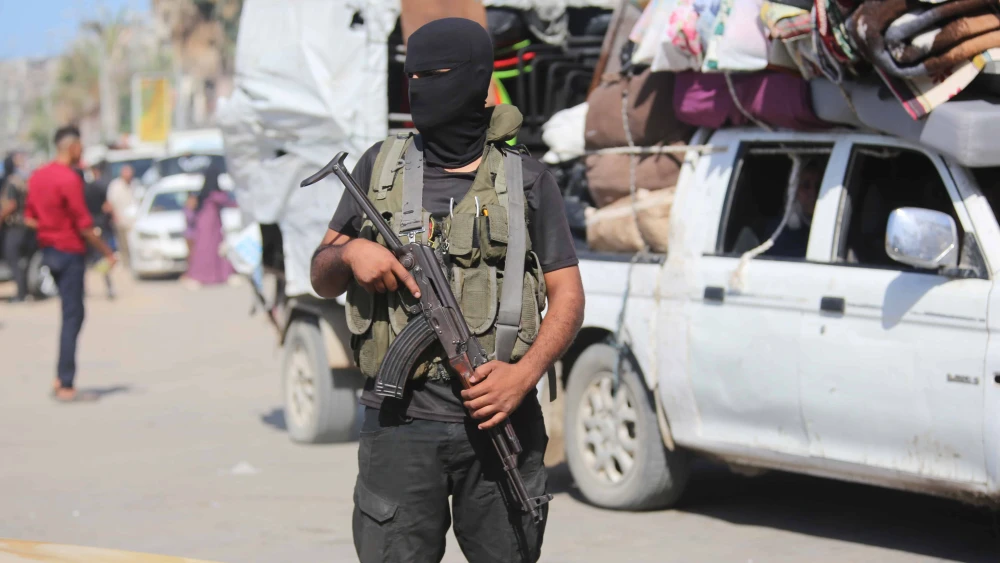
(JNS) The Palestinian Authority’s “pay-for-slay” program helped make the Oct. 7, 2023, Hamas attack possible. That is the contention of a July 30 study by the Jerusalem Center for Security and Foreign Affairs (JCFA), which concluded that the PA’s policy of financially supporting terrorists “materially facilitated” Hamas’s ability to “prepare for and execute” the massacre.
The PA “pay-for-slay” program provided indirect support for Oct. 7, IDF Lt. Col. (res.) Maurice Hirsch, author of the study and the director of the JCFA’s Palestinian Authority Accountability Initiative, told JNS.
His report, titled “Did the PA’s ‘Pay-for-Slay’ Policy Facilitate the October 7 Massacre?” caught the attention of Israel’s Foreign Ministry. “The Palestinian Authority’s pay-for-slay policy helped bankroll Hamas’s future leadership,” the ministry posted to its X account.
The Palestinian Authority’s pay-for-slay policy helped bankroll Hamas’s future leadership.
A new study finds it paid hundreds of millions to released terrorists – including those who went on to plan and lead the October 7 massacre.https://t.co/bFz5dXupLy
— Israel Foreign Ministry (@IsraelMFA) July 31, 2026
The study focused on terrorists released in the 2011 Shalit deal. In that prisoner-exchange, 1,027 terrorists were set free to secure the release of IDF soldier Gilad Shalit, who was captured in a Hamas cross-border raid in 2006.
Of those, several hundred were released to their homes in the Gaza Strip. Many of them would arrange and carry out the massacre, including Yahya Sinwar, the head of Hamas and the mastermind of Oct. 7.
All were eligible to receive payments from the PA as “employees,” a reward for their terrorist activities. “If the terrorists were required to actually work, instead of living on the PA/PLO terror payments, they would not have been able to dedicate themselves to planning and executing the massacre,” Hirsch wrote in his report.
PA responsibility for the Oct. 7 massacre goes beyond “general incitement and promotion of terror,” and the “ex post facto ratification” of terrorist attacks through pay-for-slay payments, he said. “Rather, the PA/PLO’s responsibility for the Oct. 7 massacre also rests on the fact that they employed terrorists, simply for being terrorists, and those terrorists, while in the employ of the PA, carried out the massacre.”
Zaher Jabarin, Rawhi Mushtaha and Tawfiq Abu Naim were all involved in the planning, directing, financing and carrying out of the Oct.7 massacre.
Jabarin was dubbed the “CEO of Hamas” by The Wall Street Journal in January 2024 for his role in securing the funds to attack Israel. He served 18 years of a life sentence prior to the Shalit deal. Exiled, he is based in Turkey.
Mushtaha, Sinwar’s right-hand man at the time of the Oct. 7 massacre, served 23 years of his four life sentences.
Abu Naim served 22 years in prison. He headed Hamas’s internal security force during the Oct. 7 massacre.
Their many years in Israeli prison before their release in the Shalit deal entitled them to senior PA positions with commensurate salaries.
Another terrorist, Wessam Farhat, spent 10 years in prison. He, too, was entitled to PA remuneration, though not at the same pay scale as the others. He helped plan Oct. 7 and directed Nukhba Force terrorists to infiltrate the Nahal Oz kibbutz and an IDF post.
Mushtaha, Abu Naim and Farhat were eliminated in Israeli airstrikes. Only Jabarin remains alive. “He is currently tasked with implementing the decision to resume suicide attacks within Israel,” Hirsch said.
While Hirsch can’t show PA pay slips for Sinwar and the others, all indications point to their having received payments. According to Palestinian law, every released terrorist is entitled to remuneration without exception—a fact PA officials admitted to Hirsch, an attorney, upon cross-examination in Israeli courts.
Further evidence that Sinwar and the others received salaries is that “the PA specifically changed the law in order to cater to these people,” Hirsch said, referring to a 2013 amendment to the Law of Prisoners following the Shalit deal, which required the PA to provide jobs to released security prisoners. If the PA couldn’t find them a job, it would supply a monthly sum.
Another provision in the amendments referred specifically to terrorists in the Shalit deal expelled from Judea, Samaria and Gaza, ensuring that they, too, would receive payment.
In Judea and Samaria, payments are made through standalone ATM machines. In Gaza, the PA provides payouts through authorized money lenders. The exact amount provided to imprisoned and released terrorists is unknown. Hirsch estimates it to be in the many hundreds of millions of shekels each year.
Hirsch hopes his study will provide a still stronger basis for lawsuits against the PA for its role in the Oct. 7 massacre. While thousands of such suits have been brought, their argument is that the PA rewarded the Hamas attackers through pay-for-slay. Hirsch said that it could be argued, as he does in the report, that the PA was the Hamas attackers’ employer.
“When you are employed by someone and you conduct an action which is perceived to be part of your employment, and that action causes damage, then your employer will be responsible for your action,” he explained. “The PA paid these terrorists because they were terrorists.”
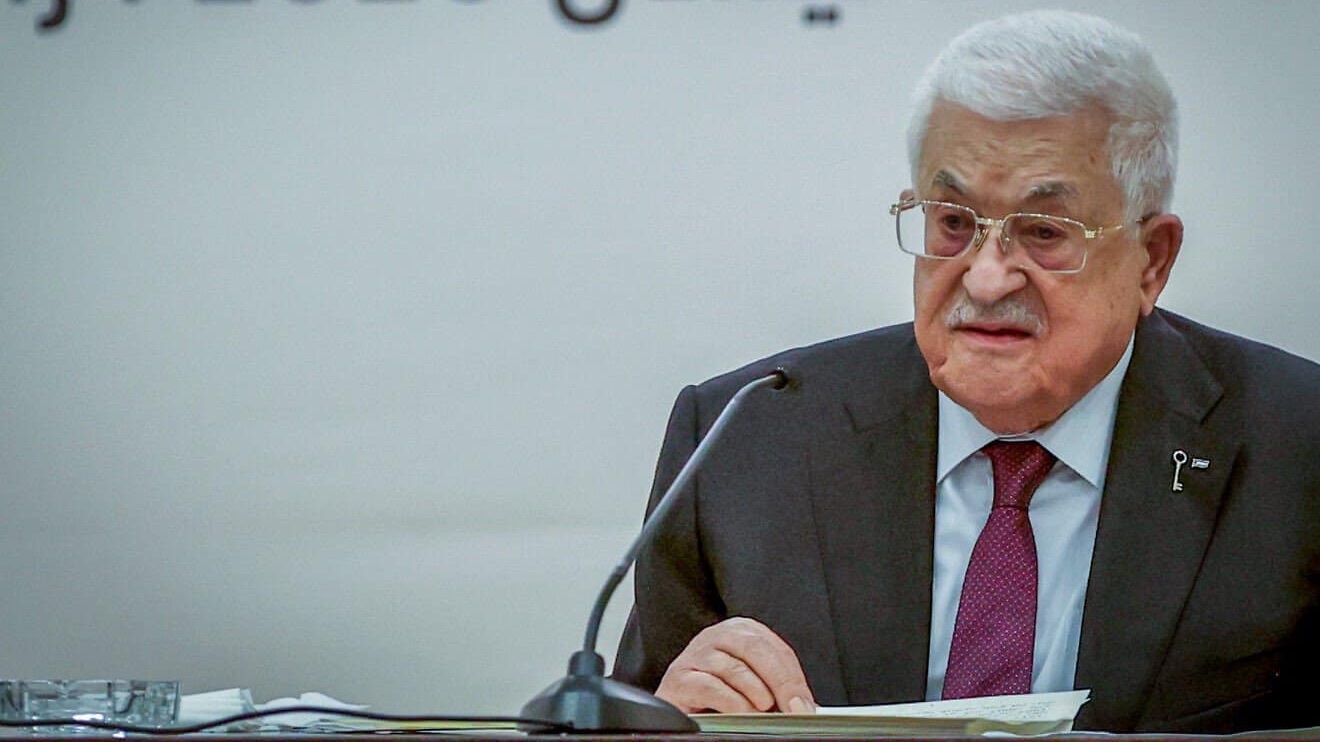
Noting that PA chief Mahmoud Abbas has since called for the release of all the terrorists, Hirsch said, “Not only did he employ them for being terrorists, but he has actually taken them under his wing and is fighting for their release.”
Want more news from Israel?
Click Here to sign up for our FREE daily email updates






There is coming a battle on the mountains of Israel, that will produce the largest grave site in the world, the name of it will be Hamon-gog, the grave site of jihad. From the prophecy of Ezekiel 39.