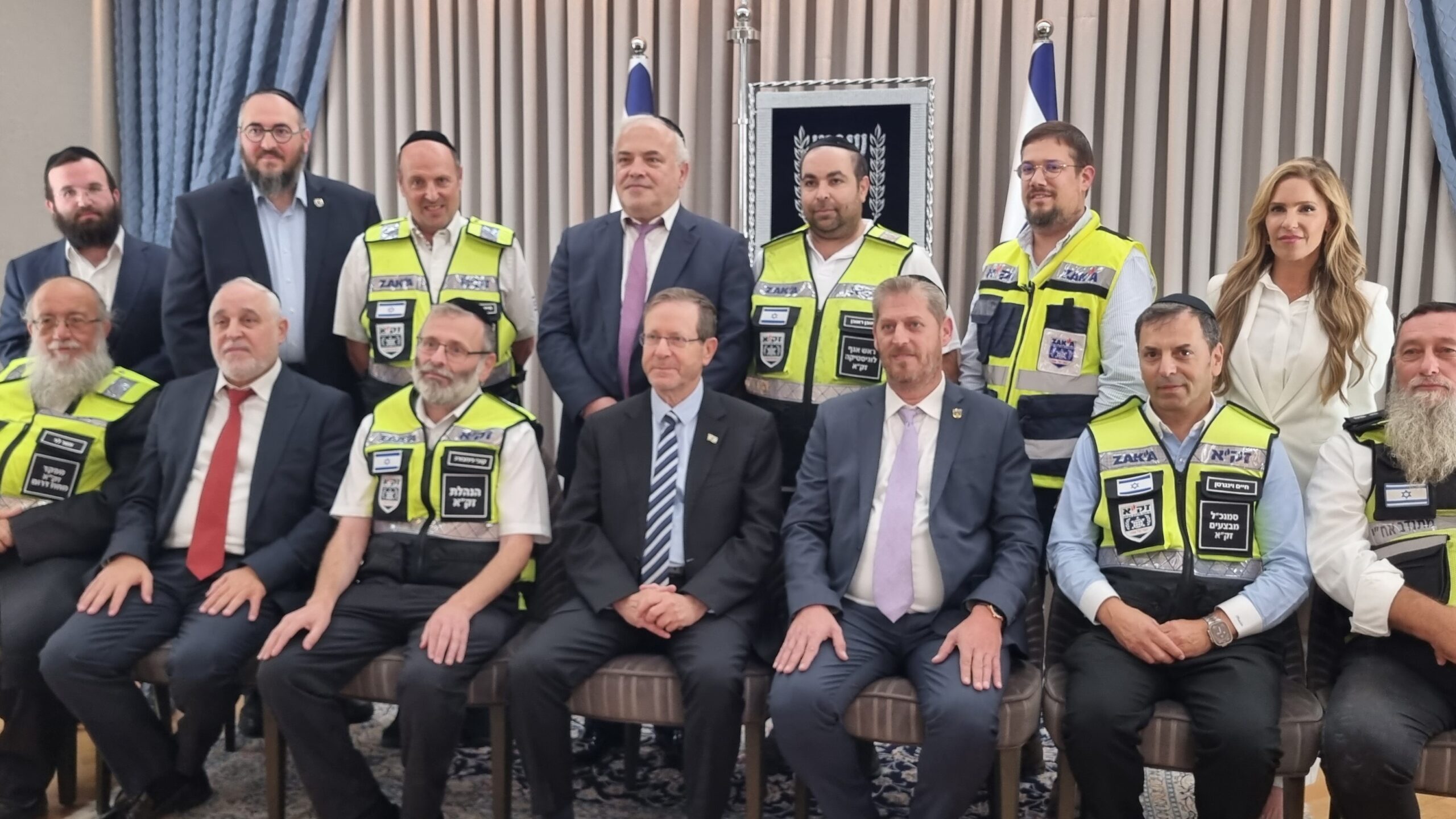
(JNS) Israeli President Isaac Herzog paid tribute to ZAKA volunteers at the President’s Residence in Jerusalem on Tuesday, describing their work as a form of “continuous duty” that begins when the work of many other emergency responders ends.
“We know how to say thank you to soldiers; we know how to thank doctors, paramedics and firefighters,” Herzog said. “But when we come to thank you, the people of ZAKA, it seems the words are missing.”
The president said the work of ZAKA volunteers is difficult to talk about.
“We hear on the news ‘the scene was treated,’ and we move on with our day,” he said. “We do not stop to ask who treated it, how many hours it took, at what hour of the night, or with whose hands.”
ZAKA volunteers specialize in recovering human remains and personal effects following terrorist attacks, accidents, disasters and other unnatural deaths, enabling victims to be identified and buried with dignity and in accordance with Jewish law. The organization also operates search-and-rescue and emergency response units.
Herzog distinguished ZAKA’s work from that of other emergency services.
“In every emergency profession, there is a certain moment that can be called ‘success,’” he said, citing the return of a pulse, a child rescued from a fire or a voice heard beneath rubble.
“You have no such moment,” he continued. “You always arrive after the storm, always to a place where there is already nothing left to save.”
For ZAKA volunteers, Herzog said, success is measured differently.
“Your success, rather paradoxically, is rest. Not your rest, but the eternal rest of someone else, which only you in this world can give him.”
That concept, he said, is reflected in the organization’s religious motivation and the Hebrew phrase chesed shel emet, “true kindness,” referring to a mitzvah performed without expectation of repayment.
Herzog turned to the biblical Book of Ezekiel, drawing a connection between the prophet’s description of a devastated land after war and the painstaking work of those who recover the dead.
He quoted the passage describing people who search the land and, upon finding a human bone, mark the spot.
“These verses are wondrous in my eyes and describe your sacred work so well,” Herzog said.
The president emphasized the importance of ensuring that every victim is accounted for.
“A person does not cease to be a person the moment he dies; he ceases to be a person only if no one comes to look for him,” he said.
For families, he said, ZAKA does not necessarily bring comfort.
“There is no comfort,” Herzog said. “What you bring to a family is something else, perhaps small but immense, a place. A grave one can stand beside, a space on which one can place a stone.”
ZAKA’s work became especially visible following the Oct. 7, 2023, Hamas massacre, when volunteers were dispatched to massacre sites across southern Israel to recover remains and assist with identification. However, the organization’s work did not begin on Oct. 7, or even during the waves of terrorist attacks of the 1990s and early 2000s.
The organization traces its origins to 1989, following the terrorist attack on Egged bus 405, when religious volunteers began organizing systematically to recover victims’ remains. It subsequently developed into a national network of volunteers and specialized search-and-rescue units. Not all the units consist of religious Jews.
The president also addressed something less visible: what happens to the volunteers when they leave the scene.
“You return home in the morning, take off the uniforms, and sit down at the breakfast table with the children,” Herzog said. “And no one around the table knows what you did during the night.”
“There is a price to this, a heavy price,” he added, urging volunteers who need assistance not to remain alone with their experiences.
That issue has become a central part of ZAKA’s work.
Dr. Vered Atzmon Meshulam, a medical psychologist with more than two decades of experience in end-of-life care, heads ZAKA’s Resilience Division.
She became involved with the organization after Oct. 7 and helped establish its first dedicated resilience department, designed to provide emotional and spiritual support for volunteers and first responders dealing with the trauma of recovering human remains.
Atzmon Meshulam told JNS that she had written a new book, which she presented to Herzog, about resilience and “the power of the soul” that protects ZAKA volunteers.
She described chesed shel emet as “giving without getting anything back,” calling it the highest level of giving.
Her work combines clinical trauma approaches with Jewish spiritual practices, including prayer, song, writing, guided imagery and meaning-based reflection. She said she has accompanied more than 1,000 first responders.
The occasion also coincided with Herzog’s 66th birthday, and musicians unexpectedly marked it by singing “Happy Birthday” to the president, a lighthearted moment during an otherwise solemn gathering.
During the Beit Hanasi event, ZAKA CEO Dubi Weissenstern also presented Herzog with a framed piece connected to an official Israel Post stamp honoring ZAKA and its thousands of volunteers.
The stamp states: “Saving what is given, honoring what is left.”
The phrase captures the distinction at the heart of ZAKA’s mission: saving those who can still be saved, while ensuring that those who cannot are treated with dignity.
As Herzog concluded his remarks, he returned to the volunteers’ enduring presence.
“You are our men of continuous duty,” he said. “Thank you. Be strong and of good courage.”
Want more news from Israel?
Click Here to sign up for our FREE daily email updates