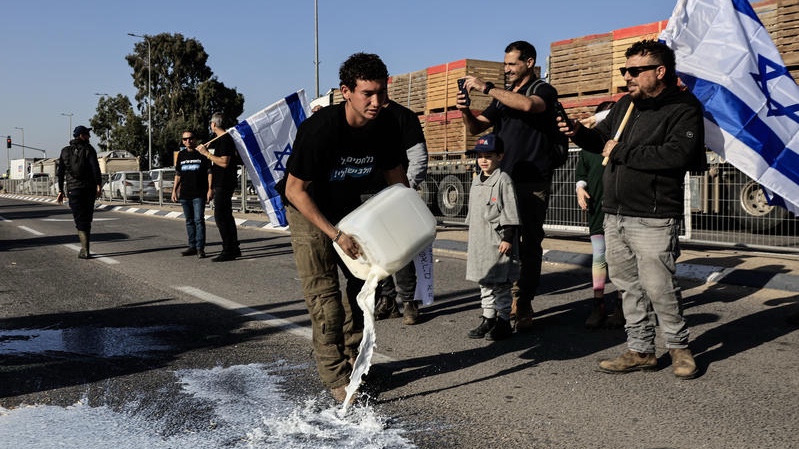

Hundreds of Israeli farmers took to the streets on Monday dumping thousands of liters of milk in protest of proposed agricultural reforms targeting the dairy industry.
The reforms, spearheaded by Finance Minister Bezalel Smotrich, would scrap current regulations and open Israel’s dairy market to foreign competition.
This comes in response to recurring nationwide shortages of price-controlled milk forcing many consumers to purchase increasingly expensive alternative products. Israel’s dairy industry is controlled by a small handful of conglomerates, which has also pushed prices up.
Rising dairy prices have resulted in a number of mass demonstrations in recent years, and the situation is routinely ranked as one of the top concerns of Israeli voters.
But the farmers who supply those dairy conglomerates argue that the proposed reforms and the sudden influx of foreign competition is a destructive approach that will force them to shut down and put an end to the local diary industry altogether.

“Protecting Israeli milk” – protesters in the Western Negev. Photo by Tsafrir Abayov/FLASH90
At junctions across the country, they held signs with slogans such as “We’re fighting for the future of agriculture” and “Zionism and security can’t be imported.”
Amit Yifrach, chairman of the Israeli Farmers Federation, declared at one protest: “The farmers and dairy farmers are the Iron Dome of food security for the State of Israel.”
In remarks carried by Israel’s Ynet news portal, Yifrach added that the government must not “eliminate a blue-and-white product that’s existed for 100 years. We won’t allow the finance minister to trample and destroy some 400 dairy farms for the sake of a reform that won’t bring down costs, but will create a dangerous dependence on imports.”
Asher Regional Council head Moshe Davidovich stressed that local agriculture is “an anchor of presence and security” that Israel dare not abandon.
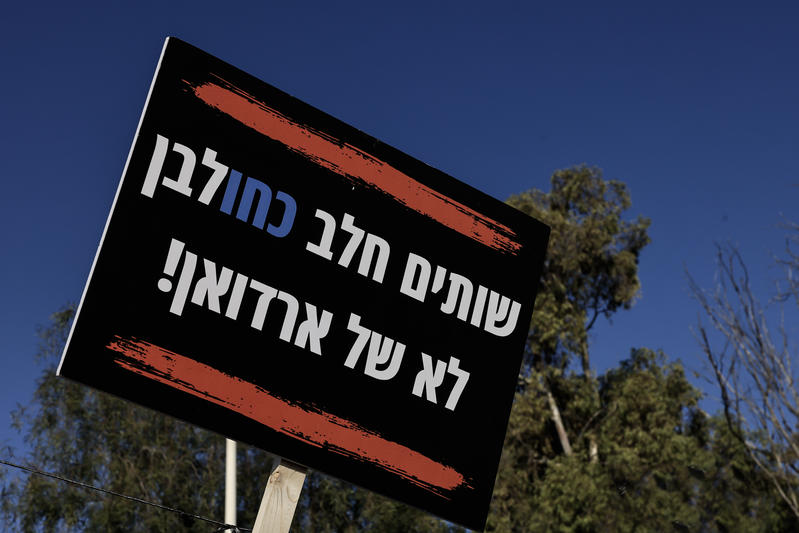
“We drink ‘blue-and-white’ milk, not the milk of Erdogan!” – a reference to the fact that Israel might have to import dairy from potentially hostile sources if the reforms go through. “Protecting Israeli milk” – protesters in the Western Negev. Photo by Tsafrir Abayov/FLASH90
Agriculture Minister Avi Dichter said at Monday’s Knesset Finance Committee meeting that he opposes the planned reforms, and has instead come up with a plan to “upgrade the dairy market, not destroy it.” No additional details were given on how that would be accomplished.
Dichter said he was confident the Finance Ministry’s reforms would be removed from the agenda.
A tricky balancing act
These challenges are not unique to the dairy industry. Israel is a tiny market, so local producers who rely primarily on local consumption (as opposed to exports) need to charge enough to justify staying in business.
At the same time, the cost of living in Israel is already among the highest in the OECD, and every increase can be painful for the majority of the population.
Israel could decide to simply forgo having its own local dairy industry outside boutique producers, and instead rely on imports. But given the history of global hostility toward Israel, this is seen as a risk that cannot be taken. Israel must maintain at least a basic level of food security.
Want more news from Israel?
Click Here to sign up for our FREE daily email updates