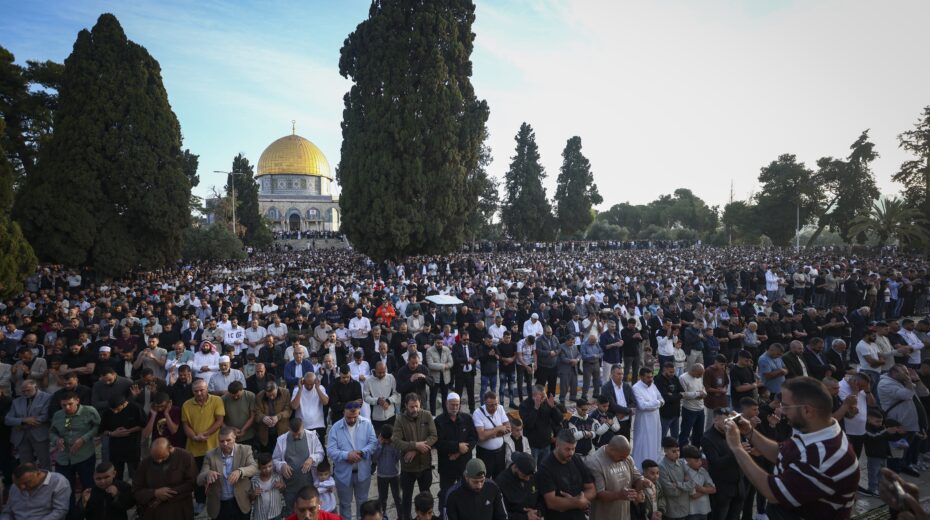

Israel’s Central Bureau of Statistics (CBS) has published its annual report on the Muslim population in Israel in time for Eid al-Adha, the Islamic Feast of Sacrifice. The holiday is celebrated from the tenth day of the Islamic month of Dhu al-Hijjah and lasts four days. It marks one of the high points of the Hajj pilgrimage to Mecca. The figures show a community undergoing demographic, educational, and social change.
Growth, birth rate, and family life
At the end of 2025, around 1.849 million Muslims lived in Israel — 18.6 percent of the country’s total population. The community grew by 34,000 people, but the growth rate slowed to 1.8 percent, down from 2.2 percent the previous year and 3.8 percent in 2000. This means that Muslim population growth remains higher than that of the Jewish population at 1.2 percent, the Christian population at 0.4 percent, and the Druze population at 0.8 percent, but the gap is steadily shrinking.
The birth rate has been declining continuously since 2001: in 2025, Muslim women had an average of 2.76 children — fewer than Jewish women, at 3.08, but more than Druze women, at 1.69, and Christian women, at 1.62. The year 2020 marked a historic turning point: for the first time, the birth rate among Jewish women, at 3.00, was higher than that of Muslim women, at 2.99. There are major regional differences: in the Southern District, the Muslim birth rate is highest at 4.55 children, while in Tel Aviv it is lowest at 1.63. This means that the birth rate among Muslims in Israel is higher than in many neighboring countries, such as Lebanon at 2.2 or Iran at 1.7, and similar to Egypt and Jordan, each at 2.7.
In 2024, 13,690 Muslim couples married in Israel, while 2,808 couples divorced. The age of marriage is rising: Muslim men married for the first time in 2024 at an average age of 27.2, and women at 23.7 — significantly later than in 1980. Around 25 percent of Muslim households have six or more members, compared with nine percent of Jewish households. The average household size is 4.27 people, compared with 3.00 among Jews. Life expectancy is 77.4 years for men and 83.1 years for women, compared with 82.6 and 86.4 years respectively among Jews.
Geographically, the Muslim population is concentrated primarily in the north: 33.6 percent live in the Northern District and 13.0 percent in the Haifa District. The city with the largest Muslim population is Jerusalem, with 395,200 people, representing 37.2 percent of the city’s population, followed by Rahat with 80,300, Umm al-Fahm with 60,900, and Nazareth with 56,300.
Education: women are catching up rapidly, while dropout rates remain a problem
In the 2024/2025 school year, 408,900 Muslim students attended Israeli schools — 20.2 percent of all students nationwide, including 7,100 in the Hebrew-language system. Some 40.4 percent of Muslim high-school students studied in technical-vocational tracks, more than among Jewish students, at 34.9 percent. Among Muslim high-school graduates, 75.8 percent earned a matriculation certificate; 50.0 percent met university entrance requirements — a slight increase from the previous year. By comparison, the rate was 78.3 percent among Christians and 65.8 percent among Druze.
The gender gap in access to higher education is striking: 42.2 percent of Muslim women with a school-leaving certificate began academic studies within eight years — more than twice the rate among men, at 20 percent. In total, 49,800 Muslims studied at Israeli higher-education institutions, accounting for 16.4 percent of all students. Their share of the population aged 20 to 29, however, is 24.3 percent, meaning there is still ground to make up. The share of Muslim students is highest at teacher-training colleges, at 22.0 percent, and lowest at universities, at 12.2 percent. Some 12,300 Muslims completed a degree last year, representing 13.6 percent of all graduates.
However, there is a serious problem with students dropping out: 27.2 percent of Muslim first-year students left their studies after the first year — significantly higher than among non-Muslims. The dropout rate is especially high among men, at 17.1 percent, compared with 10.0 percent among women.
Labor market, social issues, and transportation
The labor-force participation rate among Muslims aged 15 and older stood at 50.5 percent in 2025 — 63.8 percent among men and 37.0 percent among women. This means that labor-force participation among Muslim women is significantly lower than among Jewish women, at 64.6 percent. The unemployment rate among Muslims was 4.1 percent — higher than among Jews at 2.8 percent, Christians at 2.9 percent, and Druze at 2.5 percent. Around 28 percent of Muslim men work in construction, while 32 percent of Muslim women work in education. Housing density in Muslim households stands at 1.23 people per room — significantly higher than in Jewish households, at 0.76, or Christian households, at 0.90.
In the social-services sector, around 311,600 Muslims were registered with the Ministry of Welfare in 2024. Some 204,200 Muslims are listed in the disability register — the most common type of disability is physical impairment, at 47.9 percent, followed by chronic illness, at 35.3 percent.
CBS data also show disproportionate involvement in criminal proceedings: 38.9 percent of all defendants in Israeli criminal trials are Muslim — more than twice their share of the population. The most common offenses are crimes against public order, at 27.7 percent, offenses against life and bodily integrity, at 22.5 percent, and property crimes, at 21.9 percent. Sexual offenses, however, are significantly less common among Muslim convicts than among non-Muslims. The problem of violence within the Arab community is also recognized internally: according to a survey from May 2026, 52 percent of Arab Israelis said that crime within their own community creates a sense of insecurity for them.
In road transportation, 915,890 Muslims held a driver’s license — 17 percent of all license holders. One striking figure: 41.2 percent of all privately owned trucks belong to Muslim owners — far above their share of the population. In traffic accidents, 2,784 Muslims were injured or killed, accounting for 20.7 percent of all victims, including 128 fatalities, 593 seriously injured, and 2,063 lightly injured. Compared with the previous year, however, the number of Muslim traffic-accident victims fell by 16 percent — a positive trend.
Want more news from Israel?
Click Here to sign up for our FREE daily email updates