On August 1, 2014, Israeli Lieutenant Hadar Goldin was killed during the Gaza War in a battle in Rafah. Hamas exploited a ceasefire that had been agreed upon shortly beforehand to abduct his body. Goldin was 23 years old at the time. For more than eleven years, his fate remained closely tied to one of the most difficult chapters of the Israeli-Palestinian conflict.
On November 9, 2025, his remains were finally returned to Israel. A year later, the Israeli army published further details about the years-long efforts and the vast tunnel system in which Hamas had kept Goldin hidden. The story is not only about the search for a fallen soldier, but also about an underground network that served Hamas as a hiding place, command center, and military infrastructure.
An underground network of enormous proportions
Israeli forces discovered a tunnel system in the south of Rafah that, according to the army, stretched for more than ten kilometers. It had three levels and reached approximately 30 meters underground at its deepest point. The complex contained around 80 rooms, including quarters for Hamas members, storage rooms, and command facilities.
The network ran beneath densely populated residential areas and also extended under public facilities. According to the Israeli army, these included, among others, a UNRWA compound, mosques, clinics, kindergartens, and schools. Hamas had expanded the underground infrastructure over years and used it for military purposes.
Among the Hamas commanders who used the network was Mohammed Shabana, the commander of the Rafah Brigade. Hamas military leader Mohammed Sinwar also had connections there. The complex was therefore far more than a hiding place for individual fighters. It served senior Hamas officials as a protected area for shelter and command.
Years-long search for the hiding place
The search for Goldin was significantly intensified during the Gaza War. Israeli units and the domestic intelligence agency Shin Bet carried out numerous covert operations to obtain information about his whereabouts.
In July 2025, Israeli security forces arrested Hamas operative Marwan al-Hams. He was suspected of possessing information about the location where Goldin had been hidden. The arrest was part of a series of covert operations through which Israel sought to identify the hiding place.
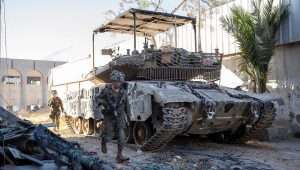
At the same time, Israeli units searched the vast tunnel system in Rafah. Those involved included, among others, the Yahalom special unit, the naval unit Shayetet 13, and forces from the Southern Command. The search proved extremely difficult. Despite extensive intelligence work, they initially failed to find the exact chamber where Goldin was being kept.
According to the army, soldiers were at times only a few meters away from his hiding place, without knowing its exact location.
Hamas eventually returned Goldin themselves
The story took an unusual turn in November 2025. As part of the ceasefire, a small Hamas team was granted permission to enter an area under Israeli control. The Hamas members searched the tunnel system for Goldin’s remains and eventually found the chamber where he had been kept.
“We assume that Hamas saw how close we already were and did not want their reputation to suffer,” said an Israeli officer involved. “They preferred to retrieve him themselves.”
On November 9, Hamas handed over the remains to Israel. This brought an end to a search lasting more than eleven years. Goldin was subsequently laid to rest in Israel.
For the Israeli armed forces, the return was nonetheless accompanied by mixed feelings. The army had made considerable efforts over many months to find Goldin themselves. The fact that Hamas members ultimately identified the exact location was a bitter experience for the soldiers involved. The military leadership stated, however, that the extensive operations had yielded important intelligence about Hamas structures in Rafah.
More than 30,000 cubic meters of concrete used against the tunnel system
Following Goldin’s repatriation, attention turned to the permanent elimination of the underground network. At the end of June 2026, the Israeli army announced the completion of work to seal the tunnel complex.
According to the military, a network of more than 16 kilometers was sealed in the process. More than 30,000 cubic meters of concrete were used to do so.
In addition, Israeli soldiers had already destroyed the tunnel entrance through which Goldin had been abducted during the 2014 battle back in November 2025.
After eleven years underground, Hadar Goldin was finally able to be laid to rest in Israel. His story also stands as a symbol of Israel’s long-standing efforts to return the remains of fallen soldiers and the hostages abducted by Hamas.
Want more news from Israel?
Click Here to sign up for our FREE daily email updates