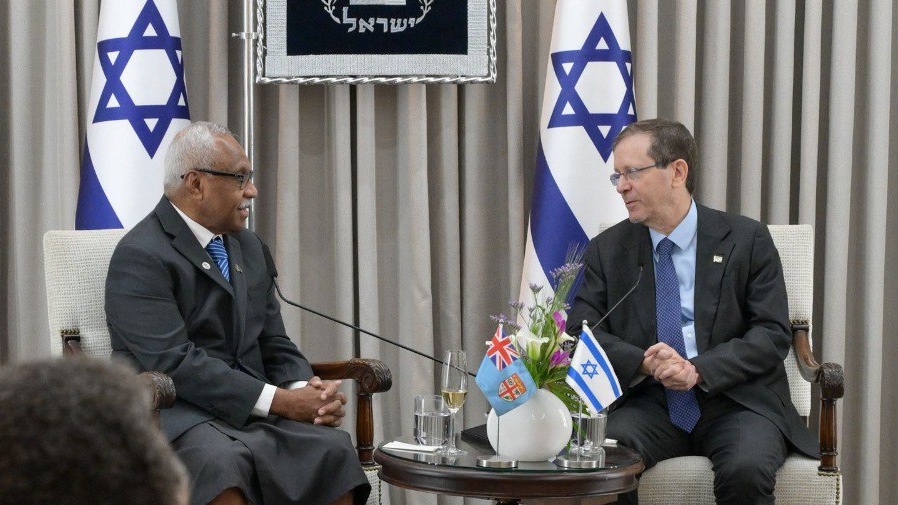

(JNS) When Israel reopens its embassy in the Fijian capital of Suva this April, some might view the move as little more than a bit of diplomatic housekeeping, just another formal diplomatic mission being opened. That would be a mistake.
The decision, first reported by the Fiji Sun newspaper on Jan. 21, is not merely a bureaucratic or political step. It says something important about how Israel rewards loyalty and how small states can exercise real moral agency in a world increasingly hostile to the Jewish state.
Fiji is not a country that generally dominates world headlines. Located in the South Pacific, nearly 10,000 miles from Jerusalem, it is an island nation of roughly 900,000 people spread across an archipelago of more than 330 islands. It is geographically remote, economically modest and far removed from the Middle East’s daily turbulence, which makes its consistent friendship towards Israel all the more notable. Fiji’s support is not born of proximity or pressure, but of choice.
In September, Fiji made a quiet but consequential decision of its own, opening an embassy in Jerusalem. At a time when many countries still treat Israel’s capital as radioactive—fearing backlash from blocs, activists or Arab countries—Fiji chose recognition over ritualized ambiguity. Indeed, it did so knowing that criticism would ensue.
Israel noticed.
Fiji’s support did not begin with the decision to open an embassy in Jerusalem, nor is it limited to symbolism. For years, it has refused to participate in the automatic majorities that dominate UN votes on Israel. While others treat Israel as a convenient punching bag, often without even reading the resolutions placed before them, Fiji has frequently voted with Israel or abstained when fairness demanded it.
That behavior matters. In an institution such as the United Nations, where legitimacy is manufactured by numbers rather than substance, each dissenting vote carries weight far beyond its size.
This is not bloc politics. Fiji is not part of a Western alliance, nor is it dependent on Israeli aid. Its choices are shaped by a worldview rooted in sovereignty, faith and lived experience. As a small state that has fought to maintain political stability, Fiji understands well some of the challenges that Israel faces.
American Jewry, in particular, should take note of Fiji’s gesture. In an era when many large and influential countries hedge, equivocate or retreat behind diplomatic boilerplate statements, a small Pacific nation with no Jewish lobby to court and no domestic political incentives has chosen clarity over convenience. Fiji’s support is not driven by donations, pressure or proximity. It is voluntary, and precisely for that reason, it carries greater moral weight.
For Jewish leaders accustomed to measuring allies by size or strategic utility, Fiji is a reminder that principled support for Israel often comes from unexpected quarters.
And that is why Israel should treat the reopening of its embassy in Fiji not as the culmination of the relationship, but as a starting point. Deepening cooperation in agriculture, security training and disaster preparedness would anchor the partnership in long-term substance and signal that principled friends are not merely thanked, but invested in.
There is also a broader strategic logic at work. The Pacific Islands have become an increasingly contested arena, courted aggressively by China and routinely ignored by Europe. Israel’s presence in Fiji strengthens its footprint across the region and reinforces ties with countries that have already demonstrated a willingness to think independently.
But the relationship is not driven only by strategy.
Fiji is a deeply Christian society, and its connection to Israel is informed by more than geopolitics. Biblical literacy shapes public culture and political instincts. Israel is not viewed as an abstraction or a slogan, but as a real country with historic and spiritual significance. That grounding—as unfashionable in some Western quarters as it may be—has translated into consistency when others follow trends.
There will be critics. Some will argue that Fiji’s alignment with Israel is naive or outdated. Others will insist that small states should keep their heads down and follow the consensus. That argument misunderstands both Suva and Jerusalem.
Fiji’s foreign policy has never been about submission to international groupthink. It has been about autonomy. And Israel, for all its power, remains acutely aware of who stands with it when standing up carries a cost.
The reopening of the Jewish state’s embassy is therefore not merely ceremonial. It is a signal to friends and adversaries alike that Israel distinguishes between those who posture and those who act.
Fiji stood with Israel when doing so carried a cost. In today’s diplomatic climate, that alone can and does set it apart.
Want more news from Israel?
Click Here to sign up for our FREE daily email updates