

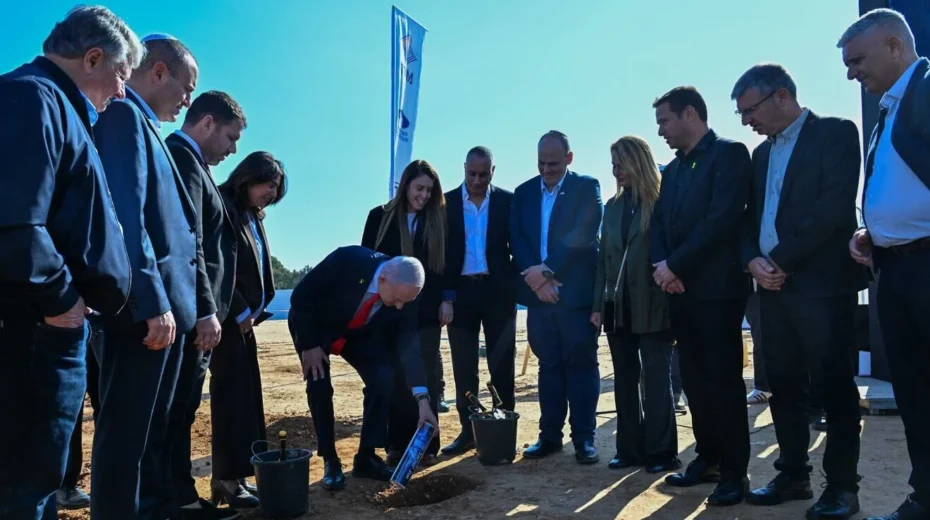

Prime Minister Benjamin Netanyahu took part in a symbolic ceremony in Petah Tikva, marking a historic step forward in the expansion of Israel’s infrastructure. On Thursday, he laid the foundation stone for the Tel Aviv Metro — an underground rail network that is being hailed as the largest infrastructure project in the nation’s history. A plan that has been talked about for decades is now finally becoming concrete reality.
In his speech, Netanyahu recalled that Israel’s founding leader, David Ben-Gurion, had already spoken about an underground railway in the densely populated center of the country. “Many have talked about it,” the prime minister said. “But talk alone is not enough.” Dreams are necessary, he continued, but without implementation they remain empty. “We promised it, we are keeping that promise — and we are delivering.”
The scale of the project is enormous. Around $50 billion will be invested to build a metro system capable of transporting up to two million people daily. The network’s launch is expected in roughly 15 years. Three main lines are planned, spanning about 160 kilometers with 109 fully underground stations.
The metro will extend across 24 municipalities in the Greater Tel Aviv area — from Kfar Saba and Ra’anana in the north to Rehovot and Lod in the south.
Designed as the backbone of a new integrated transport system, the metro will connect to the Tel Aviv light rail, whose first line opened two years ago, as well as to other existing and planned rail links. The aim is to create a powerful network that will significantly relieve chronically congested road traffic in Israel’s economic and demographic center.
The Tel Aviv metropolitan area is among the most densely populated regions in the country. For years, the number of vehicles has grown faster than the transportation infrastructure. Traffic jams, long commutes, and high environmental strain shape the daily lives of many. The new metro is intended to bring a fundamental change — with fast connections, frequent departures, and capacity that meets real demand.
Prime Minister Benjamin Netanyahu at the foundation stone laying ceremony for the Metro:
“Israel is a power in security, transportation, technology and energy. These are great days for the State of Israel and for Israel’s economy”Full remarks >>https://t.co/xpvwFe5kgU pic.twitter.com/BK9X51hbcA
— Prime Minister of Israel (@IsraeliPM) December 18, 2025
Transport Minister Miri Regev described the project at the ceremony as one of national significance. The metro will not only alter Israel’s transport landscape but also place the country among the world’s leading infrastructure initiatives. Beyond easing traffic, the government hopes for economic stimulus, improved quality of life, and more sustainable urban development.
Despite the enormous costs and long construction timeline, the project is seen as essential across political lines. Israel is growing — demographically, economically, and spatially. Without a massive expansion of public transport, the heart of the country risks hitting its limits. With the Tel Aviv Metro, Israel is investing in a future where mobility is not a bottleneck, but a pillar of urban life.
Want more news from Israel?
Click Here to sign up for our FREE daily email updates







A stark contrast to tunnels under Gaza, these will be tunnels to enhance communication and freedom of movement, and for the benefit of the whole population !