(Israel Hayom) Amid rising tensions with Iran, the United States is steadily amassing military force in the region, according to open-source intelligence analysts, media outlets covering the US military and American newspapers reporting.
According to The Wall Street Journal, President Donald Trump has continued to press his advisers for “decisive” military options against Iran, even after backing away from a strike last week. Senior US officials told the paper that the president repeatedly uses the word “decisive” when describing the impact he wants any American action against Iran to have.
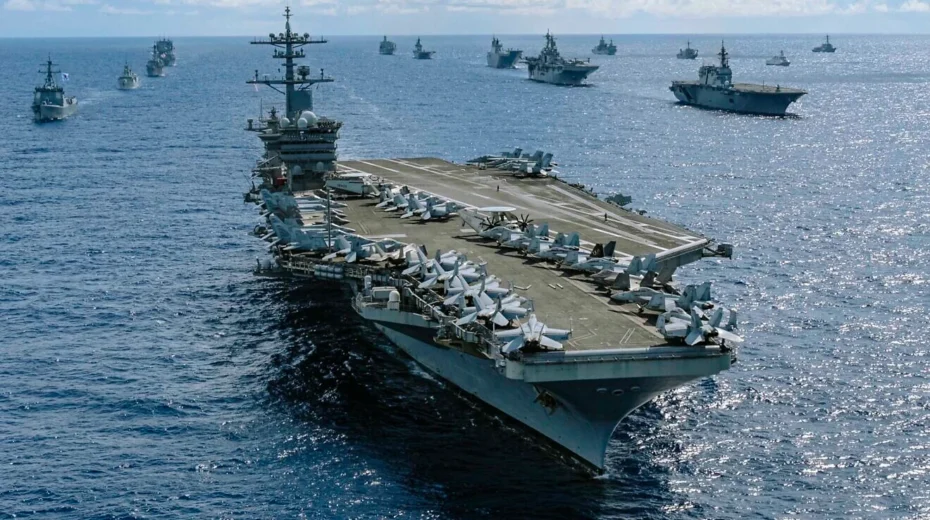
At the center of the buildup is the movement of the aircraft carrier USS Abraham Lincoln and its strike group, which includes destroyers, F-35 jets and additional combat aircraft.
According to maritime tracking websites, the carrier passed through the Malacca Strait on Tuesday and was heading west toward the Persian Gulf, several days away. After leaving the heavily trafficked shipping lane, the vessel has been sailing without activating its AIS transponder, which enables open-source tracking.
The aircraft carrier USS George H.W. Bush also departed Norfolk, Virginia, on Tuesday. Online assessments suggest it may also be heading to the region, though no official confirmation has been issued, and in any case, its arrival would take at least several weeks.
Meanwhile, air traffic to the region continues. F-15 fighter jets arrived in Jordan on Sunday, according to flight-tracking data and senior US officials who spoke with WSJ. On Tuesday, US Central Command publicly acknowledged the movement and released a photo of an F-15 landing at one of its bases. “The F-15’s presence enhances combat readiness and promotes regional security and stability,” the command said in an X post.
Last week, there were also reports of European military aircraft moving into the region, including British Typhoon jets.
Overnight, flight-tracking applications documented US Air Force KC-135 aerial refueling aircraft flying eastward over the Atlantic Ocean toward the Middle East, though this movement may also have been linked to the president’s visit to the World Economic Forum in Davos. The military news site The War Zone reported that C-17 transport aircraft were also spotted en route to the region.
During “Operation Midnight Hammer” last June, in which B-2 bombers struck Iranian nuclear facilities, dozens of refueling aircraft took part. The tankers enabled the bombers to fly from their base in Missouri to Iran, a round trip of roughly 18,000 kilometers, and also refueled the fighter jets escorting them.
According to reports, Israel conveyed concerns to Washington last week about its defensive capabilities should Iran attack, after having used a significant portion of its interceptor stockpile during the war in June.
Against this backdrop, senior US officials told WSJ that additional air defense systems would be deployed to the region, including Patriot and THAAD batteries. The arrival of additional forces will give the US more offensive options, American officials told the newspaper.
In the Persian Gulf itself, two US destroyers with precision strike and air defense capabilities are currently operating, along with three mine countermeasure ships, which could prove critical in the face of a potential Iranian threat to close the Strait of Hormuz, according to USNI News of the US Naval Institute.
The United States operates an extensive network of military bases across the Middle East. The most prominent is Al Udeid Air Base in Qatar, which hosts US Central Command. The headquarters of the Fifth Fleet is located in Bahrain, and Al Dhafra Air Base in the United Arab Emirates hosts some of the most advanced US fighter aircraft. Additional bases are spread across Jordan, Saudi Arabia, Iraq and Turkey.
These bases could become targets if Iran decides to retaliate against a US strike. According to Reuters, an Iranian official said last week that Tehran had made clear to countries in the region, from Saudi Arabia to the United Arab Emirates and Turkey, that American bases on their territory would be considered targets.
Originally published by Israel Hayom.