(JNS) While the October 2025 ceasefire in Gaza is holding tenuously, the Israeli defense establishment is working to preserve the truce, while reportedly preparing for a range of scenarios, presenting the political echelon with a series of alternatives should diplomatic efforts fail.
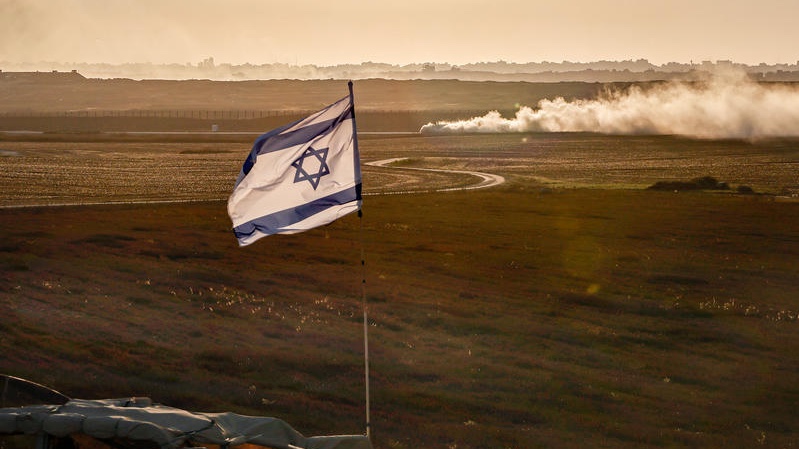
An IDF official told JNS on Monday that Israel’s adherence to the ceasefire for nearly five months, including the withdrawal to the Yellow Line separating Israeli-controlled Gaza from Hamas-controlled Gaza, demonstrates a genuine desire for a long-term solution.
However, the source assessed that a long-term solution is contingent on two distinct possibilities: a full military victory or a diplomatically driven alternative.
“It can be a complete defeat of Hamas,” said the source, “returning to fight and not giving up until the last ammo warehouse is destroyed.”
Alternatively, the official pointed to American-led diplomatic efforts, specifically the new Civilian Coordination Center (CMCC) in Kiryat Gat, which aims to create a Hamas-free alternative for Gaza’s residents.
This strategy involves luring the population of Gaza, currently under the Hamas terror regime, to move to caravan-like structures on the Israeli-side of the border, proving to the population that life is preferable without Hamas and without experiencing Hamas’s attacks on Israel and IDF responses.
This effort includes constructing infrastructure to support these alternative communities, aimed at preventing Hamas from reinfiltrating.
Whatever happens going forward, the official stressed that Israel will not accept a situation where a terror organization with “pickups and weapons” sits on its border.
The source said that in the Hamas-run part of Gaza, the terror organization is focused on rebuilding its civilian economic grip and its status as the ruling entity, while stealing humanitarian aid and profiting from taxes extracted from Gazans.
The IDF official confirmed that despite the ceasefire, the military retains the freedom to strike any immediate threat, adding that “no one is immune.”
Manufacturing explosives remains a simple task for the terrorists, the source said, adding, “A charge is a little sugar, some dual-use material like fertilizer, and a YouTube video. It’s not an overly challenging event.”
“The current situation is relatively static because they are still trying to find the way in which Hamas disarms, and the Gaza Strip is demilitarized,” said the official.
According to a report by Army Radio on Feb. 2, the IDF General Staff has outlined a number of options, including a “Lebanon model” for the Gaza Strip, involving aerial strikes to thwart Hamas’s rearmament and rehabilitation, similar to the enforcement mechanism currently applied against Hezbollah. Another option is a full-scale maneuver to retake the whole of Gaza (Hamas currently controls 47% of the Strip), based on an evacuation of the civilian population under Hamas’s rule, and a clearing phase targeting weapons and tunnels, according to the report.
While the cabinet has yet to make a final decision, the military reportedly assesses that clarity regarding the nature of “Stage B” of the war will emerge within weeks.
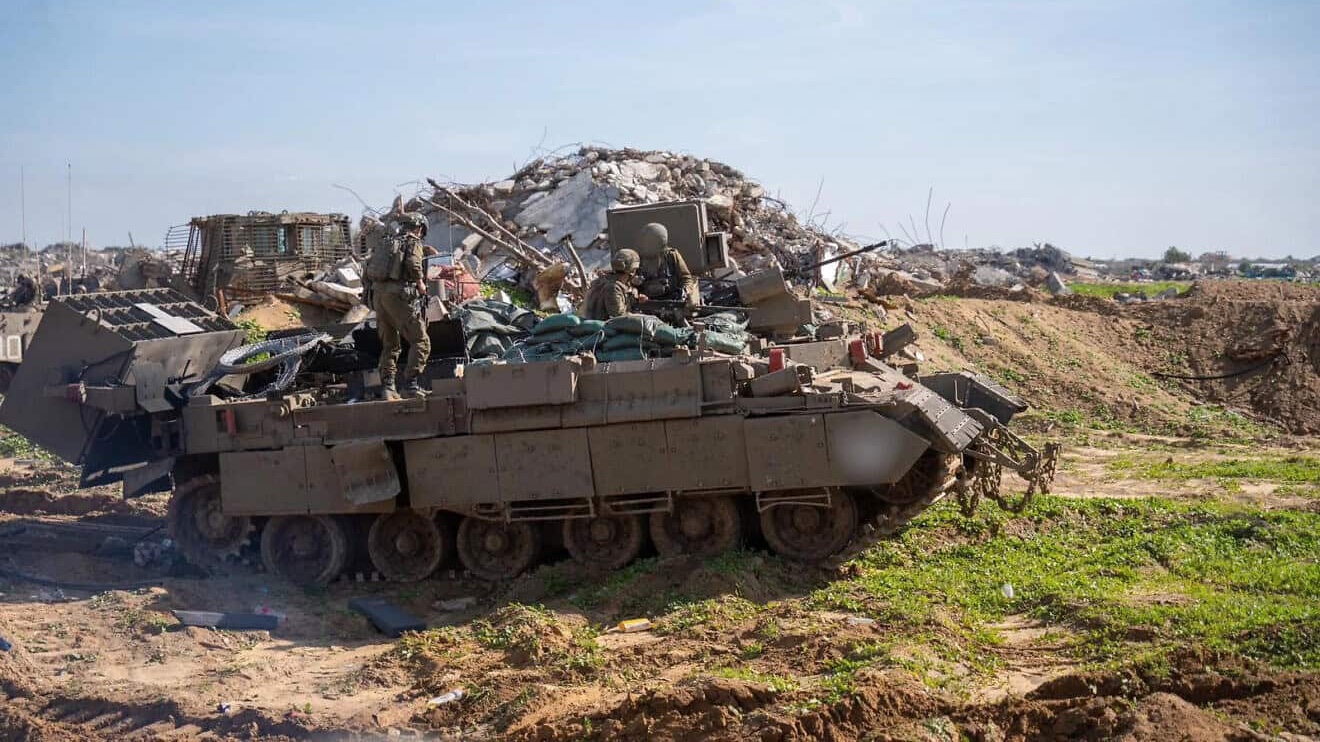
“Either Hamas disarms, and the IDF continues the withdrawal according to Trump’s 20 points … or it does not disarm, and we stay on the Yellow Line,” the official summarized.
The official confirmed that Israel has shared information with the United States about the scope of Hamas’s weapons and tunnels, creating a common basis for demanding specific disarmament and demilitarization goals.
Shalom Arbel, a former senior member of the Shin Bet who served from 1988 to 2013 in roles involving human intelligence recruitment and operations, and a former IDF major in the reserves who served in Gaza, Judea and Samaria, and Lebanon, expressed skepticism regarding the viability of Phase 2 as currently envisioned by the Americans.
Arbel identified a major gap between the American approach, which seeks stability and “non-war,” and the Israeli public’s demand for the total elimination of Hamas as a ruling entity in Gaza.
“It’s not complicated to identify these enormous gaps, at the level of east and west, between the Israeli and American approaches regarding Phase 2,” said Arbel.
Israel’s position is deeply influenced by Israel’s own society, he argued.
“The Israeli society will not allow the Israeli government to go in other directions,” said Arbel. “Israeli society does not want to hear the word ‘Hamas’ after Oct. 7.”
Arbel predicted that a resumption of conflict is likely, but argued against a purely military ground invasion. Instead, he advocated for a “combined campaign” involving diplomatic, military, and civil pressure leading to Hamas’s collapse.
He suggested measures such as closing the Rafah crossing, imposing a humanitarian siege, and other levers of pressure that do not rely solely on the “gun sights.”
Arbel also warned against the involvement of multiple international actors like Turkey and Qatar, arguing their interests often conflict with Israel’s security needs.
“Every country will act to realize its interests, and they are not necessarily Israeli interests,” he noted. “For Israel, it is clear what Egypt, Qatar, and Turkey want.”
He added, “I think that from a certain perspective, the United States and President Donald Trump are mistaken for involving so many actors in this issue. It’s true that the US needs their support, but it would be appropriate to receive their quiet support, not their active involvement.”
The involvement of such countries will disrupt rebuilding plans due to rivalries and competitions, he assessed. Israel, for its part, “should be the last to push for reconstruction, or to move to stage B. Israel should drag its feet as much as possible, so that Gaza is punished again for what it caused on Oct. 7,” he said.
‘Wider freedom of operation’
Lt. Col. (res.) Shaul Bartal, a senior research fellow at the Begin-Sadat Center for Strategic Studies, who served extensively in multiple security capacities in Judea and Samaria, said that a return to military action is a reasonable scenario.
Bartal noted that while the declared goal remains the end of Hamas rule, Washington is grappling with whether a technocratic government that includes Hamas affiliates constitutes a sufficient change.
“From an Israeli security perspective, significant presence of armed operatives or those with organizational ability and subordination to Hamas leadership is not ‘end of rule,’ but an arrangement that leaves Hamas as a de facto governing and military power,” Bartal said.
Bartal highlighted that in areas under IDF control, Israel is working with local clans and anti-Hamas forces to establish non-Hamas civil governance and to preserve a military grip on the ground. “The absence of kidnapped people in these areas gives the IDF wider freedom of operation against infrastructure and Hamas headquarters in the depths of the Hamas territory,” he stated.
He added that Israel is keen on preserving good relations with the Trump administration, due to Washington’s focus on Iran, while the US views Gaza as a “manageable problem that can be blocked.”
“Jerusalem will try not to confront Washington head-on regarding the Gaza outline as long as it believes Trump will give it broader backing in dealing with Iran,” Bartal assessed.
Meanwhile, he added, Hamas is working on restoring its force and broadcasting sovereignty.
“It is trying to rebuild the military wing, strengthening the remaining tunnel network, activating an enforcement mechanism against those who cooperate with Israel, and supervising humanitarian assistance and hospitals,” said Bartal.
Want more news from Israel?
Click Here to sign up for our FREE daily email updates