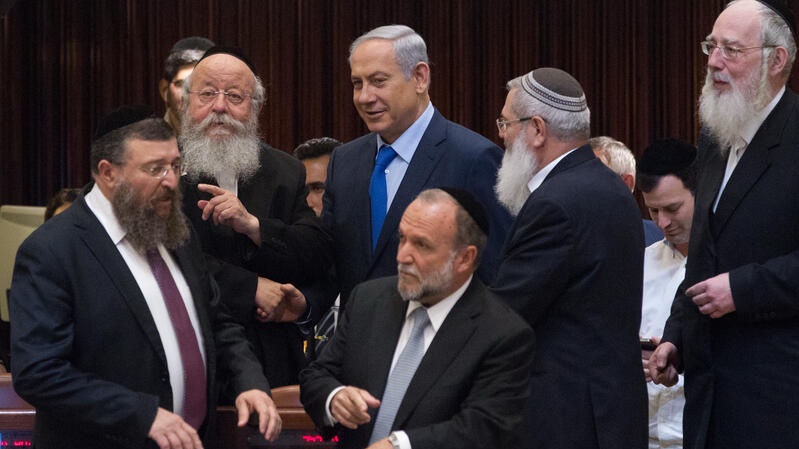

Benjamin Netanyahu’s hopes of forming Israel’s next government suffered a setback this week, as United Torah Judaism, one of his most reliable coalition partners, signaled it may not back him when President Isaac Herzog begins consultations on Wednesday.
According to several Hebrew media reports citing a party source, the Haredi faction is considering not recommending any candidate to form the next government, a move Israeli reports say would break with a pattern of backing Netanyahu that dates back to 2009.
UTJ is angry that during four years in power, Netanyahu’s coalition never passed a law exempting yeshiva students from IDF service. The party now says it is no longer part of Netanyahu’s bloc.
The numbers
With all votes counted, Netanyahu’s bloc holds 53 seats, Gadi Eisenkot’s “Change” bloc 48 and the Arab parties 19. Thirteen of Netanyahu’s 53 belong to UTJ and Shas.
A senior Joint List official has signaled that when Herzog begins consultations on Wednesday, both Arab lists will recommend Eisenkot. If that happens and the Change bloc holds, 67 MKs back Eisenkot. If UTJ abstains, Netanyahu drops to 46.
While Herzog is not bound to making his decision based on a simple count, Netanyahu’s claim to the first mandate will be far weaker.
What Netanyahu can offer
The obvious fix is another promise on the draft. But Netanyahu has already played that hand, and UTJ chief Yaakov Asher has made entry into the next government conditional on the exemption law actually passing, not on assurances.
The courts have also limited what any promise is worth. In June 2024, nine High Court justices ruled there was no legal basis for blanket non-enforcement against yeshiva students who refuse to report for duty. In April 2026, the court ordered concrete sanctions and enforcement.
In July, the Knesset tried a shortcut by passing a temporary law freezing arrests of yeshiva students on July 14. The court froze the law on July 15. On September 3 the court annulled it. Eight justices found it substantively unequal, not just procedurally flawed.
So while Netanyahu can promise new legislation, he can’t guarantee it will survive judicial review, and the recent track record suggests it won’t, leaving Bibi with little of substance to offer the Haredi factions.

United Torah Judaism party chairman MK Yaakov Asher alongside members of his party at the party’s election headquarters in the ultra-Orthodox city of Bnei Brak, central Israel, following the release of exit poll results on Israel’s general election night, October 28, 2026. Photo by Hilel Ben Or/Flash90
Eisenkot’s problem
The same issue also binds Eisenkot. While he is now more likely to be given first crack at forming the next government, actually achieving that goal is far from guaranteed.
The Change bloc campaigned on two things: replacing Netanyahu and sharing the burden of service more fairly. In June, Eisenkot said he would rather go to another election than accept a draft-evasion law.
If UTJ abandoned its traditional partner in Netanyahu over his failure to pass a new exemption law, it is hard to see how the party (or Shas) could sit in an Eisenkot government that has dedicated itself to equal service obligations among Israel’s Jewish citizens.
Unless Eiseknot bends on one of his key campaign promises. And even if he does, the other Change bloc parties might not. All of them demand Haredi conscription, too.
Just as for Netanyahu, the arithmetic for Eisenkot is unforgiving. His Change bloc plus UTJ plus Shas equals exactly 61 seats (the narrowest majority). But it only works if Avigdor Liberman, Yair Lapid and Yair Golan remain, and they have all ruled out compromise on the draft issue.
Eisenkot’s other options
Eisenkot’s bloc could reach a firm 67-seat majority by joining with the two Arab factions, but, again, all party heads with the exception of Yair Golan have publicly rejected such an arrangement.
The unity route also would require broken promises by Eisenkot and his partners, all of whom have said they would not sit in a government led by Netanyahu.
Every possible path to a stable government requires someone break a foundational campaign promise. The UTJ move just made the list of possible promises to be broken a little longer.
Want more news from Israel?
Click Here to sign up for our FREE daily email updates