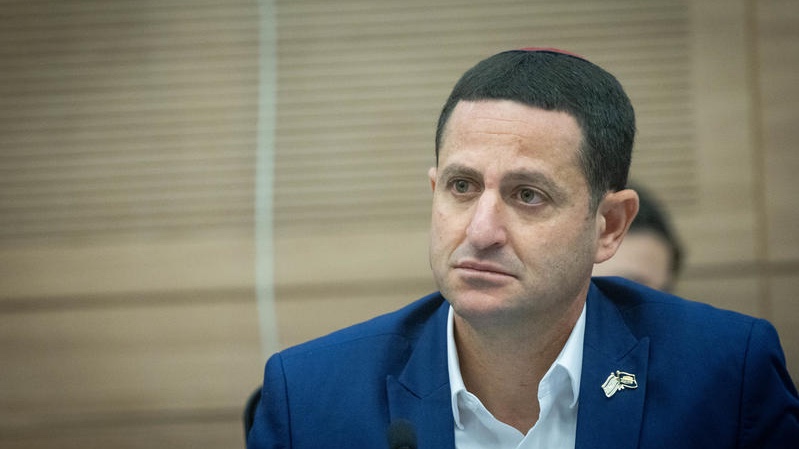
(JNS) Religious Zionism lawmaker Ohad Tal on Tuesday initiated an emergency conference at the Knesset titled “Stop the Terror of Kidnappings,” focused on changing Israel’s deterrence equation.
At the meeting, Tal presented a bill aimed at formally anchoring the recommendations of the Shamgar Committee—a professional panel appointed by former prime minister Ehud Barak in 2008—regarding negotiations over the release of hostages.
The committee, headed by former Supreme Court President Meir Shamgar, recommended in 2011 that the Israeli government adopt tougher positions in future hostage negotiations with terrorist organizations. However, its conclusions were never fully implemented, as successive governments were reluctant to limit their flexibility in conducting negotiations.
Cabinet ministers, Knesset members, public figures and bereaved families participated in the debate.
At the center of the conference—organized in collaboration with the Yachin Research Center and the Al Hamashmaut podcast hosted by Tamir Dortal—Tal outlined his proposed legislation, which seeks to codify the Shamgar Committee’s conclusions into law.
The bill establishes clear principles for negotiating the ransom of captives, with the aim of limiting terrorist organizations’ ability to extort the government.
“I think what we have seen over the past two years is a collective trauma. We all suffered from the reality that more than 250 people were held in Hamas’s dungeons,” Tal told JNS. “We must change that reality.”
“As long as, through our own policies, we are incentivizing terror organizations to kidnap more Israelis—because it pays off and is worth it—we are effectively telling them: If you want to bring Israel to its knees, kidnap more Israelis and more Jews. We cannot allow that to continue,” he added.
“We should return to the logic that guided the Shamgar Committee, the same logic applied by Prime Minister Yitzhak Rabin and Defense Minister Shimon Peres, who said we cannot negotiate with terrorists and certainly should not release thousands of terrorists, thereby incentivizing and rewarding such acts.”
Similar bills, Tal said, were previously introduced in the Knesset by lawmakers including Yair Lapid and Elazar Stern, among others, because this was once the Israeli consensus—and should be again.
“Thank God, we now have a window of historic opportunity. Hopefully, after Ran Gvili is returned, we will not have Israeli hostages in Hamas’s hands, and we will be able to hold this discussion without manipulation or heightened emotions, but rather a clear-eyed debate about what Israel’s policy on hostages should be,” said Tal.
The bill has been introduced in the Knesset and is awaiting discussion in the ministerial committee. Once approved there, it will advance in the Knesset.
Smotrich, Strook and Sukkot laud move
Israeli Finance Minister Bezalel Smotrich congratulated Tal in a video address at the opening of the conference for advancing what he described as critical legislation to end the strategic threat of kidnappings.
“We need to demonstrate to our enemies that they will not achieve anything through kidnappings. We will strengthen Israel’s security, God willing, in this session,” said Smotrich.
Israeli National Missions Minister Orit Strook, who also addressed the conference, told JNS that the intensive campaign prioritizing the return of the kidnapped above all other war objectives led to many mistakes.
“Public consciousness has deteriorated greatly, which is why it is important that this law be enacted and that consciousness return to normal,” she said.
She added that opposition leader Yair Lapid (Yesh Atid), as a politician attuned to the Israeli consensus, had previously initiated similar legislation precisely because it reflected that consensus.
“If he submitted such a law in the past, it shows that he verified it was the consensus. Our goal is to restore that consensus,” she said.
Religious Zionism lawmaker Zvi Sukkot told JNS that the conference was among the most critical events of the day.
“We are living in an abnormal reality—one in which about 80% of the terrorists who murdered Jews are back home. They often spend less time in prison than someone who stole a car or ran a red light,” he said.
“This is a reality in which the only place in the world where there is effectively no cost for killing Jews is the Jewish state. That cannot continue. Today, every terrorist organization is motivated to kidnap our people, and if we do nothing, we will find ourselves in the same situation again,” he added.
Never again
Tzvika Mor, co-founder of the Tikva Forum, which advocated for the release of hostages through military pressure, and whose son Eitan spent 738 days in Hamas captivity, told JNS he wanted to ensure no other family endures what his has.
“For the past two years, I have asked that my son be saved in a way that ensures there will not be more hostages in Israel, so that other parents will not go through what we experienced. Now that we are nearing the end, and only Rani [Gvili] remains and we are waiting for his return, this is the time to legislate a strong law with a broad majority of lawmakers,” he said.
“We must also begin education and public awareness efforts so that we can stand firm against terror organizations and ensure they can no longer extort us. Otherwise, this will continue for generations to come,” he added.
Also speaking at the conference were Maj. Gen. (res.) Uzi Dayan and Brig. Gen. (res.) Amir Avivi, who addressed the security and strategic implications of implementing the Shamgar Committee’s recommendations, as well as attorney Maurice Hirsch, who outlined the legal framework required to eliminate incentives for kidnapping terrorism.
“The issue of the hostages is a painful one in Israeli society. The goal is to think about how to prevent future hostage-taking,” Avivi told JNS. “We have entered a cycle in which our enemies know that kidnapping pays off. We need to create a policy that ensures it will not be worthwhile to kidnap Israelis.”
“That is what this discussion is about: creating a reality in which hostage-taking is taken off the agenda because it no longer pays off. We need a clear policy, because we see that every government pulls this issue in a different direction,” he said.
“We must wait for the moment when the last hostage is returned, so it will be possible to think clearly and without the pressure of captives being held, and then build the future policy of the State of Israel,” he added.
The conference also featured remarks from representatives of bereaved families, including Deborah Gonen, who urged the government to move from defense to offense and impose a heavy price for every attempted kidnapping.
Yisrael Beiteinu lawmaker Yevgeny Sova told JNS that his faction, headed by Avigdor Liberman, has been deeply engaged on the issue.
“In 2011, Avigdor Liberman opposed the [Gilad] Shalit deal. He had the courage to sit next to Noam Shalit, of blessed memory, Gilad’s father, and tell him—despite the pain—that as a government minister he opposed the deal because he believed it was not good for Israel’s future. Another Yisrael Beiteinu minister, Uzi Landau, also voted against it,” said Sova.
Want more news from Israel?
Click Here to sign up for our FREE daily email updates