
(JNS) When Steve Witkoff, special envoy to the Middle East in the Trump administration, told an audience at the Israel-American Council’s conference this week in Hollywood, Fla., that they should “trust” President Donald Trump to do the right thing on both Iran and Gaza, many, if not most, of those in attendance were probably ready to do so. Trump’s historic support for Israel and willingness to repeatedly confront the Islamist regime in Tehran have earned him the benefit of the doubt when it comes to what will happen in 2026.
Right now, the administration seems primarily focused on the next steps. For the moment, Trump appears to have backed down from his threats to attack the regime to force it to stop the mass killings of dissidents. Whether this leads to negotiations with the mullahs, as some members in the administration appear to have been advising, remains to be seen.
It’s probably premature to say for certain that Washington has fumbled an opportunity to push the theocrats and their Islamic Revolutionary Guard Corps past the tipping point when their fall would be inevitable. But if reports are true that their bloody tactics have succeeded in largely quelling the protest movement, then hopes for freedom for Iranians and a respite from the regime’s terrorist campaign and nuclear threats for the Middle East have been disappointed.
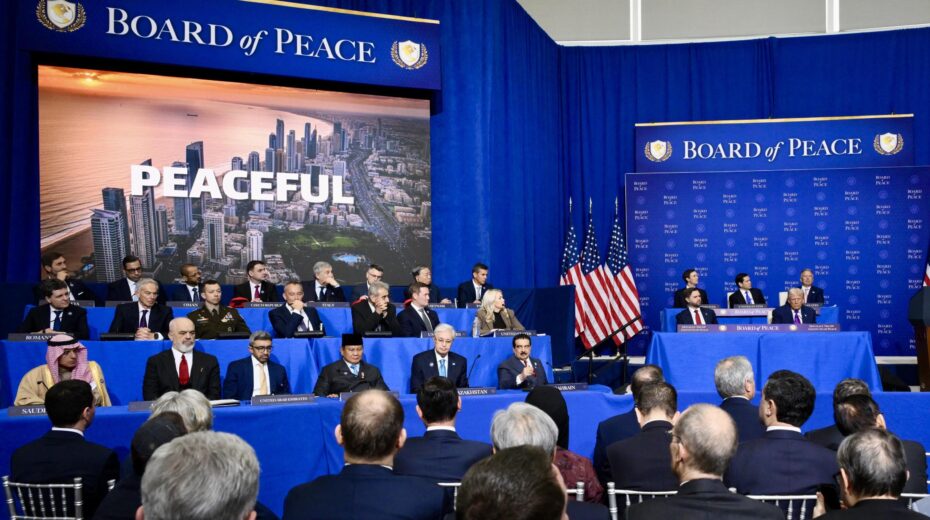
When it comes to what the administration is doing to implement the ceasefire it brokered in the Gaza Strip, disillusionment is also merited. At the IAC event, Witkoff touted the announcement of the naming of a technocratic governance framework for Gaza called the Board of Peace. While he exuded optimism, what he appears to be asking for is not so much support for a coherent policy, but blind faith that is unjustified by actions on the ground.
Witkoff said that the board, of which Trump is the titular chairman, will “forever replace Hamas” and that this “actually happened today.” That body is a key element of the ceasefire that ended the fighting in the war that followed the Hamas-led Palestinian attack on southern Israel on Oct. 7, 2023. The agreement was predicated on a pledge that Hamas would not only disarm but also give up power in Gaza.
Trump is, as he said in a post on Truth Social, vowing that the ceasefire’s terms will be implemented, including “full demilitarization,” and that “they” (meaning, Hamas) ”can do this the easy way or the hard way.”
But a briefing this week by Trump aides seemed to indicate that the administration may be defining demilitarization as something other than the absolute terms used by the president. That involved, “a general concept, which is the terror infrastructure that’s been built in Gaza will be destroyed and the heavy weaponry, like RPGs and rocket launchers and missiles, those need to be put into a place where they’re not being used to defend against Israel, or in offensive raids or attacks on Israel.”
Another important element of the ceasefire—the creation of an International Stabilization Force, staffed by non-Israeli foreign soldiers who would enforce its rules—also appears to be a matter of trusting Trump, and by extension, Witkoff. Like the Board of Peace, whose efforts would be led by Ali Shaath, a Palestinian civil engineer who previously held a post with the Palestinian Authority, the force is being organized in consultations between Witkoff and representatives of Qatar, Turkey, Egypt, the United Arab Emirates, Bahrain and Morocco.
That may sound good to Witkoff. But as with the facts about Iran, a wide gap exists between the promises and tough talk, and the reality of post-ceasefire Gaza.
Hamas remains in control of roughly 47% of the Strip after Israel withdrew to a “yellow line” mandated by the October agreement. Inside that territory, there is every indication that operatives are doing their best to rearm and repair the tunnel network where they store arms, material and hide their terrorist cadres.
No one seriously believes that they can be trusted to store any of their equipment in a manner that will prevent them from using it to attack Israel as soon as they are ready to resume their war against the Jewish state. And as long as Hamas cadres are still armed with lethal weapons not covered by this farcical process, the notion that Palestinian Arab technocrats will implement policies or reconstruction that will prevent Hamas from retaining control is simply nonsense. Nor is there any reason to believe that a stabilization force that isn’t prepared to fight Hamas (and one composed of elements from the countries that Witkoff is talking with won’t do that) will budge the Islamists from power.
Like their sponsors in Tehran, Hamas forces in Gaza are not prepared to simply meekly accept that their time on the world stage has come and gone. These are people whose beliefs are rooted in fanatical religious faith that considers the use of violence not merely acceptable, but integral to their dogmatic system. Mere threats, even those from a president who has shown his willingness to order strikes on Iran and Venezuela, won’t suffice.
There is reason to believe that the Israeli government understands that Trump’s scheme for peace won’t lead to a Gaza free of Hamas. And since Hamas believes that it is engaged in a multi-generational war to destroy Israel, that means the conflict will, sooner or later, begin again. In the short term, Israeli Prime Minister Benjamin Netanyahu is likely not eager to lead a weary nation that is still recovering from two years of fighting back into combat.
There is no question that the Hamas regime in the truncated Gaza it controls is not nearly as dangerous as the one it ruled as an independent Palestinian state in all but name on Oct. 6, 2023. Add to that the beating Israel administered to Hezbollah to its north has reduced, if not eliminated, the threat it posed from Lebanon. The related fall of the Bashar Assad regime in Syria, another ally of Iran, also reduced the peril Israel and the region faced from Tehran. And the Israeli and US airstrikes on Iran’s nuclear and missile programs altered the balance of power in the region.
Still, the expectations for the fall of the Islamist regime in Tehran that were raised in recent weeks by domestic protests may not be fulfilled. The same is true for the promises being made by Trump and Witkoff about real change in Gaza.
The administration deserves credit for not making the Middle East worse, as well as for backing Israel in ways that have made it safer and undermined the Islamist forces waging war on the West. Its policy goals and tough-minded approach may yield more such gains. But for now, optimism about Trump’s vision for peace in the Middle East must yield to grim determination to continue a long war against forces that have no intention of giving up.
Want more news from Israel?
Click Here to sign up for our FREE daily email updates