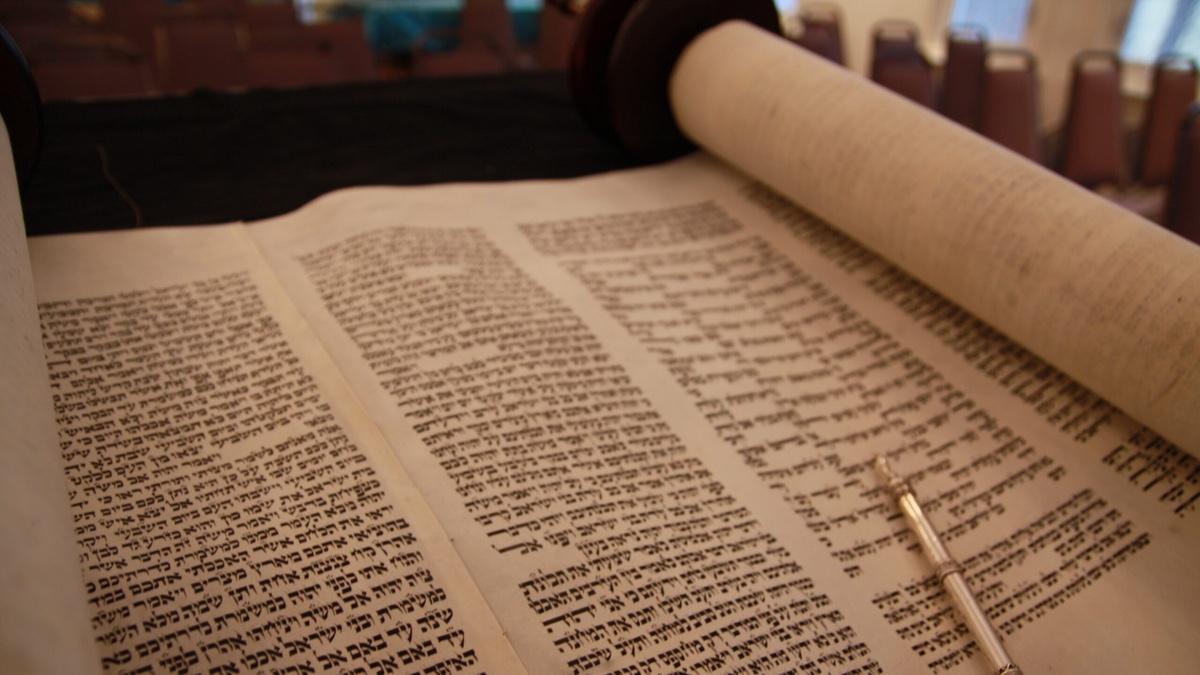
On the road to Emmaus, Yeshua met with two of His disciples and, beginning at Moses and all the Prophets, He expounded to them in all the Scriptures the things concerning Himself. (Luke 24:27). For our Torah studies this year, therefore, week by week we will seek to discover how all of Torah prepared the way for the coming Messiah.
25th April 2026 (8 Iyyar)
Acharei Mot (after the death), Leviticus 16:1-18:30, K’doshim (holy ones), Leviticus 19:1-20:27
These can be difficult chapters to read. The Bible does not draw a line on exposing the nature of the sins of mankind. After an entire year since the previous Day of Atonement (Yom Kippur) what would go through the minds of many of the Children of Israel as they, yet again, watched the Scapegoat wandering away into the wilderness?
The majestic animal was bearing the sins of those who watched. At the same time, a second goat was slaughtered for the same sins, before the High Priest entered the Holiest Place to stand before Almighty God on behalf of the people.
Though there were daily sacrifices, including those for the remission of sin, on this most awesome day of the year there was no clearer reminder that the sins which separate man from God are also a matter of life and death. Anyone desiring to be cleansed of sin would surely have trembled before God on this most holy of days.
Yom Kippur is still the most solemn day of the year in the Jewish calendar, preceded by ten days of introspection and repentance, called Yamim Noraim or Days of Awe.
To simply read the first chapter of our Torah portion this week is enough to humble us, just as it is intended to do. It is unfortunate that because of the separation of the Christian Church from its biblically Hebraic roots, the practice of reading the weekly Torah portion and hence the yearly deep searching is missed by many Christians.
So too are the regular reflections on the commands of God to the Children of Israel concerning sin. Our readings this week cover deep sins indeed, with a whole chapter allocated to what in God’s eyes are wrong relationships between men and women and even between humans and animals. The uncleanness that is defined is repeated, as an extra emphasis, in the fourth of this week’s chapters. We should have in our minds, as we consider this, the purpose of Aaron’s intercessory ministry:
So he shall make atonement for the Holy Place, because of the uncleanness of the children of Israel, and because of their transgressions, for all their sins; and so he shall do for the tabernacle of meeting which remains among them in the midst of their uncleanness. (Leviticus 16:16)
In reading these chapters we cannot doubt the gravity of transgressing the laws of God, which are put in even starker terms elsewhere in Scripture. Even our supposed good works are considered as falling far short of the perfection that God requires of us:
All of us have become like one who is unclean, and all our righteous acts are like filthy rags; we all shrivel up like a leaf, and like the wind our sins sweep us away. (Isaiah 64:6)
Again, the central theme of our study is holiness:
And the Lord spoke to Moses, saying, “Speak to all the congregation of the children of Israel, and say to them: ‘You shall be holy, for I the Lord your God am holy. (Leviticus 19:1-2)
In this week’s chapters, most of God’s commandments through Moses concerned purity in relationships. The emphasis is on intimate relationships to be kept within marriage that is according to God’s order for mankind, relationships within family and also those in the wider community. One of the two commandments that Yeshua taught as being foundational to all else (Mark 12:30-31), is first stated here:
You shall love your neighbour as yourself. (Leviticus 19:18)
These are commandments concerning the way God’s community must live, with complete purity of relationships, dignity and honour in the family and in relationships with all people.
So much can be conveyed by a single principle of life, as we meditate on individual Scriptures. For example:
You shall rise before the grey headed and honour the presence of an old man, and fear your God: I am the Lord. (Leviticus 19:32)
If we do not study the Bible and apply its teaching to everyday life as for a growing number of people in a world that is falling away in large measure, we can now only imagine the wonderful order between the generations whose hearts are stirred by the respect that begins with such a principle and becomes magnified in many ways as a result. God still defines through the Scriptures the parameters within which His people must live in order to live under His blessings.
These are challenging Scriptures to read and could lead us to mourn for a lost generation, as well as to personal conviction. Yet, throughout the entire Bible, there is also a wonderful deeper undercurrent of truth.
The laws of God are not to bring us into bondage but into freedom within the boundaries that are set. James saw this when he wrote:
But whoever looks intently into the perfect law that gives freedom, and continues in it—not forgetting what they have heard, but doing it—they will be blessed in what they do. (James 1:25)
The perfect law that brings freedom! We must look into this.
Our study this week begins with God’s injunction through Moses to Aaron, the High Priest:
Tell Aaron your brother not to come at just any time into the Holy Place inside the veil. (Leviticus 16:2)
Yet there is access into the presence of God!
Relationships with God are to be pure, and so our impurities bring limitations on our access to Him.
Yet, the deeper undercurrent of truth throughout the Bible is about love between God and His people. Within the bounds that define holiness, there is also a developing desire for relationship.
This is echoed time and again through the Scriptures from those who desire that relationship. For example:
As the deer pants for the water brooks,
So pants my soul for You, O God.
My soul thirsts for God, for the living God.
When shall I come and appear before God?
My tears have been my food day and night,
While they continually say to me,
“Where is your God?”
When I remember these things,
I pour out my soul within me.
For I used to go with the multitude;
I went with them to the house of God,
With the voice of joy and praise,
With a multitude that kept a pilgrim feast.
Why are you cast down, O my soul?
And why are you disquieted within me?
Hope in God, for I shall yet praise Him
For the help of His countenance. (Psalm 42)
The desire for relationship between God and His people comes from our side, and also from God’s side. He likened Himself to a husband to Israel:
When I passed by you again and looked upon you, indeed your time was the time of love; so I spread My wing over you and covered your nakedness. Yes, I swore an oath to you and entered into a covenant with you, and you became Mine,” says the Lord God. (Ezekiel 16:8)
For your Maker is your husband,
The Lord of hosts is His name;
And your Redeemer is the Holy One of Israel;
He is called the God of the whole earth. (Isaiah 54:5)
I will betroth you to Me forever;
Yes, I will betroth you to Me
In righteousness and justice,
In lovingkindness and mercy;
I will betroth you to Me in faithfulness,
And you shall know the Lord. (Hosea 2:19-20)
It is the intention of God to draw His people to Himself as a wife to her husband. No wonder He makes it clear how serious it is to fall away into following false gods, and how careful we must be in our own personal relationships. Paul expressed this clearly in his letter to the Ephesians. He described the worldwide body of believers as the one new man, a united body of all who live by faith in Yeshua, both Jews and Gentiles (Ephesians 2). He goes on to show how the relationship of human beings in marriage is an earthly representation of our relationship with God:
Wives, submit to your own husbands, as to the Lord. For the husband is head of the wife, as also Christ is head of the church; and He is the Saviour of the body. Therefore, just as the church is subject to Christ, so let the wives be to their own husbands in everything.
Husbands, love your wives, just as Christ also loved the church and gave Himself for her, that He might sanctify and cleanse her with the washing of water by the word, that He might present her to Himself a glorious church, not having spot or wrinkle or any such thing, but that she should be holy and without blemish. So husbands ought to love their own wives as their own bodies; he who loves his wife loves himself. For no one ever hated his own flesh, but nourishes and cherishes it, just as the Lord does the church. For we are members of His body, of His flesh and of His bones. “For this reason a man shall leave his father and mother and be joined to his wife, and the two shall become one flesh.” This is a great mystery, but I speak concerning Christ and the church. (Ephesians 5:22-32)
We would do well to read the entire Epistle to the Ephesians alongside our Torah portions this week.
We are to seek purity in our human relationships, so that we will be worthy to develop our close relationship with God through Yeshua. In his summary of his search for meaning in life, Solomon touched on this:
Live joyfully with the wife whom you love all the days of your vain life which He has given you under the sun…(Ecclesiastes 9:9)
Solomon also made the beauty of pure relationship between man and woman more explicit in his Song of Songs.
Nevertheless, even with this wondrous purpose of God for His people, we cannot escape the fact that a remedy to mankind’s fallen condition is needed in order for us to attain the high place of God’s relationship with us. Even the Patriarchs could not achieve it of their own strength. Jacob, for example, broke the marriage laws before they were even known, as later shown by Leviticus 18:18, by marrying both Leah and her sister Rachel.
All of this points to the immensity of Yeshua’s sacrifice. We must constantly remember that this was because of the Father’s love for us and our Saviour’s loving obedience to be the fulfilment of all the sacrifices that went before, including the scapegoat who took the sins of Israel to a faraway place:
For God so loved the world that He gave His only begotten Son, that whoever believes in Him should not perish but have everlasting life. (John 3:16)
Greater love has no one than this, than to lay down one’s life for his friends. (John 15:13)
In closing, just think of this. Relationship between God and His people is likened to a marriage, but one that must be within the bounds of holiness. The High Priest of the Old Covenant could only go into the closest presence with God once each year. In the Tabernacle, and later in the Temple, there was a veil separating the Holy Place from the Most Holy Place, through which only the High Priest could pass on Yom Kippur. When Yeshua gave His life as our Sacrifice on the Cross, it was reported by eye witnesses:
Jesus cried out again with a loud voice, and yielded up His spirit. Then, behold, the veil of the temple was torn in two from top to bottom….. (Matthew 27:50-51)
The way was opened by God as never before. Consider this in the purity of meditative prayer.
With the New Covenant comes a new perspective on the Heavenly Bridegroom. There is both continuity and renewal as Old Covenant matures into the New. Our Creator God is known as our Father, and His Son Yeshua, is both as the Lamb of God who takes away the sins of the world (John 1:29), and as the Bridegroom betrothed to His Bride of the New Covenant. The New Testament contains much of this imagery and is completed in the Revelation of John:
Let us be glad and rejoice and give Him glory, for the marriage of the Lamb has come, and His wife has made herself ready.” And to her it was granted to be arrayed in fine linen, clean and bright, for the fine linen is the righteous acts of the saints. Then he said to me, “Write: ‘Blessed are those who are called to the marriage supper of the Lamb!’ ” And he said to me, “These are the true sayings of God.” (Revelation 19:7-9)
This is a completion of what began in the wilderness with Moses and is very much related to our Torah portions this week.