

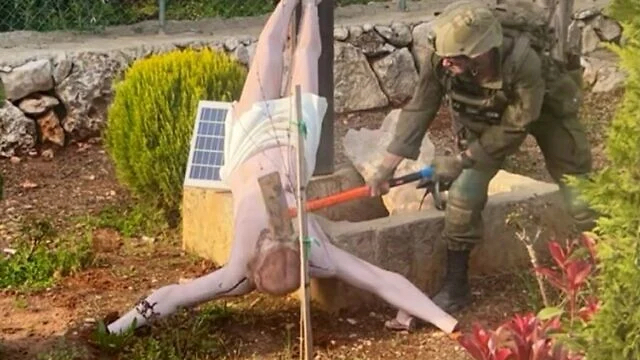

An Israeli soldier decided, on his own initiative, to destroy a statue of Jesus Christ in the Christian village of Debel in southern Lebanon. The action of one man is not perceived by the international public as individual misconduct, but is immediately projected onto Israel as a whole—onto the army, the state, and the people.
Such behavior clearly contradicts the official values of the Israeli army and also Israel’s self-understanding as a state that protects religious freedom and respects holy sites. That is precisely why Israeli authorities responded with condemnation, apology, and the announcement of disciplinary consequences. But the media damage often comes faster than any investigation or correction. For the international public, Israel’s self-correction is unimportant; what remains is the image of a hammer against a statue of Christ. In social networks and international commentary, this quickly revived an old hostile image—as though “the Jews were once again striking and crucifying the Savior.” Such interpretations show how quickly historical resentments can be attached to current images. From an Israeli perspective, the incident was therefore not only a disciplinary...
Become a Member
-
Read all member content
Get exclusive in-depth reports from Israel.
-
Get exclusive in-depth reports from Israel
Connect with Israel, right from your home.
-
Lift up the voice of truth and hope
Support Jerusalem-based Zionist journalism.

Already a member? Login here.








So true! Because Israel is called to be “a light unto the nations,” its response must be God-centered so all the world will know the difference. In the U.S the head has shown itself corrupt, but nothing has been done to hold it accountable !