
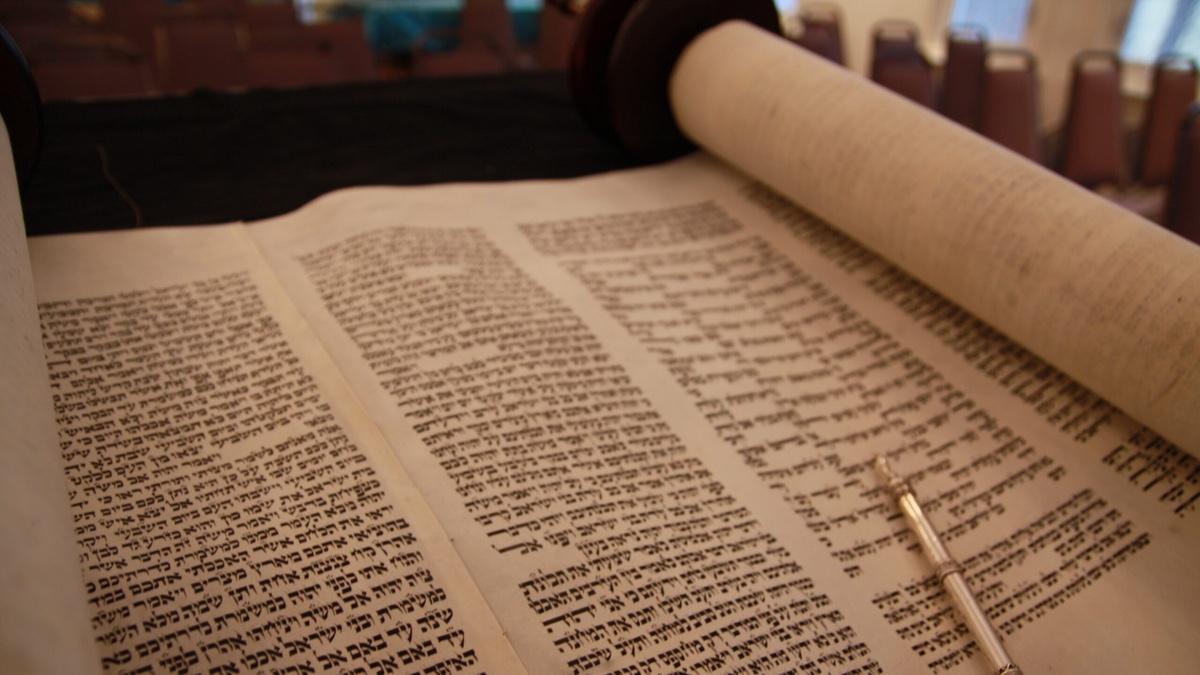
On the road to Emmaus, Yeshua met with two of His disciples and, beginning at Moses and all the Prophets, He expounded to them in all the Scriptures the things concerning Himself. (Luke 24:27). For our Torah studies this year, therefore, week by week we will seek to discover how all of Torah prepared the way for the coming Messiah.
14th February 2026 (27 Shevat)
Mishpatim (Judgments): Exodus 21:1-24:18
This week, we begin to consider how Moses recorded many specific judgments relating to issues that arose in the community of Israel. We must each consider carefully how they apply to us. The Ten Commandments are much easier to understand than the specific detail of the hundreds of other instructions especially when, thousands of years later, our world can be so different from that of the Israelites of Moses’ day.
This matter should be studied by Christians as well as Jews. But how must we study?
This has certainly been important to the leaders of developing Judaism over many years. The influence of the Jewish Sages goes on to today. These are the scholars and rabbis throughout Jewish history, particularly during the Mishnaic and Talmudic eras. Famous among them are Hillel, Shammai, Rabbi Akiba, Maimonides and Baal Shem Tov. Records of the disputes between prominent rabbis, particularly Hillel and Shammai, as to how to interpret various teachings, have been preserved for others to study even today.
Especially prominent is Maimonides. This is the name by which Moses ben Maimon is known. He was born in Cordoba, Spain on Passover Eve 1135 or 1138, leaving Spain when his family refused to convert to Islam, dying in Fustat in Egypt on 12th December 1204. He was also known as Rambam. His tomb is in Tiberias. He derived the most well-known list of 613 Mitzvot (Commandments), gleaned from the Torah, published as a basis of his fourteen volume work entitled Mishneh Torah (Repetition of the Torah), the foundations of modern Jewish Halakhah. These 613 Mitzvot are traditionally considered as 365 negative commands (one for each day of the year) and 248 positive commands (one for each bone of our body).
Likewise there are many well-known Christian writers who, over the years, have brought rich understanding to Scripture from their personal walk with God.
By studying such history of the interpretation of Torah, we see that it is no small matter to seek out a way of living in obedience to the Commandments of God. We pay much honour to those who have taught well in their own generation, leaving records that are still rich sources of insight. Even so, when He brought His Torah to Moses, did God intend us to glean only from the experience of others, or is there light for or own unique path?
We read this week of the treatment of servants, of animals, of property, of violent behaviour, of sorcery and of justice. We are also introduced to the annual cycle of the Feasts of the Lord. These matters are of great importance, emphasised by the fact that Moses was called back into the presence of God at that time.
Each of us must pause and linger prayerfully on what seems most relevant to us. As we do so, we surely see that there is much more than a checklist of 613 commandments to tick off day by day in our lives, or to spend our life reading only from the voluminous commentaries of others.
Take, for example, Exodus 21:22-25. Is there an interpretation for today?
If men fight, and hurt a woman with child, so that she gives birth prematurely, yet no harm follows, he shall surely be punished accordingly as the woman’s husband imposes on him; and he shall pay as the judges determine. But if any harm follows, then you shall give life for life, eye for eye, tooth for tooth, hand for hand, foot for foot, burn for burn, wound for wound, stripe for stripe.
What is described may happen literally, from time to time when men fight, resulting in harm to a pregnant mother and her baby. We know what God specified as punishment for such a fight. However, we may never come across this exact thing: but is there still relevance? Surely we should look into the heart intent of the commandment. God cares about the safety of an unborn child and holds those accountable who violently cause premature birth and harm to the child. Surely, this is of extreme relevance in nations that have legalised the abortion of unborn babies, and has thereby become a major issue relating to God’s judgment across those nations in our day. In a few verses, we have insight into the heart of God and the urgent need to understand, teach and apply His laws. We will find infinitely many applications to what God taught through Moses when we take the judgments of God seriously and prayerfully dig deeply into them day by day.
Take another example that may seem irrelevant today. At first sight it seems like a disconnected thought tagged on to the rest of the Commandments:
The first of the firstfruits of your land you shall bring into the house of the Lord your God. You shall not boil a young goat in its mother’s milk. (Exodus 23:19)
What has boiling a kid in its mother’s milk have to do with us? Yes, perhaps remembering kindness and respect to animals even though there is permission from God to eat the flesh of clean animals since the time of Noah. Yet, we can dig a little deeper with the help of archaeological evidence, which has suggested that it was an ancient Canaanite oblation to their gods to carry out this act. Now, it makes sense. This comes in the passage where God has specified how to come into His presence at the Moedim, the Appointed Times: do not come in the manner of the nations serving their gods, but come in the prescribed manner. Here we have a beginning of a meditation which points to the exact fulfilment that was to come through Yeshua. We can search this out for ourselves across the entire Bible.
So how do we approach the study of Torah when each Commandment of God has depths of revelation that apply to individuals, families, communities and nations in various ways and at different times?
There are some wonderful moments in the history of God’s people when light came on the path of life for some. These insights will lead us to understand how Yeshua taught us about the heart intent of Torah.
The writer of Psalm 119 exclaimed (Verses 97-104):
Oh, how I love Your Torah!
It is my meditation all the day.
You, through Your commandments, make me wiser than my enemies;
For they are ever with me.
I have more understanding than all my teachers,
For Your testimonies are my meditation.
I understand more than the ancients,
Because I keep Your precepts.
I have restrained my feet from every evil way,
That I may keep Your word.
I have not departed from Your judgments,
For You Yourself have taught me.
How sweet are Your words to my taste,
Sweeter than honey to my mouth!
Through Your precepts I get understanding;
Therefore I hate every false way.
When Ezra came back from the Babylonian captivity to establish Torah in Judah, it was said of him:
Ezra had prepared his heart to seek the Torah of the Lord, and to do it, and to teach statutes and ordinances in Israel. (Ezra 7:10)
Micah understood the heart of Torah (Micah 6:8):
He has shown you, O man, what is good;
And what does the Lord require of you
But to do justly,
To love mercy,
And to walk humbly with your God?
Isaiah was given insight as to what God required of His people (Isaiah 66:1-2):
Thus says the Lord:
Heaven is My throne,
And earth is My footstool.
Where is the house that you will build Me?
And where is the place of My rest?
For all those things My hand has made,
And all those things exist,”
Says the Lord.
“But on this one will I look:
On him who is poor and of a contrite spirit,
And who trembles at My word.
Jeremiah spoke of the New Covenant when, because of the sacrifice of Yeshua, the Holy Spirit would be given to cleanse hearts and put God’s wonderful Torah into them:
This is the covenant that I will make with the house of Israel after those days, says the Lord: I will put My Torah in their minds, and write it on their hearts; and I will be their God, and they shall be My people.(Jeremiah 31:33)
The starting point is our attitude to the teaching of God, which brings a love for all He has said, a desire to search it out for ourselves and, with a humble heart, want nothing more than to imbibe its teaching and live in accordance with it.
When Yeshua was on the earth, he spent a lot of time confronting those who wrongly interpreted Torah. For all our efforts, we can simply get it wrong. We can read the precepts of Torah, skim over the surface and think them irrelevant. We can also strive to codify them into philosophical compartments so much that we have a dry religion rather than a living walk with our Living God.
Yeshua did not bring such dry religion. He encouraged us to live by the heart truths of Torah.
As Isaiah had already proclaimed, God begins by looking into our hearts.
When he taught the parable of the Sower of good seed (Matthew 13), Yeshua spoke of the heart of people, some of whom have a soft heart to learn so that God’s teaching matures in their inner being, and others, for various reasons who, even hearing the wonderful teaching of God, fail to retain it.
In the Sermon on the Mount (Matthew 5-7), He spoke of those whom God could bless: the humble, those who mourn, the meek, those who hunger and thirst for righteousness, the merciful, the peacemakers and those with a pure heart. These are the ones whom Isaiah also highlighted as him who is poor and of a contrite spirit,
and who trembles at My word.
Those who listened to Yeshua may not have yet achieved what they sought, but many desired to become what He was describing, compelled to follow Him, witness His sacrificial crucifixion and accept forgiveness of their transgressions. Such people echo King David’s cry in Psalm 51 – create in me a clean heart, O God, and renew a steadfast spirit within me (Psalm 51:10): thereby, by receiving the empowering of the Holy Spirit, a new possibility of a walk with God begins for them – the true Halakhah.
How then do we read the Commandments of God, this week and in the coming weeks? Are we studying superficially, looking for ritual or even the philosophical interpretations of others – or to deepen our personal relationship with the God of Israel?











Torah is our bedrock. What does the Torah say about those who fight against abortion, yet promote the use of young girls by rich men?